Category Archives: General Cynicism

Bevacizumab (Avastin) in Breast Cancer — Neither Effective nor Cost-Effective

It’s been well documented that bevacizumab is not very effective in breast cancer.

However, Roche/Genentech continues to lobby it’s use for this indication. At the ASCO 2011 meeting there was yet another study documenting the lack of efficacy and value of the drug in breast cancer. Needless to say there were no company hyped headlines touting the results.

The study from Singapore found:

Bevacizumab added 0.49 years of PFS and 0.135 QALY with an incremental cost of $100,300 and therefore a cost of $204,000 per year of PFS gained and an ICER of $745,000 per QALY.

PFS= progression free survival
QALY= quality adjusted life year
ICER= the additional cost per one life year gained of one treatment over another

Medicynical note: Three reasons why bevacizumab should not be used in breast cancer. High costs, lack of benefits and additional toxicity.

The numbers are embarrassing. $745,000 for an additional life year (ICER). A statistical gain of just .135 life years (QALY).

If Genentech/Roche were to price the drug at 1/10 the current price it would be marginally cost effective, while remaining ineffective in extending life. It’s amazing that there is still a discussion about this indication.


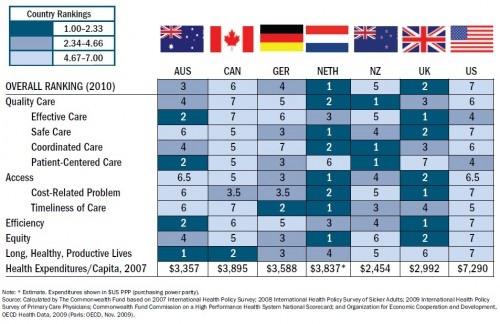
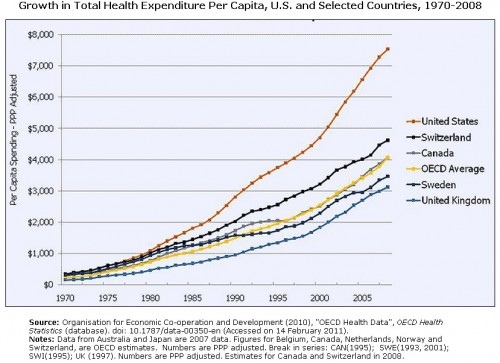
Health Care: We’re Number 7 OVERALL, Number 1 in COSTS


Medicynical Note: At least we’re number 1 in something.


ASCO (American Society of Clinical Oncology) Meetings 2011, Oncology Costs? Value? Cost Effectiveness? Not our Department

The 2011 ASCO meeting ended last week. An estimated 20,000 physicians and others with research and clinical interests in cancer care attended. 4500 abstracts of scientific work were presented with tremendous publicity given to many of the studies, particularly those sponsored by pharmaceutical companies. Reporting on the “event” was obvious on financial pages, daily newspapers and the web.

Drugs and studies touted included the use of exemestane in breast cancer presentation, the use of vemurafenib in melanoma, use of pemetrexed maintenance, bevacizumab in ovarian cancer, targeted therapy, and so on. What was pointedly missing was any emphasis on costs or even mention of the relative cost effectiveness of the various regimens so vigorously publicized.

ASCO accepts a great deal of money from the pharmaceutical industry but even so, as a professional organization in a time when health care spending is soaring, one would think they would pay more than lip service to the problem.

ASCO’s lip service:

In the U.S. health care system, the challenge of coping with cancer, and the effect of both disease and treatment, can be compounded by the uncertainty of whether patients will have access to appropriate care and who will pay for it. It is clear that the costs of cancer care are going up, driven in large part by innovation and by our ability to do more for patients.

In many settings these costs are being shifted to our patients, with a poorly understood effect on access to care and treatment decisions. There is a clear need to better understand the financial effect of cancer care on our patients and how we as oncologists can best promote informed decision making and access to appropriate care.

And:

For decades, it has been clear that a lack of health insurance leads to patients with cancer presenting with more advanced stages of disease at the time of diagnosis and to worse outcomes. The recent passage of the 2010 Patient Protection and Affordable Care Act promises to reduce the ranks of the uninsured, currently estimated at more than 50 million people.

More than 25 million additional Americans may be considered “underinsured” based on inadequate coverage for medical expenses. Ideology aside, we likely can agree that all patients with cancer should have access to quality health care, and that guaranteed access to screening, timely diagnosis, treatment, and supportive care should be our priority for any emerging policy. At this time, there is a patchwork of services and support that can provide financial assistance for patients with cancer.

And:

Despite the availability of financial assistance programs, one-third of patients with cancer report trouble paying their bills and up to 25% report exhausting their savings. These figures are perhaps not surprising in light of the costs of treatment, particularly with novel molecularly targeted agents. Drugs that extend median survival by several months may be priced at as much as $100,000 per patient.

Costs are indeed a problem in our chaotic non-system of care. Where else in the industrialized world do you find 50 million uninsured and people bankrupted by health care costs. Only in America.

When searching the 4500 abstracts of presentations at ASCO 2011 for the word “cost” 286 (6.3% ) studies were found. On review most of these abstracts mention the word “cost” but do no analysis of the actual cost of the intervention.

When the 4500 abstracts were searched for the words “cost effectiveness” a mere 50 (1.1%) studies are highlighted. Once again the great majority of these don’t measure cost effectiveness. In the end fewer than 15 or less than .3% of all presentations were cost effectiveness analyses.

Part of the problem of course is funding. Drug companies are not interested in cost containment, cost efficiency, or value. Rather, their primary goal is ever increasing revenue and profits. They rarely fund cost effectiveness or comparative effectiveness studies unless they are trying to gain an edge over a competitor’s product. And if the study doesn’t show the company’s product positively, they are not publicized, presented or published.

Over the next couple of weeks I’ll review some of the studies of cost effectiveness and point out a few that PHarma did not tout during its publicity blitz last week.

If you are interested you can browse the 2011 abstracts yourself.


Reality in Iowa? Crossing the Border for Health Care

Interesting editorial in the Des Moines Registeron traveling for care:

It simply isn’t true. The United States does not lead the pack on health care.

Not according to the World Health Organization, which ranks health care systems of countries all over the world.

Not according to the millions of uninsured Americans who likely think Canadians waiting for elective knee or hip replacements have it pretty good. Most Americans who are uninsured cannot be examined by a family practice doctor or receive mental health treatment or surgery or medications because they cannot afford to pay for them. That is the definition of rationing medical services in a country that spends more on health care than any country on the planet. (Medicynical emphasis)

and:

The most obvious example are the thousands who fill prescriptions at pharmacies in other countries. They may drive across the border or use an Internet pharmacy.

and:

According to one study, 750,000 Americans traveled abroad for health care in 2007 — almost double the number of nonresidents who came to the United States for treatment. Americans, particularly younger ones, head oversees for such services as stem-cell treatments, cosmetic surgery, or tubal ligations. They go elsewhere because it is cheaper.

Medicynical Note: America’s self-delusion does show signs of ending.


Women and Children pay first: Cuts to WIC program pay for Tax Cut to the Wealthiest

This apparently is the new American way. The proposed cuts are based on bogus analysis:

In deriving the 40 percent figure, the Committee apparently misunderstood a finding in a federal Agriculture Department (USDA) report that for every $1 in federal WIC funds spent for WIC foods in 2006, another

  • 41 cents in federal funds went for administrative costs plus WIC nutrition services. But: 41 cents out of $1.41 in expenditures equals 29 percent, not 41 percent; and
  • over two-thirds of that 29 percent goes not for administrative costs but instead for core WIC services such as breastfeeding support, nutrition education, smoking cessation support, diet and health assessments, substance abuse screening and education, and referrals for immunizations and other needed care.

Medicynical Note: Strange but true. The sad state of the U.S. economy allows such travesties. We’ve sold our soul to the……..banks, corporations and such.


Improving Health Care: Women’s life expectancy falls

For years our, the U.S. non-healthcare system’s emphasis has been on treatment. We go to extremes at great cost and have little benefit in terms of survival of our population. For example, women, “in large swaths of the U.S. are dying younger than they were a generation ago”.

But over the last decade, the nation has experienced a widening gap between the most and least healthy places to live. In some parts of the United States, men and women are dying younger on average than their counterparts in nations such as Syria, Panama and Vietnam.

Overall the United States is falling further behind other industrialized nations, many of which have also made greater strides in cutting child mortality and reducing preventable deaths.

Medicynical note: We spend more per capita by a wide margin on health care but we forgot that preventing disease offers more benefits (at lower price) than treatment. Meanwhile we reap the consequences of smoking and obesity in our population.


Socioeconomic Status, Quality of Care, Outcomes in Lung, Pancreas and Esophageal Cancer

At ASCO 2011 there were very few studies on cost efficacy, it doesn’t seem to be an issue to researchers funded mainly by pharmaceutical manufacturers. There was however an interesting abstract (6004) which looks at the care provided and outcomes of patients in different socioeconomic groups.

The study was of patients with cancers of the lung, esophagus and pancreas which “account for over 35% of all cancer deaths in the US and a sizable share of cancer costs.”

The researchers from the University of Michigan used the SEER-Medicare data base and examined the effect of socio-economic status on treatment and 2 year survival rates. The authors found:

The lowest SES (socio-economic status) patients were more likely to require urgent or emergent admissions and to be treated at very low volume hospitals and non-teaching hospitals. For all three cancer types, low SES patients were more likely to receive no cancer-directed treatment (e.g., 60% of the lowest SES patients received no treatment for pancreas cancer). Receipt of cancer-directed surgery, chemotherapy, and/or radiation therapy was consistently higher for the highest SES patients, with most patients receiving at one type of treatment and many receiving a combination of treatments.

And concluded:

There is pronounced variation in types of cancer treatment received by different SES groups. Despite receiving more aggressive treatments, higher SES patients do not have improved survival rates.* Reducing variation in treatment strategies may improve healthcare efficiency without changing patient outcomes.

*emphasis by medicynic

Medicynical Note: I’m not sure what more there is to say. We have a primeval, possibly money driven urge, to do all modalities of treatment to patients with bad disease, especially to those with money, insurance or other resources. But we have no impact on the ultimate course of the disease.

This mania is costly. We are using drugs and procedures costing our health care non-system many thousands of dollars a month, uselessly. More careful shepherding of resources and more considered use of treatments would save money (lots) and not impact outcomes adversely.


Melanoma, Real advances

Malignant melanoma has resisted virtually all treatment approaches once it’s metastasized. It’s wonderful that there’s been progress at least for one subset of these patients. Abstract LBA4 ASCO 2011 also.

Early results in a study using the drug vermurafenib in melanoma patients with a specific tumor mutation (GRAF V600E) showed strong evidence of the drug’s efficacy. This mutation is found in 40-60% of patients with cutaneous melanoma. Whether this will result in prolonged remissions and significant life extension remains uncertain.

A previous phase 2 trial with this drug showed a rated of response of 57% with a duration of 6.7 months. A previously unheard of response rate in melanoma. This phase 3 trial compared the drug with dacarbazine alone which has response rates of 7-12% and an overall survival of 5-8 months.

This phase 3 trial found:

A total of 672 patients were evaluated for overall survival. The hazard ratio for death in the vemurafenib group was 0.37 (95% confidence interval [CI], 0.26 to 0.55; P<0.001)The survival benefit in the vemurafenib group was observed in each prespecified subgroup, according to age, sex, ECOG performance status, tumor stage, lactate dehydrogenase level, and geographic region (Figure 1B). At the time of the interim analysis, there were an inadequate number of patients in follow-up beyond 7 months in either study group to provide reliable Kaplan–Meier estimates of the survival curves.17 At 6 months, overall survival was 84% (95% CI, 78 to 89) in the vemurafenib group and 64% (95% CI, 56 to 73) in the dacarbazine group. Further follow-up is required.

Very hopeful, but very preliminary, results.

Medicynical notes: The discussion of the results in the NEJM article reported a relative reduction of 63% in the risk of death and 74% a tumor progression compared with dacarbazine. Dacarbazine is a poor comparator as it probably is not much better than placebo in this very resistant to treatment tumor.

I don’t argue that the new drug is not an advance but touting the improvements in outcome as a percentage rather than actual numbers overstates the benefit–not surprising that this is done in a drug company study.

You might want to look at the Kaplan-Meier survival curve in the article which shows the percent surviving (40%) in the two groups apparently merging at 9 months. The drug offers some benefit but it not a panacea.

Wonder what Roche will charge?


Health care: Our non system

This week’s at ASCO there were numberous examples of studies involving high priced drugs for treating cancer costing in the range of $60,000-$100,000 and more for the drug alone, most with very limited benefit. When one adds up other care required the yearly costs of following these patients approaches $150,000 or more. Consider that one year’s dialysis, all costs included, is in the range of $75,000. Where is the value in these new oncologic advances? True it’s wonderful that there is progress, but at what cost? Affordability? Reality?

Average individuals (median income in U.S. approximately $50,000) will can not pay more than their annual salaries for such limited benefits. Health insurance is a buffer but it doesn’t work if insurers won’t control costs. However, insurers have problems denying patients. The proposals to objectively (non-drug company sponsored evaluations) evaluate cost effectiveness would help with this. If a drug proved no better than standard and/or less expensive options there would be grounds for both the insurance company and physicians to use the more economic alternative. Patients, if they wished, could always opt to pay themselves for the more expensive choice.

Ryan, and his republican colleagues, find regulation to be abhorrent and one can predict that their “plan” will have few protections for those with serious illness and simply allow insurers to discriminate in their provision of coverage (charge unaffordable rates or not offer policies) rather than discriminate against expensive ineffective treatment alternatives.

Our population appears to have reservations about mandating that we all have insurance, high and low risk people. The mindset appears to be that ” I’m not sick, why buy insurance” and that “you can’t make me do anything.” But these same people have no aversion to appearing at ER’s and demanding free care (the most expensive, least efficient available); manipulating the system to get their parents into medicaid covered nursing homes; and demanding affordable health insurance at the moment they become ill.


Defying Gravity: Cancer Care Costs, Hepatoma, sorafenib

The American Society of Clinical Oncology meeting finishes and I’m left with a continued disbelief in treatments with limited efficacy costing in the range of $60,000-120,000/year. Patients are not cured; many studies report no survival benefit found as of yet (reports of delays of progression abound); and yet there appears little or no concern whether the advances are affordable by the various insurance schemes or individuals.

Consider the improvement provided by sorafenib compared with sunitinib in Hepatoma ( abstract 4000 at the meeting).

The report noted:

Median OS (overall survival) was 8.1/10.0 mo (HR 1.31 [95% CI: 1.13–1.52], P=0.0019); PFS was 3.6/2.9 mo (HR 1.12 [95% CI: 0.98–1.29], P=0.1386) and TTP (Time to Progression) was 4.1/4.0 mo (HR 1.13 [95% CI: 0.97–1.31], P=0.1785). OS for pts with hepatitis B (Hep B; Su 290/So 288; post hoc analysis) was 7.8/7.9 mo (HR 1.09 [95%CI: 0.9–1.32], P=0.236). In 526/541 pts evaluable for safety, all-causality, grade 3/4 adverse events (AEs) occurred in 82/73% of pts; the most common were thrombocytopenia (19%) and neutropenia (16%) for Su, and skin disorders (21%) for So. Discontinuations due to AEs occurred in 26/23% of pts. Serious AEs were noted in 44/36% of pts, with grade 5 AEs in 18/16%.

Neither drug seems particularly effective but the fact that there was any effect in this difficult cancer is considered an event.

Medicynical Note: Sofafinib costs in the range of $6000/month. It has a benefit of a few months over no treatment and perhaps 2 months over sunitinib, apparently in patients with associated Hep C. Cases of cancer associated with Hep B cases were equally “improved” OS 7.8 and 7.9 months.

It should be noted that when compared with placebo in an earlier study the results were similar, a 2-3 month improvement of overall survival.

Median overall survival was 10.7 months in the sorafenib group and 7.9 months in the placebo group (hazard ratio in the sorafenib group, 0.69; 95% confidence interval, 0.55 to 0.87; P < 0.001).