Police Outgunned– Why in world do we have legal AK47’s

The four Oakland policemen killed last week were victims of an ex-felon who used an AK-47 in his rampage.

There are many open questions about this terrible episode. The most important to me is why we have such lethal weapons readily available in our society. In this case the gunman had more firepower than the policemen making the traffic stop. How could this happen? I don’t think the “founders” had this in mind with the second amendment.

Powered by Zoundry Raven

It’s Hard to Imagine a More Dysfunctional System– Healthcare, that is

The Seattle PI may have stopped it’s print edition but it’s still online. Today it reports on the continued increase in health insurance rates in Washington State.

What’s going on is the continued waste and mismanagement in a non-systematic health care scheme (I can’t bring myself to call it a system). We’re so inefficient that even what was once the world’s wealthiest economy can’t afford it. Maybe we’ll see some change?

Powered by Zoundry Raven

PSA or Not, More analysis

Nice summary of the findings of the two PSA studies in the NY Times.

“The European study found that for every man who was helped by P.S.A. screening, at least 48 received unnecessary treatment that increased risk for impotency and incontinence. Dr. Otis Brawley, chief medical officer of the American Cancer Society, summed up the European data this way: “The test is about 50 times more likely to ruin your life than it is to save your life.””

Medicynic: How about a comparison to the use of adjuvant treatments for example in breast cancer or colon cancer where 100 people are treated with expensive highly toxic medications to benefit 10%. Admittedly breast cancer has a higher mortality but the costs are exponentially higher.

“For older men, the screening decision should be easier. P.S.A. screening is already not advised for those 75 and older.”

For middle aged patients:

“The advice is murkier for middle-age men. In the European study, 50- to 54-year-olds didn’t benefit from screening. But men ages 55 to 69 were 20 percent less likely to die from prostate cancer than those who weren’t screened.

Medicynic: The articles would have been more powerful with an economic analysis. Cost effectiveness data would help place it in perspective with other interventions.

Powered by Zoundry Raven

PSA Screening the Definitive Answer: Not Quite

Two articles and an editorial in the New England Journal of Medicine (NEJM) this week look at the efficacy of screening for prostate cancer. They are available on line here, here and here.

Both studies showed that the benefits of screening are limited, though in both studies the screened group has a higher rate of cancer diagnosed than the unscreened. In the European study in each center there was “a lowering of the death rate from prostate cancer associated with screening.” This benefit was limited to those between the ages of 55 and 69.

“During a median follow-up of 9 years,the cumulative incidence of prostate cancer was 8.2% in the screening group and 4.8% in the control group. The rate ratio for death from prostate cancer in the screening group, as compared with the control group, was 0.80 (95% confidence interval [CI],0.65 to 0.98; adjusted P=0.04). The absolute risk difference was 0.71 death per 1000 men. This means that 1410 men would need to be screened and 48 additional cases of prostate cancer would need to be treated to prevent one death from prostate cancer.”

The problem with PSA testing is false positive PSA tests (positive tests in patients without cancer) and the diagnosis of non aggressive lesions that would not be clinically significant during the patient’s lifetime. Currently biopies are done on all such patients and definitiive treatment offered (in the U.S.) to almost every patient with cancer even if they appear to be of the non-aggressive variety.

In the U.S. study it was found that

“screening was associated with no reduction in prostate-cancer mortality during the first 7 years of the trial (rate ratio,1.13), with similar results through 10 years, at which time 67% of the data were complete.”

“However, the confidence intervals around these estimates are wide. The results at 7 years were consistent with a reduction in mortality of up to 25% or an increase in mortality of up to 70%; at 10 years, those rates were 17% and 50%, respectively.”

Meaning the results are not as yet statistically significant.

There are number of explanations. First, the test is not specific enough to be effective–it picks up insignificant tumors and people without evidence of malignancy. Second, the control group may have experienced an effect simply from being in the study. That is, by being in the study the patient and his doctor were more aware of prostate screening and may have introduced an artifact into the result by being more aware of the problem and testing more for indication than would have otherwise occurred. At the start of the study some PSA screening was done in both groups and some cancers detected before entry, eliminating “some cancer detectable on screening from the randomized population. Third, it was noted that there was improvement in therapy that may eliminated the benefits of screening.

It’s clear from the study that PSA screening is marginally effective procedure. Many false postives result in excessive diagnostic biopsies. Many tumors are diagnosed that would not progress to invasive cancers. But, importantly, mortality from prostate cancer has dramatically decreased since screening began.

We need a new test, one with excellent sensitivity but also greater specificity and one that would discern between tumors that would follow a more benign and malignant course. For now it appears that patients will continue to decide whether to be tested and whether to accept the risk of false positivity.

Powered by Zoundry Raven

Medical Tourism and HSAs– Fatally flawed or healthy competition?

Today’s NY Times has an article on medical tourism.

It reports on a patient who went to Costa Rica for double hernia surgery. The financials on his decision were as follows:

“No longer covered under his former employer’s insurance and too young to qualify for Medicare , Mr. Schreiner has a private health insurance policy with a steep $10,000 deductible. Not wanting to spend all of that on the $14,000 his operation would have cost stateside, he paid only $3,900 in hospital and doctor’s bills in Costa Rica.” Medicynical note: Plus airfare and accommodations.

Proponents of Health Savings Accounts often use the medical tourist to illustrate that the market can work in health care and to promote the notion of HSAs as a fix for our dysfunctional health care system.

For whom does a high deductible health insurance product work?

Who in our culture can afford a $10,000 deductible? If this wealthy retired bank executive didn’t want to pay it, how will those families earning less than the median income manage?

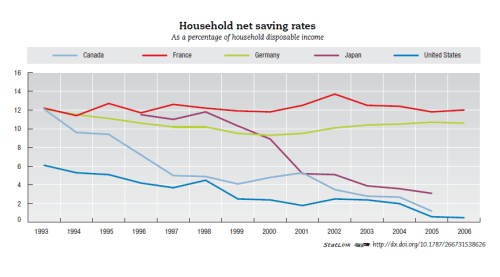
HSA proponents postulate that if used over many years the savings aspect of the HSA would be able to cover the deductible. In the real world however, half or more of our population do not have the discretionary income to put such money away–check out the rate of savings (see above) in the U.S. over the last 15 years. Furthermore, have look at the costs of care in the U.S. system. How long will savings in an HSA last in any significant illness? How will the savings needed for an HSA affect retirement savings of families living with incomes below the median ($50,000/year)?

HSA’s are designed to finesse the system, they are marketed heavily by various conservative organizations and insurers who believe free markets work in health care–no evidence anywhere in the world that this is so. Why do insurers like HSAs? Because HSA’s offer an opportunity to segment the health care market and skim off the lowest risk customers. HSA’s, with high deductibles and lower premiums, attract the young who are a low risk of illness, the healthy who do not expect to be sick and the wealthy for whom out of pocket expenses are not a problem.

However for the health care system as whole, for those who are chronically ill and those without money, HSAs are a dead end that create more problems than they solve. Consider the patients seen at a free clinic, as described in this LA Times article. They’re not quite as chirpy and self satisfied. They are stuck in a non-system of care that doesn’t work for them. HSA’s are not a consideration for them.

What happens to those with an HSA who become ill, lose their job and can’t afford the high deductible? What happens when a sick person with an HSA receives his next insurance bill and notes his rate has doubled? Where do those who can’t afford the financial outlays that an HSA demands get their care (Hint, read the LA Times article)?

Care to guess who ultimately pays? We can do better.

Powered by Zoundry Raven

The Heart of the Matter– Cost effectiveness

Ewe Reinhardt’s Economix blog today looks at pricing human life and the choices we face.

“All modern health systems now offer some medical interventions associated with very high costs per QALY. These procedures present two morally vexing questions:”

“1. Is there a maximum price per quality-adjusted life year (or life-month or life-day) beyond which society will not buy additional QALYs from the health system – certainly not out of collective insurance funds, be they public or private? Or is the sky really the limit in health care, as it is not in any other economic sector? “

2. If there is a maximum price, should it be the same for all members of society – rich or poor, prominent or not – or should there be different maximum prices for different socioeconomic classes? For example, should QALYs be rationed by market price and the individual’s ability to pay, as it would be in a free-market economy?”

Medicynical note: The point of Reinhardt’s blog is how much are we willing to pay. In the article there is a curve showing a QALY supply curve. On it there are points representing the effect of drugs costing $100,000/year on survival.

I’m not sure that any $100,000/year and more drug represents a cost effective intervention. Aren’t single drugs priced at more than the median and average income in our country by definition, cost-inefficient? And beyond most individual’s, and insurer’s ability to pay?

Abuse of the patent privilege is a real problem. Companies take the patent as a right to price medical advances higher if they treat life-threatening problems.

How did we let this happen?

Powered by Zoundry Raven

Pope Practicing Medicine? No Condoms to prevent HIV

Over the years I’ve encountered many medical missionaries in third world situations. None impressed me more than those associated with Catholic institutions abroad. In my experience these providers were devoted first to providing assistance and secondarily to influencing religious beliefs–in contrast to many other missionary groups. Most are pragmatic and effective.

In regard to the HIV epidemic in Africa, the Pope however, doesn’t appear to support this health-first attitude. His religious doctrine based pronouncement today en-route to Cameroons stated:

“you can’t resolve it with the distribution of condoms.” He said that “on the contrary it increases the problem.”

“The Vatican encourages sexual abstinence to fight the spread of disease.”

It would be wonderful if abstinence worked. It’s simple, cheap and if used would be effective in preventing HIV. For those at risk, however, abstinence doesn’t fully meet their needs. They are for the most part sexually active, in many instances at an early age. With the prevalence of the disease in double digits in many areas of these countries, condoms become a reasonable way to decrease the risk of infection, and yes they do work.

Consider “discordant” couples. One person has HIV infection and the other does not. Is abstinence a realistic choice?

“The study, whose results were presented at the 15th conference on retroviruses and opportunistic infections in Boston, Massachusetts, found that of 36,000 couples tested, 96 percent of those in sexually active discordant relationships (where only one partner is HIV positive) reported not using condoms during their last sexual encounter.”

“The people we studied were in stable relationships – usually man and wife – and thus they did not feel the need to use condoms,” said Dr Elioda Tumwesigye, the lead researcher. “Even after testing, many continued to practice unprotected sex, saying that discordance was fate or that one partner must be immune.”

Condoms are an important part of the prevention strategy. It’s tragic that the Pope’s doctrinaire pronouncements may kill some people.

Powered by Zoundry Raven

Costs, the elephant in the universal health care closet

The Massachusetts health plan is looking at better ways to finance their universal system. With universal coverage expenditures/capita have risen above the already outrageous national average of about $8,000/year.

“They want a new payment method that rewards prevention and the effective control of chronic disease, instead of the current system, which pays according to the quantity of care provided.

It appears it was a mistake not to control costs in the first place:

“Those who led the 2006 effort said it would not have been feasible to enact universal coverage if the legislation had required heavy cost controls. The very stakeholders who were coaxed into the tent – doctors, hospitals, insurers and consumer groups – would probably have been driven into opposition by efforts to reduce their revenues and constrain their medical practices, they said.”

Some good things are happening:

“Frankly, it’s very hard for the average consumer, or frankly the average governor, to understand how some of these companies can have the margins they do and the annual increases in premiums that they do,”

“Insurers seeking to participate in the state’s subsidized insurance program, Commonwealth Care, recently submitted bids so low that officials announced last week that they would keep premiums flat in the coming year.”

But:

“Some health policy experts argue that changes in payment practices will not be enough to slow the growth in spending, even when combined with other cost-cutting strategies. To truly change course, they say, the state and federal governments may need to place actual limits on health spending, which could lead to rationing of care.”

Medicynical note: In a system that has institutionalized excess expenditure at every level change is difficult. We need to look at every level in the supply chain and question costs and demand more efficiency. Cutting some of the fat out of the insurance business is a start. I’ve focused on reforming patents in the past and that’s also a possibility.

Lastly we already ration care by cost. In oncology for example, patient delay is a significant cause of morbidity and mortality. People who can’t afford to pay simply delay or completely forgo treatments.

Powered by Zoundry Raven

Health care Value Gap

The Business Round Table seems to think we have a health care crisis.

“Americans spend $2.4 trillion a year on health care. The Business Round table report says Americans in 2006 spent $1,928 per capita on health care, at least two-and-a-half times more per person than any other advanced country.”

“What’s important is that we measure and compare actual value – not just how much we spend on health care, but the performance we get back in return,” said H. Edward Hanway, CEO of the insurance company Cigna. “That’s what this study does, and the results are quite eye-opening.”

“Higher U.S. spending funnels away resources that could be invested elsewhere in the economy, but fails to deliver a healthier work force, the report said.”

Medicynical note: As expected, despite the waste in our private system, this group recommends health care remain largely as is  with a government safety net for low-income people. What they neglect to mention is that the private, for profit, system is designed to make us all low-income people by fostering the waste of duplicated administrative services, overuse of unproven approaches and not evaluating the cost effectiveness of interventions.

Powered by Zoundry Raven

10 Killed in shootings in Alabama

This Reuter’s article says it all, except…….

“At least 10 people including the suspected gunman and his mother were killed in a shooting spree and car chase in southern Alabama on Tuesday, authorities said.”

“Mass shootings have become a feature of life in the United States.”

“In one of the worst recent incidents, a gunman dressed as Santa Claus killed nine guests at a Christmas Eve party, before taking his own life in Covina, California, a suburb of Los Angeles.” “On April 16, 2007, Virginia Tech, a university in Blacksburg, Virginia, became the site of the deadliest rampage in modern U.S. history when a student gunman killed 32 people and himself.”

“Guns are widely available for purchase in the United States, a country that prides itself on the right to own weapons for self defense and hunting.”

Medicynical Note: We have almost 1 gun/person in the U.S. (90 guns for every 100 people) That includes the very young, very old, the infirm and the crazies. It’s just too damn easy.

It can happen in other places as well–Germany today, 16 dead in early reports. The common factor is the gun!

Powered by Zoundry Raven