Arguing Against Comparison Studies– Anti-intellectualism or Greed?

It’s hard to believe that one can argue against learning what works. But that’s exactly the position of drug and device makers in this article in the Wall Street Journal. It’s hard to believe that this is an issue.

At a minimum such studies will guide physicians in explaining benefits of, risks from and alternatives to various treatments. Comparisons will also help with analyzing the cost-effectiveness of various interventions. Whether insurers will use such data to decide what they will and will not cover is an open question.

My question is when new drugs are prohibitively expensive and have minimal effect on disease course, should insurers pay for their use? Should doctors recommend their use? Should there be limits on “choice” in health care when someone else is paying?

Powered by Zoundry Raven

Why Insurers Need Regulation–Because of the Money!

An example of the problems with “free” markets in health care–lack of coverage for expensive oral medications used in cancer care. For a number of years, oral medications have been increasingly used in cancer treatment . From Xeloda (oral 5 FU) to Gleevac (imitinab) expensive oral agents have become an integrated into treatment.

Gleevac (imitinab) one of the early targeted drugs (tyrosine kinase inhibitor in Chronic Myelogenous Leukemia) costs anywhere from $40,000/year to $90,000/year depending on dose and indication. Over a lifetime this drug becomes more expensive than most homes. Average families (Median U.S. income about $50,000/year) cannot afford such expense unless insurance provides coverage or they receive free drugs from the company.

Medicare took care of this problem with it’s Part D drug coverage. The issue with Medicare is the donut hole in coverage which requires a yearly $3,000 payment and the 5% copay after the donut payment is completed. In some cases this 5% payment can be considerable as noted in the article.

Most private insurers have lagged in providing this coverage. Oregon has now required insurers to provide equal coverage for IV and oral chemotherapy medication. The rest need more adult supervision.

Another issue is the price demanded by pharmaceutical companies. You and I grant these companies monopoly status for a generation (a patent). This is an industry/government sanctioned imfringement on free “markets”This restraint on open competition is granted theoretically to “encourage development of innovative agents.”

However, drugs priced at more than the yearly income of citizens have become simply unaffordable–by individuals as well as insurers. In other industrialized nations these same medications are priced significantly less. These countries negotiate and otherwise review new drugs and require more appropriate pricing. We need patent reform here as well.

Powered by Zoundry Raven

The Challenge of Cost Containment

Most people believe we spend too much on health care. From the April 7 Annals of Internal Medicine:

“The United States spends more than any other country on medical care. In 2006, U.S. health care spending was $2.1 trillion, or 16% of our gross domestic product. At the same time, more than 45 million Americans lack health insurance and our health outcomes (life expectancy, infant mortality, and mortality amenable to health care) are mediocre compared with other rich democracies. We spend too much for what we get.”

The Obama administration’s approach to control costs focus’s on “improving medical practice and health outcomes and changing the structure of the health insurance marketplace.”

In the category of improving medical practice Obama appears want to improve prevention services, promote health information technology (HIT), better manage chronic diseases, offer payment reforms that would pay providers on the basis of outcomes, and compare effectiveness different approaches. Yet as the article notes none of these interventions offer significant savings though they may improve outcomes and the process of health care.

Some savings are achievable through insurance reform:

“Insurance regulation can reduce costs (in principle) by limiting the resources that private insurers put into avoiding sales to less healthy customers and charging them much higher premiums. By prohibiting such medical underwriting and by requiring insurers to accept applicants regardless of health status, President Obama’s health reform approach could produce some administrative savings. An effective insurance exchange (a new agency that would offer Americans a choice of health insurance plans while also regulating insurers) can lower the high administrative costs that are typical in the current individual and small group insurance markets. In addition, the Obama platform proposed more direct limits on insurance overhead. It promised to “force insurers to pay out a reasonable share of their premiums for patient care instead of keeping exorbitant amounts for profits and administration.”

Medicynical note: This reform saves money by encouraging increased efficiency while ensuring equitable coverage.

The Annals then goes on to explore what works in other settings and concludes:

“If the United States is to control health care costs, it will have to follow the lead of other industrialized nations and embrace price restraint, spending targets, and insurance regulation. Such credible cost controls are, in the language of politics, a tough sell because they threaten the medical industry’s income. The illusion of painless savings, however, confuses our national debate on health reform and makes the acceptance of cost control’s realities all the more difficult.”

Medicynical note: We have a medical industrial complex as well organized and resistant to change as the military industrial complex that Eisenhower warned about. To achieve cost savings will require altering our cost structure and profit assumptions that have been increasingly entrenched over the past 50 years.

This article points out some false assumptions and the difficulties ahead.

Powered by Zoundry Raven

Provenge–Poster child for comparison studies

Lots of news on Provenge, (also in Bloomberg) a drug being tested in patients with hormone refractory advanced prostate cancer. Dandreon, the manufacturer has highlighted results in an incomplete study, perhaps jeopardizing it’s integrity.

“Provenge appeared to cut patients’ death rates by 20% compared with a placebo treatment, the company said. The release also contained statistical details that made good results seem likely when final results are released in April.”

What is a 20% improvement? Is it 1 month, two months or a year?

Compared with a placebo? Sugar pills and such? I would hope it would offer some benefit.

It’s good to see progress in this disease, but this is premature reporting more for the benefit of financial types than medical. This new drug will undoubtedly cost thousands/ month. At some point, comparison with and combination with the current best therapies will allow a more reasonable assessment of efficacy and cost/effectiveness.

Powered by Zoundry Raven

Health Care for all–errr, for all who can afford it

Employer based insurance is failing. It doesn’t work for employers, many of whom can’t afford to provide coverage, particularly those with lower income employees. And it doesn’t work for the employee who either has no insurance or has to spend a significant proportion of income to buy coverage.

McKinsey Quarterly notes that :

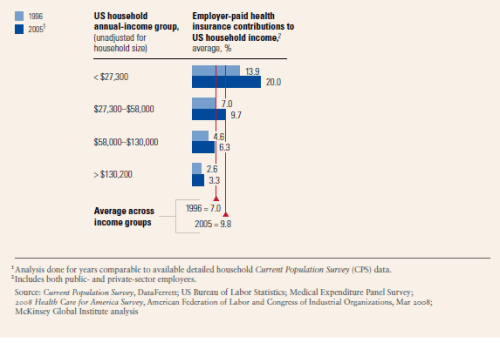
“In 2005, employer-paid health benefits covered 22 percent of households in the bottom-income group, contrasted with 56 percent of the lower-middle, 81 percent of the upper-middle, and 89 percent of the top income group”

To understand the magnitude of costs relative to income:

You will note for those earning under $27,000 dollars/year, health insurance costs are in the range of 20% of income, while for those earning over 130,000/year it’s just 3.3%.

Meanwhile Ramesh Ponnunu (of the National Review) in an OP-ED, advocated a move away from employer provided health insurance. Medicynical note: Can’t argue with that as I believe the employer based insurance system has failed.

His approach, however, would allow employers to drop health insurance and provide a tax credit to the employee to buy insurance on the private, individual market. He argued that this will bring market forces to bear on health care costs.

His plan discounts the high cost of insuring those with illness, that of course is the whole point of health insurance saying vaguely that they would be provided subsidies to buy coverage. He also neglects the issue of below average income people (after all that is 50% of the population) and the high cost of health insurance, relative to income.

His tax credits, as I understand it, will provide a decrease in the amount of taxes paid. But it won’t provide relief for a significant part of our population. For example, families and individuals with $27,000 or less income have no tax liability (see here).

We can do better than this.

Powered by Zoundry Raven

Medical abuse?–Torture and strip searches

While not as egregious, the school nurse supervised strip search of a 13 year old school girl has parallels in the torture of suspected terrorists.

The CIA medical staff:

“monitored prisoners undergoing water boarding, apparently to make sure they did not drown. Medical workers were also present when guards confined prisoners in small boxes, shackled their arms to the ceiling, kept them in frigid cells and slammed them repeatedly into walls, the report said.”

“Facilitating such practices, which the Red Cross described as torture, was a violation of medical ethics even if the medical workers’ intentions had been to prevent death or permanent injury, the report said. But it found that the medical professionals’ role was primarily to support the interrogators, not to protect the prisoners, and that the professionals had “condoned and participated in ill treatment.”

The Arizona school’s behavior is similar to the CIA’s in intent and misuse of medical staff. It raises questions both for what is allowable in the context of a school situation and how the medical profession can be used to facilitate such actions. First strip searching a 13 year old without the permission and/or presence of a parent is untenable. Using medical staff undermines the original functions of that staff in the school setting.

“Vice Principal Wilson removed her from class and brought her to his office. She gave permission for a search of her backpack, which turned up nothing.”

So far so good, appropriate use of the principal’s authority.

“Then Wilson told her to go to the nurse’s office with two female staffers. They told her to remove her socks and shoes, her stretch pants and pink T-shirt. They told her to move her bra from side to side, which exposed her breasts, and pull out the waistband of her underwear.”

In my view this is inappropriate use of the school’s authority and the medical staff. It eerily parallels the use of CIA staff to “to support the interrogators, not to protect the prisoners, and that the professionals had “condoned and participated in ill treatment.”

It’s amazing and a bit revealing that such a case would get to the Supreme Court without a resounding rejection of the use of a strip search. Any reasonable person, and that might even include a judge, should be offended by the school official’s behavior (and the CIA’s).

Powered by Zoundry Raven

A Misguided Argument Against Universal Health Care

An oped in the NY Times claims the quest for universal health care is misguided. Ramesh Ponnuru’s arguments, McCain revisited, are notable for what they don’t say.

” For people with pre-existing health problems, for example, direct subsidies would probably be more efficient than rigging insurance markets to make sure they are covered.”

Medicynical note: Sooner or later everyone will have a health problem. At that point the insurer will be “free” to increase the patient’s premiums and force those unable to afford the new higher rate out of the policy. Imagine a health insurance system demoniacally rigged to protect the insurer not the beneficiary. Guess who would provide the direct subsidy? A solution that solves nothing. Brilliant!

He follows immediately with

“As Michael Cannon, a health policy analyst at the Cato Institute, has written, “There is no evidence that a dollar spent on universal coverage will save more lives than a dollar spent on clinics, or reducing medical errors, or nutrition, or fighting poverty, or even improving education.” And if universal coverage generally reduces the quality of care or retards medical innovation, it could end up being bad for everyone, including the poor.”

Medicynical note: This is irrelevant to the argument preceding. It should be noted that our friends at Cato have not shown much enthusiasm for any of the mention interventions–nutrition, fighting poverty or improving education.

He then argues for a non-employer based system without any protections that the coverage will meet minimum needs:

“The existing tax break for employer-provided insurance could be replaced with a tax credit that applies to insurance purchased either inside or outside the workplace. At the same time, state mandates that require insurers to cover certain conditions, which make it expensive to offer individual policies, could be removed”

Medicynical note: Private health insurers salivate at the idea that they would be allowed to offer policies to the healthy that do not meet the needs of those with illnesses. What better way to force high cost patients out of their system. This is not health insurance it’s highway robbery.

In Ponnuuu’s world the employer’s current contribution to health insurance disappears into the employer’s profits. Employees are offered the sop of a tax credit to pay for new coverage obtained in a “not so free market.” No mention is made of the insurer’s ability to increase rates on individuals with chronic illness, cancer, heart disease, you name it. The market is not at all free to those with illness or without savings. The superficiality of the proposal is amazing.

Powered by Zoundry Raven

Natasha Richardson, Was her death avoidable?

Many of our conservative pundit types want to blame the Canadian healthcare system for the lack of helicopter tranport in the Natasha Richardson case. In fact, Quebec is the only Province that lacks such system. As such the lack of helicopter transport appears more a local political financial decision.

A helicopter medevac, if available, would have been quicker, presuming patient cooperation and immediate availability of the equipment.

Ms. Richardson, however, refused an ambulance about 1 hour post accident. If there were a helicopter based system it’s likely that she would have refused that as well.

A second call for an ambulance went out about 3 hours after the fall at which point her condition was deteriorating. That ambulance responded within 45 minutes (about the same response time or less than a helicopter called from another locale). Within a few minutes she was at the local hospital which lacked neurosurgical facilities. It took another two and 1/2 hours to get her to the referral center in Montreal.

With a helicopter the last two and 1/2 hour transit time could have been cut in half and the outcome possibly altered, but that is uncertain considering the initial delay and her deteriorating condition.

We shouldn’t be too certain that speed of transfer would be better in the U.S. In Illinois, for example the mean time to transfer emergent cases is a mean of 5 hours 42 minutes as noted below:

“Two-hundred thirty emergent neurosurgical transfers occurred during the study period. The most common diagnoses were parenchymal intracerebral hemorrhage (33%) and subarachnoid hemorrhage (28%). Sixty-six percent of neurosurgical transfers to academic medical facilities originated at hospitals without full-time coverage. The mean time to transfer for all patients was 5 hours 10 minutes (standard deviation, 3 h 42 min; range, 1-20 h 12 min). A decline in Glasgow Coma Scale score was seen in 29 patients. A shortage of neurosurgical intensive care unit beds occurred on 55% of the days in the study. only 19% of emergency cases were related to cranial trauma, and only 3% of transfers came from level 1 trauma”

Powered by Zoundry Raven

What’s going on? 5 dead, 13 dead, 3 dead

3 Police Killed in Pittsburg

13 Dead in Binghamton

5 children, father found dead

There are 30,000 deaths from guns in the U.S. each year. In UK there are 50. That’s not a misprint fifty. Our conservative friends are concerned about their second amendment freedoms. This is freedom?

Powered by Zoundry Raven

The Sacred BIG PHARMA/Patient Relationship

Billy Tauzin was a Republican representative from Louisiana who on leaving congress immediately became a lobbyist for the pharmaceutical industry. He had a conference call the other day. As noted in The Treatment (TNR’s health care blog)

“PhRMA still has its own, very specific notions of what reform should look like. Giving everybody insurance? Sure, that’s great. Applying more scrutiny to effective treatments–a move most experts would argue is essential for bringing the cost of health care under control? Um, not so much.”

“He also said that reform should not interfere with the “wonderful, uniquely American experience in which doctors and patients make their decisions about health care.”

Medicynical note: By wonderfully unique, is Billy referring to the practice of the pharmaceutical industry providing salaries, gifts, and stipends to researchers, and doctors presumably to in some way influence their treatment recommendations and decisions? Or the relationship the industry has with pharmacies that allows it to monitor physicians’ prescribing behavior? Or is it the industry’s direct to patient advertising that doesn’t mention cost, alternatives, or outcomes. And manages to bury the most horrific toxicity in disclosures that only a medical professional could fully understand.

The formerly ethical pharmaceutical industry also collects information about people online without disclosing that they will use the information to recommend drug treatments. See article about RealAge (NY Times ).

“Pharmaceutical companies pay RealAge to compile test results of RealAge members and send them marketing messages by e-mail. The drug companies can even use RealAge answers to find people who show symptoms of a disease – and begin sending them messages about it even before the people have received a diagnosis from their doctors.”

Maybe Billy was talking about the sacred BIG PhRMA patient relationship–so much for doctors.

Powered by Zoundry Raven