Vitamin D Supplementation– All Hype? Little Evidence of Efficacy

The prestigious Institute of Medicine released a report November 30th indicating that the hype over Vitamin D supplementation is just that, hype:

The committee provided an exhaustive review of studies on potential health outcomes and found that the evidence supported a role for these nutrients in bone health but not in other health conditions. Overall, the committee concludes that the majority of Americans and Canadians are receiving adequate amounts of both calcium and vitamin D. Further, there is emerging evidence that too much of these nutrients may be harmful.

Regarding the efficacy of Vitamin D on health problems the study concluded:

It reviewed a range of health outcomes, including but not limited to cancer, cardiovascular disease and hypertension, diabetes and metabolic syndrome, falls, immune response, neuropsychological functioning, physical performance, preeclampsia, and reproductive outcomes. This thorough review found that information about the health benefits beyond bone health—benefits often reported in the media—were from studies that provided often mixed and inconclusive results and could not be considered reliable.

Medicynical Note: I recently went to our local health food Coop and was amazed, (as I always am) at the two to three aisles of vitamins , food supplements and such ironically being marketed to people who are deeply interested in maintaining their precious bodily fluids (see General. Jack D. Ripper).

The notion that there be some proof of efficacy of these supplements before taking megadoses seems foreign to our culture and perhaps has to do with our belief in miracles, religiousity, aggressive marketing and doing what we are told to do.

Our Health Care System: Inefficiency, is that a problem?

The Washington Times presents a tortured argument against promoting more efficient care in the most expensive health care non-system in the world.

Think of it, a centralized, federal database tracking your every visit to a health care provider – where you went, who you saw, what was diagnosed and what care was provided. Chilling.  Medicynical note: as if private insurers oversight that  controls and limits treatment given is less intrusive, or as if the data will have patient identifiers.

The Times takes issue with the notion of efficiency in health care.  To them, apparently,   spending 50% more per capita on health care than any other nation in the world and 17% of GDP, and increasing yearly, is acceptable:

There is no telling what metrics will be used to define the efficiencies, but it is clear who will bear the brunt of these decisions. Those suffering the infirmities of age, surely, and also the physically and mentally disabled, whose health costs are great and whose ability to work productively in the future are low. And how will premature babies fare under the utilitarian gaze of Washington’s health efficiency experts? Will our severely wounded warriors be forced to forgo treatments and therapies based on their inability to be as productive as they once might have been? And will the love between a parent and child have a column on the health bureaucrats’ spreadsheets?

The Times then goes on to compare cost efficacy measures with the nazis.

Medicynical note: Nothing surprising here. Until we show some will to control  costs our non-system caring for an aging increasingly health care needy population will continue to spend our nation’s wealth.

Our republican friends have been amazingly quiet about their solutions. Their “free market” rhetoric leads one to assume they would put an increasingly large burden of expense on individuals–their form of individual mandate. They would then let the costs of health care assure economic rationing. For those who can’t afford care, I suppose their solution for patients is that of 18th century France and will let them eat cake.

Medicare Hospital Pricing — Cost plus

Our health care non-system is remarkable for it’s high cost and the resultant inability of individuals to afford insurance and care (50,000,000 uninsured).  Ewe Reinhardt’s discussion on hospital pricing helps understand the exceptional costs we pay for hospitalization and the inefficiency of the system.

He notes the origin of the Medicare hospital reimbursement mechanism:

this was a home-grown American idea that Presidents Ronald Reagan and George H.W. Bush embraced and introduced to Medicare.

He explains the differences between the amount paid by private insurers and Medicare:

Private insurers pay hospitals mainly on the basis of negotiated per-diem rates,

A natural byproduct of one-on-one negotiations is price discrimination, which means that a hospital charges different insurers different prices for the same service, and that a given health insurer pays different hospitals substantially different prices for the same service Medicynical Note:  Some remarkable price differences   without evidence of difference in outcomes.

Medicare pays on a different basis:

Medicare uses what is known as the “case base” system for paying hospitals for inpatient care, which means that hospitals receive one single payment for an entire inpatient episode of a given type.

The medicare payment is corrected for a number of factors including case severity, type of hospital, the amount of non-reimbursed care offered by the hospital and so on –read the article for more.

Medicynical Note:  Medicare’s system seems reasonable, though there have been noted to be wide geographical variations in payments reflecting differences in local economies, local inefficiencies and gaming of the system.

As we work to make Medicare more efficient and economical perhaps with a budget based system, reimbursements  will need to be rebalanced with fewer rewards for procedures and high tech interventions and more for those involved in face to face care.

Campath for Multiple Sclerosis — A Primer on Drug Marketing

This from Bnet is enough to make a Medicynic’s day:

If Campath is approved for MS, Genzyme would face several choices, both moral and economic:

It could rebrand Campath as an MS drug and sell it in MS-dose-sized ampules for thousands of dollars more. But that would lead to an uproar from MS sufferers who would know they’re being exploited. And it might lead to doctors splitting up 30mg ampules intended for CLL patients and diverting the supply to MS patients.

It could leave Campath at the same price for CLL — but that would destroy the existing MS drug market and drug companies are generally loathe to implode lucrative disease categories when they present themselves.

It could withdraw the drug completely for CLL but promise to continue supplying those patients free of charge, and then relaunch Campath as an expensive MS-only product. That might prevent MS patients migrating to diverted CLL doses, but it would also be controversial.

Medicynic: How about providing an effective drug at minimal cost

Health Care — Why it’s Bankrupting us

Interesting comparison in costs of health care here.

Medicynical Note: Argument in favor of these costs is that we, an altruistic nation, pay more to encourage innovation.

Argument against is that we are suckers, padding the profits of international and domestic corporations who don’t give a damn about health care. Our non-system is simply the least efficient and most costly in the world.

Take your pick.

More on our Dysfunctional NON-system of Health care

Health Affairs has an article Comparing our private, for large profit, health insurers with those elsewhere. The study compared insurance experiences in Australia, Canada, France, Germany, the Netherlands, New Zealand, Norway, Switzerland, the U.S. and United Kingdom. No surprises:

Overall, the study found significant differences in access, cost burdens, and problems with health insurance that are associated with insurance design. US adults were the most likely to incur high medical expenses, even when insured, and to spend time on insurance paperwork and disputes or to have payments denied. Germans reported spending time on paperwork at rates similar to US rates but were well protected against out-of-pocket spending. Swiss out-of-pocket spending was high, yet few Swiss had access concerns or problems paying bills.

The United States is the only country in which one-fifth of adults reported serious problems paying health care bills. In contrast, at most 9 percent of adults in other countries (8 percent Australia and 9 percent France) reported serious problems paying bills.

Medicynical Note: Yes our approach is unique and dysfunctional and mirrors a culture in which 80% believe in miracles: in which a large proportion, perhaps a majority doubt evolution; in which a near majority deny global warming as an increasing problem; in which large numbers of people don’t want to mandate health insurance coverage but want all possible treatment available at little or no cost when illness occurs.

Welcome to the home of magical thinking.


Health Care is about the money, Care? Not our department

This from Health Care For America.

The six largest investor owned health insurance companies recorded huge profit gains in the third quarter of 2010 by spending a smaller share of premiums on medical care, purging unprofitable members and burdening consumers with higher cost-sharing limits.

The companies, Wellpoint Inc., United Health Group Inc., Aetna inc., Humana inc., Cigna Corp and Coventry Health Care

made combined profits of $3.4 billion in the three months ending Sept. 30.

Medicynical Note: The money came, in part, from reducing the proportion of premiums spent on health care–Coventry is down to 76.8%, Aetna at 80.5%.

In 1993 95% of premium dollars went for health care. By 2007 the average amount spent on care was down to about 80%,

In comparison with other industrialized nations:

Performance on measures of health system efficiency remains especially low, with the U.S. scoring 53 out of 100 on measures gauging inappropriate, wasteful, or fragmented care; avoidable hospitalizations; variation in quality and costs; administrative costs; and use of information technology. Lowering insurance administrative costs alone could save up to $100 billion a year at the lowest country rates.

Only in America would such inefficiency tolerated. Amazing.


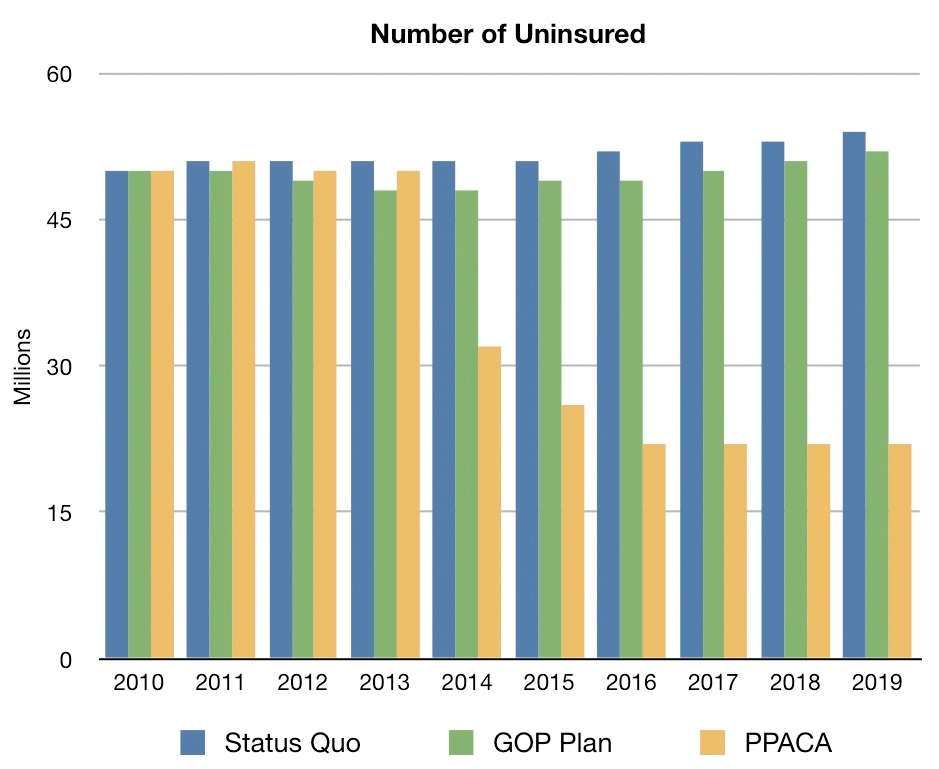
Number of Uninsured — Another reason for Health Reform

This chart is adapted from the CBO studies of health reform and the republican non- plan and was published in the Incidental Economist.

The Patient Protection and Affordable Care Act (PPACA) is Health Reform. The GOP plan is non-existent, with results about the same as doing nothing, which is exactly what it is–a new version of “let them eat cake.” Of course the GOP non-plan and the current non-system relies on “free” cake (care) provided by ER’s which really isn’t free. Guess who ultimately pays and guess why our health care costs twice as much as elsewhere–in part.


US Becoming a Low Wage Country — The Approaching Health Care Bust

BMW has recently increased employment at their Greer South Carolina plant.

Among the applicants: a former manager of a major distribution center for Target, a consultant who oversaw construction projects in four Western states and a supervisor at a plastics-recycling firm. Some held college degrees and résumés in other fields where they made more money.

But they’re all in the factory now making $15 an hour — about half of what the typical German autoworker makes.

it’s a fact that ;

the price of having a more globally competitive work force means more in America could fall well short of the middle-class living standards that manufacturing workers once could expect. Wages adjusted for inflation have declined for these workers since 2003.

Medicynical note: A salary of $15/hour approximates $30,000/year–half the average and median income in the states. Think any of these employees will be able to afford a BMer? Or even a $20,000 Chevy? High deductibles on health care?


Taxing Grandchildren to Pay Off Deficits

The deficit commission’s solution to our debt is to cut taxes, mostly for the wealthy, now and tax the benefits of our children and grandchildren.

Brave? Creative? NO