The deficit commission’s solution to our debt is to cut taxes, mostly for the wealthy, now and tax the benefits of our children and grandchildren.
Brave? Creative? NO

The deficit commission’s solution to our debt is to cut taxes, mostly for the wealthy, now and tax the benefits of our children and grandchildren.
Brave? Creative? NO
Posted in General Cynicism
It’s remarkable how shortsighted American businesses are. Their Chamber of Commerce is on record as opposing health reform. Given the cost of providing employees health insurance one would think they would be supportive of reform efforts, particularly if they removed health insurance as an employee benefit, as is the case in most industrialized countries.
Consider the bankruptcies of GM and Chrysler due in part to health insurance costs; consider also Starbucks which provides health care for employees, “a line item that tallies $300 million. That’s more than the company spends on coffee.”
Medicynical note: In other countries businesses don’t have to factor the health coverage burden into their planning, or costs. It’s another of those incomprehensible inefficiencies that is uniquely American.
Posted in Ethics, General Cynicism
More evidence that our health care institutions are failing, at health care.
Medicynical note: I’m speechless.
Posted in General Cynicism
The issue of testing advances for efficacy and value in health care is one of the sticking points for our conservative friends. They oppose such testing and feel that everyone should have infinite choices, no matter the cost or limited efficacy. And Medicare and many other insurers should simply pay and pass through the additional costs. How else to interpret their criticism of comparison testing and evaluation of efficacy in the health reform bill–and the cost savings built into it.
There is however a voice of reason somewhere. (Financial Times November 7, 2010)
But the principle is justified: a centralised body is needed systematically to assess whether a drug offers therapeutic advantages and is cost-effective. Otherwise, in a health system with finite funding, such treatments will squeeze out others offering better outcomes.
In practice, Nice should be involved in establishing value too. Its role could be extended to rule on what constitutes a fair price at the time of launch with periodic amendments as greater clinical use better demonstrates value.
Medicynical note: Of course in the U.S. we don’t have finite funding. We think it’s perfectly all right to spend twice as much as other industrialized countries per capita on health care and eat up almost 20% of GDP. Value in medicine? An archaic concept when the profits of the medical industrial complex are involved.
Posted in General Cynicism, Health Economics
A series on health care quality in the United States, here. Read the series and weep!
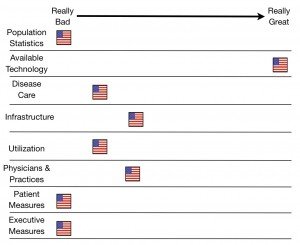
Posted in General Cynicism
It’s quite remarkable that anyone would oppose reforming our health care system. It’s not the “best in the world” by any measure but is the most expensive.
Atlanta’s large employers watched the per-employee cost of health insurance go up by 140 percent during the past decade, from $3,877 in 2001 to a projected $9,316 for 2011, AJC staffer Carrie Teegardin reports.> Atlanta Journal Constitution
The market analysis firm Standard & Poor’s released new figures on health care costs last month, and the results are disturbing, if unsurprising. The numbers show that from August 2009 to August 2010 the average, per capita cost of health care services rose 7.32 percent. During that same period, overall inflation rose a mere 1.1 percent. Press Enterprise
Meanwhile:
Purchases increased 0.2 percent, the smallest gain in the third quarter, Commerce Department figures showed today in Washington. Incomes fell 0.1 percent, the first drop since July 2009, and the Federal Reserve’s preferred measure of inflation stagnated, capping the smallest 12-month gain in nine years. Bloomberg
Medicynical Note: Its simple arithmetic and it’s been going on for many years. Incomes are not increasing at the rate of increase in health care costs. That sucking sound is health care removing discretionary expenditures from the economy.
We are in a crisis of expectations. The sick expect everything possible to be done, no matter the cost, whether or not they have insurance. Physicians and other providers expect healthy incomes–we’re number one in the world in this.
Hospitals expect continuing income to support their extravagant overhead. They compete for patients by the grandeur of their building and the beauty of their public spaces. Pricing is not competitive and obscured. Outcomes are not understandable or easily accessible.
Insurers are in a cost plus situation and pass through increases, keeping their excessive 20% margin to fuel profits and executive income.
Pharmaceutical companies and other technology suppliers to the health care industrial complex expect increasing profits each year and generation long patent protection. Pricing of advances does not reflect the benefit of an innovation but rather the desperateness of the patient.
Value? Quality? Not our department
Fasten your seatbelts. Regardless of the election outcome the system is about to crash.
Posted in General Cynicism, Health Economics
Posted in General Cynicism, Health Economics
It’s hard to believe that we spend so much and have less than optimal outcomes.
In the U.S. its all about revenue and income rather than patient outcomes.
Some recent posts:
Medicynical Note: Like many other aspects of the U.S. economy health care coverage is heading for the bottom–fewer people covered, uncontrolled costs. A system in chaos.
It’s sobering to hear politicians on the right talk about their concern about balancing the budget. After all their “starve the beast strategy” has created massive deficits (with the exception of the Clinton years) and the more recent Bush tax cuts and unfunded wars accounted for over one or two trillion in deficits over the past 10 years. Added to this are the deficits caused by the deregulation of the financial industry and it’s subsequent self-immolation.
Now these same interests wish to further cut taxes particularly for the wealthy. At the same time they claim not to want to privatize or cut social security and criticize health reform for decreasing medicare costs and oppose any defense cuts. (defense spending in their view needs to go up)
But reality is this:

From the Center on Budget and Policy Prioities:
It’s obvious that if you want to balance the budget you need to go where the money is. That means increasing government revenues (taxes and fees) and/or cuting the budget where money is spent.
It’s easy to fall into deep despair about the deficit, but Obama’s former budget director, Peter Orszag, recently grabbed the fiscal spotlight with a remarkably easy solution: Let the 2001 and 2003 tax cuts expire for everyone. By allowing taxes to return to the pre-Bush era levels for taxpayers, the federal budget would be close to balance by 2015.
Cuts in small agencies have little effect on the deficit but great effect on the necessary programs and regulations those agencies oversee. Our conservative friends stipulate that defense spending no matter how excessive or proligate is sacrosanct and should not be cut. Therefore to have meaningful budget cuts, logically, social security, medicare, social security, medicare, medicaid, CHIP, and other safety net programs are on the chopping block. This from those who criticize the health reform for more efficiently using medicare’s current funding and decreasing spending.
This leads us to a bit of irony. “Conservative” thinkers want to cut taxes on those who can afford them most and cut spending or, to put it another way, “tax” programs that provide support for people who literally can afford it least. It’s really doesn’t add up.
Posted in General Cynicism, Health Economics
The most objective measure of health care effectiveness is longevity, particularly when tracked over a period of years.
A recent Health Affairs article reviews what’ happened over the past 15 years to survival rates in our population:
Many advocates of US health reform point to the nation’s relatively low life-expectancy rankings as evidence that the health care system is performing poorly. Others say that poor US health outcomes are largely due not to health care but to high rates of smoking, obesity, traffic fatalities, and homicides. We used cross-national data on the fifteen-year survival of men and women over three decades to examine the validity of these arguments. We found that the risk profiles of Americans generally improved relative to those for citizens of many other nations, but Americans’ relative fifteen-year survival has nevertheless been declining. For example, by 2005, fifteen-year survival rates for forty-five-year-old US white women were lower than in twelve comparison countries with populations of at least seven million and per capita gross domestic product (GDP) of at least 60 percent of US per capita GDP in 1975. The findings undercut critics who might argue that the US health care system is not in need of major changes.
Medicynical note: The current dispute over health reform is actually a matter of life and death. What happens will detemine the results of the next 15 year study of outcomes. We need reform with more accessible affordable care. Health care value in our current non-system is an oxymoron.
I’ll be surprised if we don’t screw this up.
Posted in General Cynicism, Health Economics
In California CT scan data showed overdosing of patients (8 times the needed radiation) at several hospitals. Patients suffered hair loss, confusion, headaches and memory loss. The state responded by tightening the oversight of these scans.
In Alabama similar overdosing occurred in over 400 patients receiving “up to 13 times” the dose. In this state there are no state standards and no action was taken against the hospital involved.
Eight states allow technologists to perform medical imaging other than mammographies with no credentials or educational requirements.
Medicynical Note: Where would you prefer to have you CT scan? Does more need to be done? Is this a malpractice issue?
Posted in General Cynicism

