
Category Archives: Cancer medicine (Oncology)

Exemestane Prevents Breast Cancer? Maybe. Costly? Definitely

This is the week of the American Society for Clinical Oncology’s meeting so we can expect to inundated with news of medical progress, some real, some maybe real, some imagined. But all can be expected to be costly.

One of the most publicized studies is that of using exemestane (Aromasin) to prevent breast cancer in women at moderately increased risk. 4560 women were randomly assigned to a group using the drug or to placebo. The abstract from an article on the study published this week in the NEJM states:

At a median follow-up of 35 months, 11 invasive breast cancers were detected in those given exemestane and in 32 of those given placebo, with a 65% relative reduction in the annual incidence of invasive breast cancer (0.19% vs. 0.55%; hazard ratio, 0.35; 95% confidence interval [CI], 0.18 to 0.70; P=0.002). The annual incidence of invasive plus noninvasive (ductal carcinoma in situ) breast cancers was 0.35% on exemestane and 0.77% on placebo (hazard ratio, 0.47; 95% CI, 0.27 to 0.79; P=0.004). Adverse events occurred in 88% of the exemestane group and 85% of the placebo group (P=0.003), with no significant differences between the two groups in terms of skeletal fractures, cardiovascular events, other cancers, or treatment-related deaths. Minimal quality-of-life differences were observed.

The drug has fewer side-effects than other agents used to prevent breast cancer (tamoxifen and the aromatase inhibitors) but still in 3-4% of patients severe joint pain was reported.

Medicynical Note: Exemestane (Aromasin) costs about $3600/year. In this study about 2280 (half of the number randomized) patients were treated with exemestane for three years and according to the study 21 fewer cancers occurred than in the placebo group. This reduction of incidence from 32 in placebo to 11 given drug was cited in news articles as a “65% reduction in cancer occurrence.”

The cost of this preventive strategy/case prevented is $3600 (yearly cost) X 3 (number of years treated) X 2280 (number of patients treated)/ 21 (number of cases of cancer prevented) and was $1,172,571/case prevented.

In fact, relatively few cancers occurred in either group (32 and 11). The reduction of 21 cases was significant but the cost/cancer prevented is prohibitive. Given that these patients will also be followed with mammograms and physician exams (adding to the cost) it’s doubtful that this intervention will lead to a measurable survival benefit.

Cancer Care Costs

Nice article in NEJM on an approach to limiting the cost of cancer care:

The authors note that cancer care costs are rising rapidly and are unsustainable:

from $104 billion in 20061 to over $173 billion in 2020 and beyond.2 This increase has been driven by a dramatic rise in both the cost of therapy and the extent of care. In the United States, the sales of anticancer drugs are now second only to those of drugs for heart disease, and 70% of these sales come from products introduced in the past 10 years. Most new molecules are priced at $5,000 per month or more, and in many cases the cost-effectiveness ratios far exceed commonly accepted thresholds. (medicynical emphasis) This trend is not sustainable.

The authors suggest five strategies to control costs. They are basic and can be easily incorporated into oncologic practices. Whether they will be adopted or not is an open question. Read the article!!


Abiraterone (Zytiga), Provenge — New Overpriced Approaches to Prostate Cancer

It’s remarkable how insensitive to price we are in medicine, particularly when the illness is severe and likely fatal. You may say well that’s appropriate as there is no price one can place on life. The big drug companies, however, sensing this “weakness” cannot resist taking advantage.

In the case of Provenge, proven to increase median survival 4 months, the charge is $93,000. In the case of abiraterone a hormonal blocker (blocks androgen biosynthesis more completely) the cost will be in the range of $5,000/month with a median survival benefit of about 4 months.

After a median follow-up of 12.8 months, overall survival was longer in the abiraterone acetate–prednisone group than in the placebo–prednisone group (14.8 months vs. 10.9 months; hazard ratio, 0.65; 95% confidence interval, 0.54 to 0.77; P<0.001). Data were unblinded at the interim analysis, since these results exceeded the preplanned criteria for study termination. All secondary end points, including time to PSA progression (10.2 vs. 6.6 months; P<0.001), progression-free survival (5.6 months vs. 3.6 months; P<0.001), and PSA response rate (29% vs. 6%, P<0.001), favored the treatment group. Mineralocorticoid-related adverse events, including fluid retention, hypertension, and hypokalemia, were more frequently reported in the abiraterone acetate–prednisone group than in the placebo–prednisone group.

Medicynical Note: It’s wonderful that there are options for prostate cancer patients that appear to have some benefit. It’s not wonderful that the cost of these innovations exceed the yearly income of most Americans. One wonders who would be able to pay for such advances if Medicare (insurer of most patients with prostate cancer) became a voucher system that didn’t fully cover the treatment, or failed outright.

Our non-system of health care is in crisis. The Obama administration has passed a plan that will moderate Medicare costs by using care more cost-effectively and cover most of our population. Patients would always have the option of paying themselves for whatever care they desired if not covered by Medicare.

The republican counter plan does nothing for the uninsured. It appears to provide vouchers for Medicare recipients without certainty that those with illness will be able to afford either the insurance or the associated deductibles and co-pays.

In the end, I guess we’ll get what we deserve.

Meanwhile the pharmaceutical industry overcharges those with the most severe illnesses to assure their continued excessive profits. As a result, costs of drugs continue to increase at several multiples of inflation, even during the “great recession.”

Addendum: June 9: Additional results of this study presented at the ASCO meeting claims better results than in the abstract:

Overall survival in the phase 3 trial was 15.8 months in the abiraterone group and 11.2 months in the placebo group (P < .0001); median follow-up was 20.2 months, said investigator Howard I. Scher, MD, from Memorial Sloan-Kettering Cancer Center in New York City, at a press conference.

Quite modest improvement given the price.

I’m remain amazed that medicine has come to drugs costing $5000/month with very limited benefit. No wonder the “systems” are failing–our national financial system, our health care non-system, and the world’s view of intellectual property rights. Overpricing in the long run leads no where, and that appears to be where we are going.


Insurance Costs More for Cancer Patients: The Ryan Plan formalizes Economic Rationing

The Ryan plan for cutting Medicare costs will cut some costs but  undoubtedly will also cut coverage and  increase out of pocket expenses, particularly for those with serious illness.  The Journal of Clinical Oncology documents this effect in this article on insurance coverage for cancer patients. The article notes:

The risk of high burdens is significantly greater for patients with cancer compared with other chronically ill and well patients. We find that 13.4% of patients with cancer had high total burdens, in contrast to 9.7% among those with other chronic conditions and 4.4% among those without chronic conditions. Among nonelderly persons with cancer, the following were associated with higher out-of-pocket burdens: private nongroup insurance, age 55 to 64 years, non-Hispanic black, never married or widowed, one child or no children, unemployed, lower income, lower education level, living in nonmetropolitan statistical areas, and having other chronic conditions.

Medicynical note:  As people age the prevalence of illness dramatically increases.  Many of the elderly, if not most, would be denied insurance in the current private market or be offered insurance that is priced so high that it would be unaffordable and/or inadequate.  Ryan’s plan makes no accomodation for elderly patients with medical problems, throwing them into the individual market.  It will formalize economic rationing of health care and penalize most severely the elderly who have limited or no health care savings.

In doing this the U.S. would (un) distinguish itself from all other industrialized nations who provide health coverage to all citizens regardless of illness and age.

So not only do we pay more for health care than any other country in the world but also provide the least comprehensive coverage for those who need it most. 

Cancer Drug Costs: More Economic Rationing

The Wall Street Journal notes the expense of cancer drugs and the inability of people and our non-system to pay the price.

Two pieces of news out this week underline this point, and its consequences. Medco’s Drug Trend Report says that the oncology-specialty drug market, i.e. targeted therapies, could increase total cancer-drug spending by about 15% annually through 2013. That’s partially because of increased use, but mostly because the cost of the therapies themselves are rising.

And:

Some 16% of patients had an out-of-pocket cost of greater than $500. And one in four of those patients “abandoned (medicynical emphasis) the prescription and did not follow up with another oncology medication within 90 days,” the researchers write. Lower income and Medicare coverage were also associated with a higher abandonment rate.

And:

A study published jointly this week by the Journal of Oncology Practice and the American Journal of Managed Care finds that 10% of patients failed to fill new prescriptions for oral cancer drugs. The research will also be presented at ASCO.

Medicynical Note: The Journal won’t call it so, but this is evidence of more economic rationing in our non-system.

The most amazing part of this story is that these new “targeted” drugs, while advances, have only a modest effect on survival of patients…..but a tremendous effect on the bottom lines of pharmaceutical companies.

They are a tour de force of scientific progress and creative marketing. But as to patient care and improved outcomes, only a slight benefit–while bankrupting individuals and the non-system.

We need to insist that we don’t pay more for these “advances” than other countries in the world.   The power of the government in providing patent protection, for a generation, should be used to assure that drugs are priced realistically and competitively.

Drug shortages in the land of Plenty: The Free Market Speaks, Your Money or Your Life!

More on drug shortages:

Hospitals in Indiana are dealing with the worst drug shortage in at least a decade, forcing them to briefly delay cancer treatments, scramble for supplies or use other medications.

The University of Utah’s Drug Information Service has tracked drug shortages for the past 10 years. Shortages have increased steadily during the past four years and now include chemotherapy drugs, antibiotics, painkillers and electrolytes used for liquid nutrition.

In 2007, the number of shortages shot up to 129 from 70 the previous year. Last year hit a high of 211. The first quarter of this year has already seen 89 drugs in short supply.

The reasons behind the shortages are as varied as the drugs involved. Many of the drugs are generics, which are less profitable than other drugs to produce, so a company may slow or stop production.

Medicynical Note: In our non-system patient care, efficiency and value are not our department. It’s about the money.


Pancreatic Cancer Progress? or Static Flux? (Folfirinox)

Static flux is a phenomenon during which things seem to be changing but in reality are not.

Pancreatic cancer sadly has been in this state since the advent of the chemotherapy age in the 70’s. Drugs are touted with great hoopla (gemcitabine, erlotinib and others) but patients still seem to have a live expectancy of less than one year. So it was with some trepidation that I looked at news of the latest “advance” (Folfirinox a combination of 5FU, leukovorin, irinotecan and oxalplatin)

For the first time in years, doctors are making progress against pancreatic cancer, one of the deadliest of all tumors, which kills all but 6% of patients.

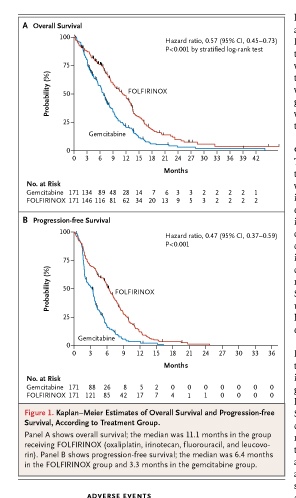
Patients taking Folfirinox, a novel combination of four drugs already approved to fight other cancers, lived 11.1 months — 4.3 months longer than those given standard chemo, according to a French study of 342 patients in today’s New England Journal of Medicine.

and:

A chemotherapy combination has been shown to provide the best survival time ever reported in metastatic pancreatic cancer, according to a study from French researchers.

But:

However, the combination of 5-fluorouracil, leucovorin, irinotecan, and oxaliplatin (FOLFIRINOX) was considerably more toxic than gemcitabine in the phase 3 trial.


Survival curves from the NEJM article.

Toxicity included serious life threatening side effects in more than 5% of patients, elevated liver function tests, loss of hair, severe diarrhea, nerve damage, fatigue, and drops in all the blood counts causing anemia, risk of bleeding and infection.

Medicynical Note: Patients with metastatic pancreatic cancer, except in very rare instances, are not “cured” of their disease. In this study the median progression free survival with treatment was 6.4 months compared with 3.3 months and overall survival 11.1 versus 6.8 months in the gemcitabine group.

Even with this new finding the unenviable choice of people with pancreatic cancer is between an earlier demise by a few months or to live a little longer but with significantly more toxicity from treatment.

While an advance this treatment does not provide an order of magnitude improvement. Hopefully the results will be confirmed.


Provenge : A (small) Tree Falling in the Woods?

Provenge a new agent that mobilizes the immune system in prostate cancer has shown small effect in improving the survival of patients, 4 months median benefit. But it’s ridiculous cost ($31,000/shot) may stimulate changes in our drug review and approval non-system.

In April 2010, the Food and Drug Administration (FDA) approved sipuleucel-T (Provenge), a novel cellular immunotherapy for the treatment of asymptomatic or minimally symptomatic, metastatic, castration-resistant (hormone-refractory) prostate cancer.1,2 The pivotal clinical trial demonstrated the benefits of sipuleucel-T: an increase in median survival of 4.1 months as compared with placebo and fewer side effects than occur with docetaxel.2 Priced at $31,000 per treatment, with a usual course of three treatments, sipuleucel-T is one of the most expensive cancer therapies ever to hit the marketplace.

Because of the high cost and limited benefit Centers for Medicare and Medicaid Services (CMS) are doing their own review of the drug. In part this is essential as FDA is not at all allowed to consider cost in its approval process. As noted FDA and CMS somewhat different missions:

The FDA approves for marketing and otherwise regulates prescription drugs and medical products. The CMS administers Medicare, a health insurance program for people 65 years of age or older and people with certain disabilities. The agencies’ distinctions are underscored by the legal criteria they use in making decisions regarding new medical products. The FDA evaluates the “safety and effectiveness” of drugs and devices, whereas the CMS covers medical products that are “reasonable and necessary” for the diagnosis or treatment of illness.

Read the article for a more complete review of the agencies differences. Suffice it to say CMS gets to look into the reasonableness of use of the drug as well as the cost impact.

Medicynical Note: We now have drugs costing twice the median and average income in the US that are not curative and offer only limited survival benefit.

Are such unaffordable drugs analogous to the sound made by trees falling in the woods?


Novo TFF for Glioblastoma, better than nothing?

A New device for glioblastoma, reports survival as good (sic) as chemotherapy in relapsed brain tumor patients, without side effects.

The FDA approved the device for patients with aggressive brain tumors that have returned after treatment with chemotherapy and other interventions. Patients with recurring brain cancer usually live only a few months.

Studies showed that people using the device lived about as long as those taking chemotherapy, roughly six months. However, patients using the device had significantly fewer side effects.

And also noted:

A 237-patient study failed to show a survival benefit for patients using the device, compared with those taking chemotherapy. Patients in both groups lived just over six months, on average.

Medicynical Note:  The efficacy of Novo TFF is  minimal.  The study reports a survival of just 6 months after evidence of recurrence in patients treated with radiation and chemotherapy.  The results speak more to the ineffectiveness of  chemotherapy after relapse, than to the effectiveness of Novo TFF. 

It remains to be seen whether Novo TFF (or salvage chemotherapy) is better than supportive care (Hospice) in this situation.  It certainly will be more expensive.

Health Care– What’s Missing?

The current crisis in health care is more than an argument about universal coverage versus “free market” medicine or costs.

Case example (this is  patient currently trying to get appropriate care):

Noting a chronic cough the patient was referred to an ER and had a CT scan which showed a fist sized anterior mediastinal mass.  Within three days she had a needle biopsy.

The first result of the biopsy came 5 days later and was inconclusive.  The specimen was referred to a university center and five days later (almost two weeks after the CT) the patient was informed that the biopsy was inadequate to make a diagnosis.

Her family doctor referred her to an oncologist and made arrangements for a surgical consultation both another 10 days later–into the fourth week since diagnosis.

On seeing the oncologist she was admitted to the hospital ostensibly to be seen by a surgeon and to have a PET scan.  The surgeon never visited the patient and the PET scan could not be authorized without a diagnosis.

The patient is now 4 weeks post CT scan and still has no diagnosis or treatment plan.

Medicynical Note: The patient has been seen by an ER doctor, primary care physician, radiologist for biopsy, pathologist (indirectly), oncologist 1( in the office), oncologist 2 at the hospital.  In the rush of their respective businesses, it appears that no one except the ER doc has taken seriously the patient’s problem and the need for  expedited evaluation, and treatment.

In our non-system we have given little attention to improving health care delivery and providing better value.  In the case cited everyone’s priorities seem to have taken precedence over the patient’s.  No one to this date has acted as if this were a serious life threatening illness.  The patient has accrued thousands of dollars in costs and yet has no diagnosis or treatment plan.

As the Harvard Public Health Review has noted:

Across the United States, trust in institutions that guard the public’s health and provide care has fallen to an all-time low. Patients mistrust insurers and pharmaceutical companies, and lack complete confidence in their doctors; physicians, in turn, are skeptical of clinic and hospital leaders.

The article also notes:

Since then, Shore notes, service has declined while premiums have risen. News headlines have fueled public suspicion by spotlighting both tragic medical errors (Boston Globe reporter succumbs to cancer chemotherapy overdose) and fraudulent practices (a hospital scam to bilk Medicare of $2.6 million). Meanwhile, government has been unable to resolve two problems Americans consider urgent: rising health care costs and the growing ranks of the uninsured.

Part of the problem is that in our non-system  financial incentives are aligned to encourage utilization of services with little consideration of organization, order, efficiency or value.

A New England Journal article on biomedical research sums up the situation:

Since the mid-1990s, the United States has invested approximately 4.5% of its total health expenditures on biomedical research. In contrast, only 0.1% supports research in health services, comparative effectiveness, new care models, best practices, and quality, outcome, or service innovations. This funding will increase to approximately 0.3% from appropriations in 2010 health legislation.

We need to not only develop new technology but must improve our delivery system.  Wasted resources jeopardize our financial well being.  Wasted time to diagnosis and treatment jeopardize patient’s lives.  Our system, such as it is, too often wastes both.