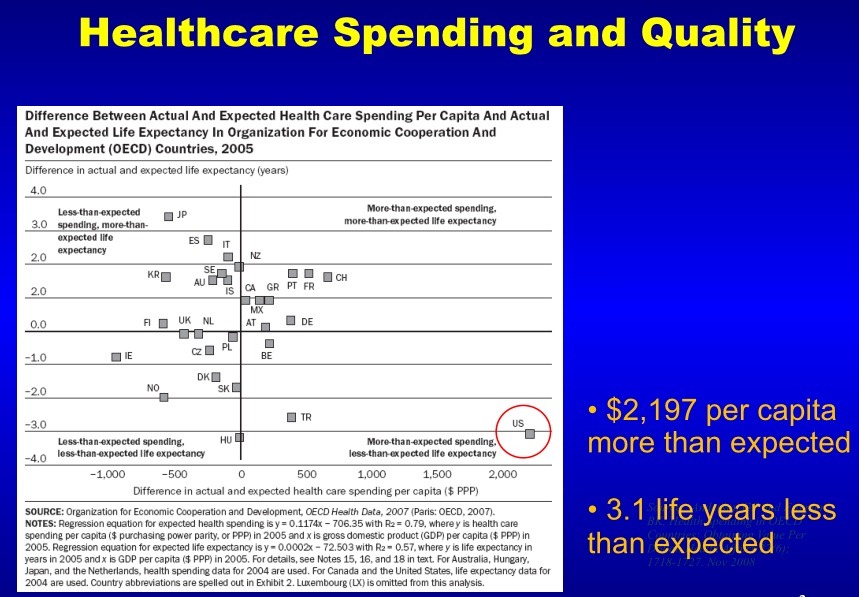
Doubleclick to enlarge
From: Schmid, Tufts University Evidence Based Medicine Lecture: http://andrewgelman.com/wp-content/uploads/2011/12/SchmidJSM2011.pdf
Medicynical Note: Something’s wrong here.

Doubleclick to enlarge
From: Schmid, Tufts University Evidence Based Medicine Lecture: http://andrewgelman.com/wp-content/uploads/2011/12/SchmidJSM2011.pdf
Medicynical Note: Something’s wrong here.
Posted in General Cynicism, Health Economics
It is a fact that there is nothing systematic or comprehensive about health care in America. It’s become an olio of exceptional money making opportunities with little concern about quality, access, outcomes or cost.
Our new and innovative ways of funding health care for the 50 plus million citizens without insurance coverage are unique in the world and include bankruptcy, asking for charitable contributions, traveling overseas, and now Groupon!
So when a deal popped up on daily deals site Groupon for a teeth cleaning, exam and an X-ray at a nearby dentist, Stella, 55, bought the deal — which the company calls a “Groupon” — for himself and another for his daughter. He paid $39 for each, $151 below what the dentist normally charges.
And
Visitors to these sites are finding a growing number of markdowns on health care services such as teeth cleanings, eye exams, chiropractic care and even medical checkups. They’re also offering deals on elective procedures not commonly covered by health insurers, such as wrinkle-reducing Botox injections and vision-correcting Lasik eye surgery. About one out of every 11 deals offered online is for a health care service, according to data compiled by DealRadar.com, a site that gathers and lists 20,000 deals a day from different websites.
Medicynical Note: By spending more on health care than anywhere else in the world and having mediocre outcomes we’ve become a shining beacon for inefficiency, waste, and mismanagement in health. We are indeed the world leader.
Health reform, yes the plan that the President sponsored, offers a way out. But with dogged determination there are “popular” political forces that aim to maintain our world dominance. Quite amazing.
Posted in General Cynicism
It’s remarkable how drug companies spin the limited proven benefits of their new drugs. This in the LA Times:
Avastin can stabilize tumors in ovarian cancer, studies find
Two independent groups working with advanced-stage cases say the drug extended the period before the disease worsened by more than 3.5 months.
At this point there is little data indicating that people with ovarian cancer treated with Avastin (bevacizumab) live longer.
Medicynical Note: In the past the end points for a cancer treatment advance was actual proof of shrinkage of tumor masses and a significant survival benefit. In recent years companies have tried to sell “delay in progression” as proof of benefit. Often as not however, this “delay”, when found, is not repeatable on follow-up trials and/or there was no observed survival benefit. That was the case when the FDA deauthorized this same drug’s use in breast cancer because the short delay in progression was not replicated and did not increase breast cancer patients’ length of life.
The problems with Avastin are it’s outrageous price, in the range of $100,000/year and the apparent fact that it is only marginally effective. This type drug is marketed to desperate patients with life threatening illness and priced way out of proportion to it’s benefit, or even development costs. It is a fact that most of the early development costs came not from drug companies but rather from taxpayers in the form of research grants.
At a cost to consumers and insurers of nearly $100,000/year, more than practically any other consumer purchase, and just a few months delay in progression–Would you buy a $100,000 car that lasted 3.5 months?–it’s hard to be enthusiastic .
More evidence that children need supervision in the sandbox. Despite yeoman’s work by Heritage Foundation and the republican party to obfuscate the causes of the financial meltdown—and blame government. It’s emerging that companies without supervision, when money is involved, do foolish sometimes cynical things. Take this for example:
Nearly four years ago, we first reported on allegations that Countrywide Financial, the failed lender that was bought by Bank of America after it collapsed, had their system set up so that non-white loan applicants were steered toward subprime loans, even if they could have qualified for a standard mortgage. Well, the wheels of justice turn remarkably slowly in Washington, DC, but today the Justice Dept. finally announced a settlement with BofA for $335 million over these allegations.
Medicynical Note: The problem was not regulation but rather greed. And as we’ve noted previously similar issues abound in the medical sphere. Consider the escalating prices of drugs for people with serious life threatening illnesses; salaries of health related companies executives; the costs of our health care non-system (the highest per capita in the world).
Sadly, unfettered capitalism opens the door to an empty room.
Posted in Uncategorized
Patients with Multiple sclerosis face a number of potential complications from the drug Tysabri including progressive multifocal leukoencephalopathy (PML) a potentially fatal brain problem. Patients trying to decide whether or not take this drug apparently are deviled by the question of their doctor’s conflict of interest. As this patient found out her physician who presumably had her best interest at heart, was also taking funding from the manufacturer of the very expensive medication that he recommended, Tysabri.
Where I live, a state law mandates that payments any doctor receives from a drug company be reported to the Minnesota Board of Pharmacy, which enters it int a public database.
When I looked up my neurologist, what I found was damning. He had received more than $300,000 from drug companies between 2006 and 2008. (The 2009 data weren’t yet available.) Major contributors to this sum were Biogen, the manufacturer of Tysabri and the sponsor of the clinical trial my neurologist suggested to me early on, and Teva Pharmaceuticals, the manufacturer of Copaxone. In addition to many payments for acting as a speaker from these companies, my neurologist also had been compensated for “promotional/marketing consulting services.”
Medicynical Note: $100,000 here, $100,000 there, soon we’ll be talking real money. It’s difficult for me to believe that this money didn’t in some way influence the doctor to recommend the medication and influence that patient to participate in a trial of the medication. Often in such trials, the more patients recruited the higher the payments.
Posted in Ethics, General Cynicism
Since 2000 there has been a warning about Poly Implant Prosthese (PIP) breast implants. The FDA refused to approve their use in the U.S. because of concerns that they might rupture. Meanwhile, until recently these fragile bags of silicone have been implanted in thousands of women in Europe, and elsewhere. They were cheaper than other brands.
The recall was expanded to PIP implants exported to Italy, Australia, and Great Britain. It is initially estimated 35,000 to 45,000 women worldwide are affected, but the British Association of Aesthetic Plastic Surgeons estimated 50,000 British women have the implants.
AFSSAPS, the health regulatory agency of France, discovered an unauthorized type of silicone gel being used in the pre-filled implants. Following the recall, the French court ordered the company to shut down entirely for the manufacturing of fraudulent implants.
Medicynical Note: We have a “movement” in the U.S. that believes less regulation will lead to a thriving economy. This despite evidence, from the thalidomide problem in medicine and the S and L fiasco in the 80’s, the Enron disaster, and most recently the world wide banking crisis, that less regulation can lead to abuses and disaster.
In the case cited today, the FDA saved tens of thousands of U.S. citizens from the problems of a substandard breast implant device. In medicine as in other fields where profit overrules reason, regulation is essential.
Posted in General Cynicism, Health Economics
I can recall fading enterprises cannibalizing themselves as they failed. In those cases, Pan Am, US Steel and such, assets were sold off, employees devalued and finally the business went into bankruptcy or was simply sold off.
It appears that we, the US, are in the midst of an orchestrated national devaluation–a downward spiral resulting in decreasing opportunity and increasing poverty. Economically, we’ve gone where we’ve never been. It’s peculiar because some segments of our population have never had it so good, while others have, in our lifetime, never had it so bad. Citing long dead economists as authority to justify the current situation is simply wrong minded–they never could anticipate the world we live in. We are in uncharted economic territory.
Like a failed corporation we have yet to realize that our operating assumptions are misguided. Perhaps Perot was right about the sucking sound from globalization? Maybe we needed to better finance our social programs? Going to war without good reason and without immediate pain (taxes to pay for it) seems dumb in retrospect. Deregulation of companies whose highest goal is to monopolize markets hasn’t worked. Remember the S and L fiasco, Enron, and most recently the banking derivative frauds. Maybe unfettering capitalists isn’t such a good idea?
Think banks learned anything from their downfall in 2007-2008? Check out last week’s MF Global collapse. Think Corzine is the only one now playing with highly leveraged debt? Think again.
Some believe there is a tension between democracy which by its nature supports equal rights and capitalism who ultimate goal is market domination and monopoly. These issues appear unresolved and still evolving.
Why has capitalism succeeded while democracy has steadily weakened? Democracy has become enfeebled largely because companies, in intensifying competition for global consumers and investors, have invested ever greater sums in lobbying, public relations, and even bribes and kickbacks, seeking laws that give them a competitive advantage over their rivals. The result is an arms race for political influence that is drowning out the voices of average citizens
Consider the move to hiring contract employees. Cheaper, probably not–given the hiring contractor’s slice of the money and their need for profit. For the worker, lower salaries and no benefits.
Ginny Townsend, 41, took a job in January as a nursing assistant in the state-run home for veterans here. Technically, she works for a private company that supplies some employees to the veterans home under a state contract. She makes $10 an hour, about half the wage of the public employees working at the facility.
We can argue whether the lower salaried employees offer the same quality services as the previous government direct hires and probably find examples both ways. What we can’t argue about is the impact of such low salaries on the ability of these employees to support themselves and families. On $10/hour they can’t. At $10/hour they will be unable to afford to save for retirement and provide their family’s health care–yes, our republican friends think that high deductible health savings accounts are the answer, but the question is for whom?
The greatest irony of this move is that it probably doesn’t save money!
Economists and other academics who study outsourcing are divided about whether it usually saves a government money. Recent data from Arizona shows that privately operated prisons often cost more to operate than state-run facilities. A study by the Project on Government Oversight, a nonprofit Washington group, found that in 33 of 35 occupations, using contractors cost the federal government billions of dollars more than using government employees.
Medicynical Note: The privatization movement removes income from those who need it most. The policy adds to the cost of the social safety net–consider WALMART’S contract employees who no longer have health care coverage going to emergency rooms for “free care” and needing MEDICAID for health services. Consider how much these minimum wage employees will be able save for retirement? Contracting doesn’t pass the smell test in that it does not result in a net savings and removes money from the economy.
It is but one part of our race to the bottom.
Posted in General Cynicism
How much is a 2 month progression delay, with no survival benefit, worth?
Another study of bevacizumab (Avastin) in Metastatic Breast Cancer :
Median PFS increased from 5.1 to 7.2 months (stratified hazard ratio for PFS (Progression Free Survival), 0.78; 95% CI, 0.64 to 0.93; P .0072). The 10% improvement in ORR (Objective Response Rate) between the placebo- and bevacizumab-containing arms (39.5% v 29.6%; P: .0193), although not statistically significant, was consistent with previous trials. There was no statistically significant difference in overall survival.
As noted in the discussion the improvement in ORR is not statistically significant and there is no improvement in survival. This, in a drug, with costs in the $5000- $10,000/month range.
Medicynical Note: The FDA has removed the breast cancer indication for this drug because of lack of objective efficacy. This study confirms their decision.
Medicare, however, as I understand it, continues to pay for it. The big question is why we should have public funds, or pooled insurance money, used to pay for an exceptionally expensive drug that has no survival benefit? In the end we all pay.
It’s no wonder that health care is bankrupting individuals and our non-system of health care.
From the NEJM Oct 26, 2011 a review of the idiosyncracies of PSA testing. Most importantly:
Using data from the European screening trial, researchers have estimated that $5.2 million would have to be spent on screening (and the interventions that follow it) to prevent one death from prostate cancer. (Medicynical emphasis) That estimate does not appear to include the costs of excessive serial PSA testing and repeated office-based encounters devoted to discussions about screening or interpretation of fluctuating PSA results. The extraordinary time, effort, and costs associated with the PSA-screening enterprise must be evaluated against other claims on health care spending and physicians’ time and energy. We believe that the current PSA-based screening paradigm does not compare favorably with competing health care priorities.
Adding to the critical view of screening was the recent NY Times magazine review Can Cancer Ever Be Ignored? The article notes:
Patients and their doctors are now faced with radically polarized views about the logic of routine testing. On one side are physicians like Mohler, who argue that the test can reduce a man’s chances of dying of prostate cancer, plain and simple. This side of the debate is passionate, backed by the persuasive conviction of men who have survived prostate cancer and well financed by the multibillion-dollar industry that has grown up around the testing and treatment of the disease.
The other camp makes a less emotionally satisfying argument: on balance, scientific studies do not support the claim that screening healthy men saves lives. Screening, Brawley and others argue, can lead healthy men into a cascade of further testing and treatments that end up injuring or even killing them. As Richard Ablin, who discovered a prostate-specific antigen, put it in an Op-Ed in The New York Times, using the P.S.A. test to screen for cancer has been “a public health disaster.”
What appears to be proven by two large studies of PSA published in 2009 is that there is no difference in deaths in groups of patients receiving PSA and those not receiving it. It appears that while there is reduced mortality from prostate cancer, there is increased mortality from other causes possible from the complications of the diagnostic procedures.
An analysis of six studies of screening involving nearly 400,000 men, published last year in the British medical journal BMJ, found no significant difference in overall mortality when screened men were compared with controls. Philipp Dahm, a professor of urology at the University of Florida College of Medicine and lead investigator for the analysis, says the study shows that P.S.A. screening “does not have a clinically important impact” on overall mortality.
There have been similar concerns raised about breast cancer screening:
A new analysis of mammography concluded that while mammograms find cancer in 138,000 women each year, as many as 120,000 to 134,000 of those women either have cancers that are already lethal or have cancers that grow so slowly they do not need to be treated.
The problem is that the benefit is tiny and expensive. A recent cost–benefit analysis showed that adherence to the current guidelines from the American Cancer Society costs more than $680,000 per quality-adjusted life-year (QALY) gained, as compared with a proposed alternative costing only $35,000 per QALY. Statistician Donald Berry has calculated that for a woman in her 40s, a decade’s worth of mammograms would increase her lifespan by an average of 5 days — and this survival advantage would be lost if she rode a bicycle for 15 hours without a helmet (or 50 hours with a helmet).5 The key issue here, however, is that these figures represent population averages. For the small number of women whose lives are saved, the difference is literally as large as that between life and death.
It should be also noted that much of widely publicized improved outcomes of cancer treatment today can be attributed to earlier diagnosis of the disease (lead time bias); and from finding lesions that would not grow and spread not treatment.
In the end more judicious use of screening and finding ways to cut the cost of same would improve the value of such testing without adversely affecting outcomes.
For example: one solution is to cut the price of the test from its current $70 to $$400 (including phlebotomy costs) to a more reasonable amount ($10-20). Economies of scale and efficiency would increase the value (in a cost-effectiveness sense) for this test. Charging anywhere from $25 to $150 for phlebotomy, as is the current practice, seems excessive as well.
In breast cancer screening one approach would be to delay routine screening from 40 to 50 years of age. Which as noted by Susan Love:
“I really don’t think we should be routinely screening women under 50. There’s no data showing it works.”
Medicynical Note: We live in a country that is on the road to bankruptcy caused in great part by profligate health care costs. Controlling these costs is not optional but also is not widely discussed in our bizarre political atmosphere. In the stunted political debate conservatives roar that patients should be able to choose what they want (NO RATIONING, NO DEATH PANELS) but cogently leaves vague who pays when patients choose. Reading between the lines they oppose public funding of medical care, including Medicare and Medicaid. Their solution however, is tantamount to medical rationing by economic status.
On the other side is the notion that all U.S. citizens should have access to a defined level of care. And those who want more can buy additional services (testing and procedures) as they wish.
Posted in General Cynicism