Entering La La Land— Cancer Drug Costs Abirateron (Zytiga) vs Sipuleucel-T (Dendreon)

The recent approval of abirateron by the FDA for use in metastatic prostate cancer highlights the otherworldly practice of cancer drug pricing. 

Sipuleucel-T purported to be an immune stimulator in early trials was reported last year to improve survival of patients with metastatic prostate cancer about 4 months  (median) when compared with placebo.  Similarly the recently approved abirateron shows a 2 months delay in progression, 3.9 months improvement of median survival.

Sipuleucel-T (Dendreon) you will recall is priced at $97,000 for a course of therapy.  The new drug abirateron is a relative “bargain” at $5,000/month.

The industry’s view is that this is a “fair” price.  Meaning it is competitive and will earn the company money:

The pharmacy strategy blog notes:

  This gives a treatment price of ~ $40K, which I think is very fair, although some patients will obviously take it for longer than that.

In U.K. however NICE (National Institute for Health and Clinical Excellence) notes:

In draft guidance the watchdog said that Zytiga could increase survival by more than three months compared to placebo, but its annual cost of £35,160 was too much for the NHS in England.

Janssen has offered a patient access scheme for the drug that would discount its list price, but NICE said even with this in place, the drug was still not cost effective.

NICE suggests that conventional chemotherapy offers a more cost effective approach.

Medicynical Note:  Welcome to the alternative universe of drug pricing in the U.S.  This is the only situation where a consumer purchases a product costing many many thousands of dollars that has utility (effectiveness) of 4 months or less.  It’s like buying a Mercedes or Porsche that will last 4 months—rational people in rational situations wouldn’t buy such a product. 

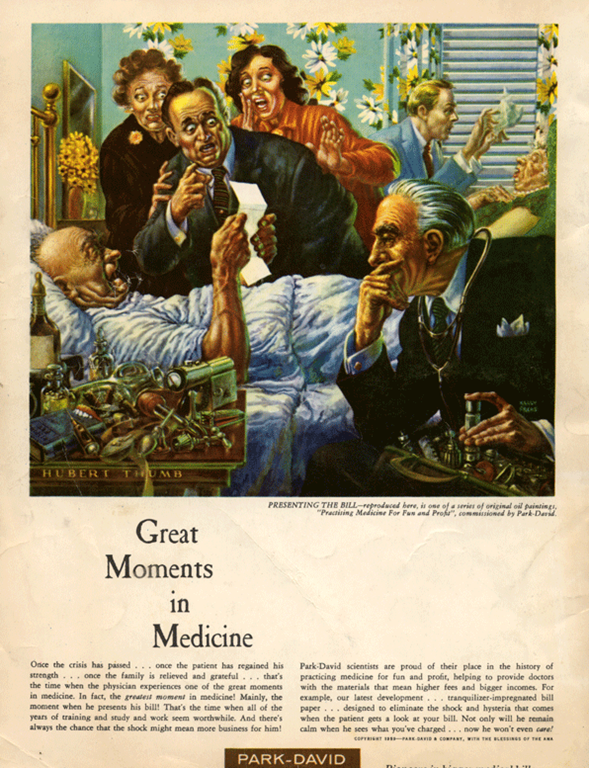
Cancer patients however are desperate.  Drug companies price these drugs to take advantage.  Patient care?  Cost efficiency? Morality?  Not their department. 

I do look forward to further studies of these new agents and hope that the results are confirmed.  However, I would warn readers that the track record of drug sponsored first studies is that they often exaggerate benefits and minimize toxicity. 

Electronic Medical Records: Increases Utilization and Costs?

Nothing new with this revelation.  It has been previously postulated. 

Computerized patient records are unlikely to cut health care costs and may actually encourage doctors to order expensive tests more often, a study published on Monday concludes.

Medicynical Note:  The cost of implementing a nationwide record system is considerable.  Having such a system, however, will facilitate easier and more comprehensive analysis of health care and if we allow such use,  perhaps some cost savings by directing care to the most effective economical modalities.  That however is a big if. 

Statins, Diabetes and Unintended Consequences

Drug companies for the past 20 years have been pushing the use of statins (for example simvastin, rosuvastatin, atorvastatin)  as cures for whatever problem you may have.  They have supported studies that show a very slight improvement in everything from incidence of heart attacks, to deaths due to infectious disease to intellect.  Except maybe in people with previous heart attacks, none  are convincing, the improvements are small and the costs high. 

Now there is data indicating the more potent statins have a very significant risk of diabetes.  The higher the dose, the higher the risk. 

What we do know is that diabetes showed up. The numbers increase to one in 167 for patients taking 20 milligrams of Crestor, and up to one in 125 for intensive statin treatments involving drug strategies to markedly lower cholesterol levels.

and

More than 20 million Americans take statins. That would equate to 100,000 new statin-induced diabetics. Not a good thing for the public health and certainly not good for the individual affected with a new serious chronic illness.

And most telling for those taking this drug the margin of benefit is very narrow.  Read the op-ed!  More on the subject here and here.

Medicynical Note:  Yet the same companies who flogged these drugs as wonderful agents for whatever ails you have no public  plans to look further into the newly identified issues.  Not surprising if you understand the motivating force of the pharmaceutical industry (money) and their reluctance to do anything that might cut sales.

Truth?  Science?  Health care?  Not their department.

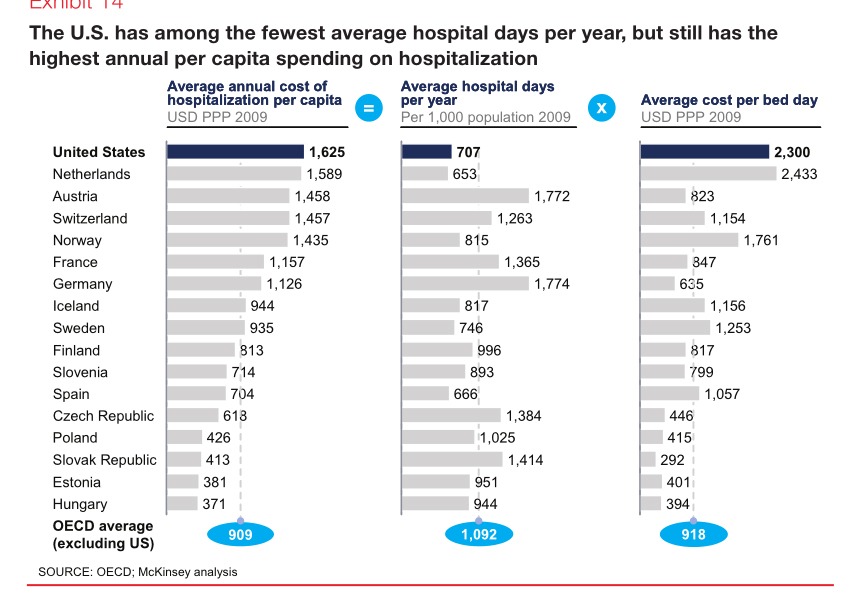
We’re Number 1: We lead the World…..in Costs

This is self explanatory.  We have the most expensive, most inefficient non-system of care in the world.

Costs

Pricing Health Care in the U.S.–Our Failure

Good review of the failure of cost containment in our non-system of health care with suggestions for fixes. 

In case you haven’t noticed there are problems with our “free market” pricing:  (from his paper in Health Affairs)

1. On average, the prices for health care goods and services negotiated by private health insurers in the United States tend to higherabout double or more (medicynical emphasis)— than prices for identical services and goods in other countries of the Organization of Economic Cooperation and Development.

2. It is in good part so because insurers do not seem to have sufficient market power, especially vis à vis hospitals, to resist very rapid price increases.

3. The varying degrees of market power among private insurers in the United States have led to pervasive price discrimination among payers, with prices for identical goods or services varying among payers by factors as high as 10

Reinhardt concludes:

I am persuaded, however, that the opaque, price-discriminatory and administratively unwieldy – and hence very expensive – payment system of individual negotiations over fees has not served Americans well during in the last few decades.

Medicynical Note:  Yet some still maintain our non-system is the “best in the world.”  The question is for whom?

American Exceptionalism: Guns

This only happens in America.

Health Care Costs Grew at Twice the Inflation Rate–2011

Health Care costs increasing at twice the rate of inflation:

The average per capita cost of healthcare services covered by Medicare programs and commercial insurance grew by 5.28 % in 2011, nearly double the rate of inflation in the larger economy, Standard & Poor’s Healthcare Economic Indices show.
A further breakdown of S&P data shows that healthcare costs covered by commercial insurance plans grew by 7.11% in 2011, while Medicare claim costs rose by 2.51%, despite the government plans’ older and sicker population.

And:

Robert Zirkelbach, a spokesman for America’s Health Insurance Plans, told HealthLeaders Media that commercial plans must contend with cost-shifting and other market forces that do not affect Medicare. He says the cost growth acceleration also could be link to the recovering economy.

Medicynical Note:  What’s not noted by Mr. Zirkelbach is that Medicare’s population is sicker, older and has greater need for care than the commercial plan population.  Think he wants responsibility for this high risk group? Think private insurers will provide adequate coverage at reasonable cost to an elderly population with pre-existing illness?  Think again.

Our non-system is not driven by concerns about care; not driven by worries about outcomes; not driven by the needs of patients.  Rather it is the mandatory profit goals of providers, insurers and technology developers that drive our costs. 

FYI last year the poor suffering private insurers had record profits.  Guess who paid?

Emergency Care Access for Indigent?—Limited in the U.S.

Kaiser Health News notes:

Last year, about 80,000 emergency-room patients at hospitals owned by HCA, the nation’s largest for-profit hospital chain, left without treatment after being told they would have to first pay $150 because they did not have a true emergency.

Sound’s reasonable? 

Physicians worry that sick people will forgo treatment. There is no data on how many who leave the ER without treatment follow up with visits to doctors’ offices or clinics.

“This is a real problem,” said Dr. David Seaberg, president of the American College of Emergency Physicians, who estimated that 2 to 7 percent of patients screened in ERs and found not to have serious problems are admitted to hospitals within 24 hours. (Medicynical emphasis)

“After you’ve done the medical screening, it makes little sense to not go ahead and write a patient a prescription,” said Dr. Michael Zappa, a Boca Raton, Fla., hospital consultant and former president of the Florida College of Emergency Physicians.

Medicynical Note:  ER care is not a solution to the severe health care access problem for the indigent and those lacking insurance.  ER care is the most expensive and most inefficient care in the world.  However, at present, most locations in our country do not have alternative more efficient facilities available.   And when people with medical problems, seemingly “non emergent” are turned away we create an incubator for the development of serious problems.  This is hardly an enlightened or reasonable health care system.

What distinguishes the U.S. health care from that provided in other industrialized countries is that ours is not provided in a systematic organized fashion.  As we’ve noted it is a non-system of care, that is slowly but surely bankrupting us individually and collectively.

Our conservative friends may be in denial but health care reform approaches this ethical medical issue by assuring coverage to almost all of us.

Death from Vascular Endothelial Growth TKI Inhibitors — pazopanib, sunitinib, and sorafenib

A recently published study on pazopanib, sunitinib, and sorafenib reported an increase in “fatal adverse events”, death.

In all, 4,679 patients from 10 randomized controlled trials (RCTs) were included, with 2,856 from sorafenib, 1,388 from sunitinib, and 435 from pazopanib trials. The incidence of FAEs related to VEGFR TKIs (Tyrosine Kinase Inhibitors) was 1.5% (95% CI, 0.8% to 2.4%) with an RR of 2.23 (95% CI, 1.12 to 4.44; P ? .023)
compared with control patients. On subgroup analysis, no difference in the rate of FAEs was found between different VEGFR TKIs or tumor types. No evidence of publication bias was observed.

The risk of dying while on these drugs was over twice that of those treated with a placebo. 

Medicynic:  These are marginally active drugs, improving outcomes by a few months.  Whatever benefit they have is partially compromised by these excess deaths.

Avastin (bevacizumab) works on vascular endothelial growth factor in a different way.  But it too has toxicity and may also have a small excess mortality.

Sobering study. No treatment, even expensive targeted treatments with “fewer side-effects,”  are without problems.

Semulaparin: Effective Maybe, Cost Effective?

It’s difficult to assess the cost effectiveness of a new intervention when price data is unavailable.  That’s the case with semulaparin, a new anticoagulant that is not FDA approved.

The NEJM this week reports that using semulaparin decreases the incidence of blood clots in cancer patients.

Venous thromboembolism occurred in 20 of 1608 patients (1.2%) receiving semuloparin, as compared with 55 of 1604 (3.4%) receiving placebo (hazard ratio, 0.36; 95% confidence interval [CI], 0.21 to 0.60; P<0.001), with consistent efficacy among subgroups defined according to the origin and stage of cancer and the baseline risk of venous thromboembolism.

There was a slight increase in bleeding complications in the semulaparin group 2.8% vs 2% in the placebo group.

The authors conclude that the drug reduces the incidence of thromboembolism in patient on chemotherapy.

Sanofi’s press release touted the results as well:

Sanofi (EURONEXT: SAN and NYSE: SNY) announced today results of the pivotal SAVE-ONCO study which demonstrated that, in cancer patients initiating a chemotherapy regimen, investigational semuloparin significantly  reduced the risk of the composite of symptomatic-deep vein thromboembolism (DVT), non-fatal pulmonary embolism (PE) or venous thromboembolism (VTE)-related death by 64%[]i], meeting the study primary endpoint (respectively 1.2% and 3.4% for semuloparin and placebo HR 0.36 95% CI (0.21-0.60)), p< 0.0001).

Medicynical Note:  The daily costs of the currently available low molecular weight heparins are between $35 and $80 dollars/day.  Assuming self-injection and negligible cost for other materials. 

The mean duration of the treatment regimens in the NEJM study was 3.5 months (approximately 100 days).  $35/day for 100 days and 80/day for 100 days gives a treatment cost for patient of between $3500 and $8000/patient.

1608 patients were treated in the study.  Using this number and the estimated cost/day, providing a low weight molecular heparin to these patients would be between $5,628,000 million dollars if the drug costs $35/day and $12,864,000 at $80/day.

The benefit noted in the article was a difference of 35 occurrences of venous thrombo-embolism between the placebo and treated group.  This gives a cost range of between $160,000 and $367,542 per thrombo-embolus prevented.

Cost effective?  Probably not.