
Category Archives: Uncategorized

Patent Reform–A Necessity For Health Care Reform

Drug companies claim the U.S. patent system encourages development of new drugs and that the high prices are a necessary corollary. (see this) Others have questions regarding the monopolistic practices legalized by the system. This FDA Backgrounder, and this chapter from Against Intellectual Monopoly by Michele Boldrin and David K. Levine offer more background information.

Wikipedia defines a patent as a “set of exclusive rights granted by astate to a person for a fixed period of time in exchange for the regulated, public disclosure of certain details of a device, method, process or composition of matter (substance) (known as an invention) which is new, inventive, and useful or industrially applicable.” The right to produce the product protected by the patent is subject to further regulation by various regulators.

The regulator of drug patents in the United States is the FDA. Over the years the rules governing drug patents have evolved. Some milestones include:

1938 Federal Food, Drug, and Cosmetic Act : For the first time it was required that a drug be shown safe.

1962 Kefauver-Harris Drug amendment: Required that the drug be proved effective before marketing.

1980 Dole-Bayh– Prior to this products developed under federal grants were in the public sphere. To encourage commercial development of these advances individuals and institutions were allowed to patent these developments and even license or sell the patent to private companies.

Products developed to a major extent with public funds, such as imatinib (Gleevac) and bevacizumab (Avastin), are taken private and the public then gets to pay whatever the drug company or developer wishes for the technology. The result of Dole-Bayh has been medical progress at a tremendous cost. Basic research has suffered as workers are continually looking for something to take private-akin to hitting the lottery. We’re talking tens to hundreds of millions of dollars in fees to the individuals and the sponsoring university of such research. This has literally changed the landscape of medical research and not all for the better. See this article for the rationale and the unintended consequences.

In part because of Dole-Bayh, prescription prices in the past 25 years have increased astronomically. The price of newly patented oncology medications has increased to 50-100 times the level of the seventies, 15-20 times that of the 80’s. Between 1990 and 2001 the average price of all types of prescriptions tripled. Not surprisingly drug profits, after paying all costs of development including research and drug promotion, are at the unprecedented level of 18-20 % of revenue. Some think Dole-Bayh as currently applied is a giveaway to the industry. They further maintain that the law has provisions calling for reasonable pricing of government financed inventions. It’s never been enforced.

1984 Hatch-Waxman act–extended the length of patents up to 5 years (normal patent length is 20 years) to make up for the time the drug took to be approved by the FDA. It also provides for accelerated approval of generic drugs by not requiring generic companies to repeat the original research that proved them safe and effective.

Drugs that are clearly effective and safe are FDA approved and marketed promptly and do not qualify for additional patent time sanctioned by Hatch-Waxman. On the other hand many of the drugs needing additional time for approval and wanting patent extensions have marginal efficacy and/or questions regarding toxicity. That’s what delayed their approval. Ironically, the terms of Hatch-Waxman will extend patents most for drugs that may deserve it least.

The law is gamed by patent holders through legal loop holes and payments to generic manufacturers that actually delay the marketing of competing generics. It’s been a boon to lawyers. A company with a patented drug for example has been able to delay a generic by 30 months simply by raising an objection to marketing it-this was done multiple times in some instances. In addition it allowed hundreds of millions of dollars in payments between the patent holder and generic companies to delay the release of generics. There has been some attempt to control this. The Greater Access to Affordable Pharmaceuticals law passed the Senate in 2002 and was reconsidered in 2003. The FDA revised the rules of Hatch Waxman to address this issue, but the affect of these changes remains unclear. This article from the July 1 2006 Times and this from the Washington Post indicate that the pharmaceutical industry continues to game the system.

Among the criticisms of patents is the notion that patents create monopolies which almost always result in inefficiencies, stifle competition (by definition), cause higher prices, lower quality and shortages.

It’s clear that our system of care has problems with inefficiency and pricing from the patent monopoly. We have the most costly health care system in the world but have mediocre results. Prices of pharmaceuticals have reached unprecedented levels. Medicynic has previously noted pricing of new cancer drugs/year exceeds the median and average incomes in the U.S. and more. The issues of lower quality and shortages apply because of aggressive marketing of mediocre patented drugs and because people lack access because of price–a pernicious form of health care rationing.

Discomfort and Change in Health Care

The health care debate continues, the strident opposition seems in the process of defeating themselves, with their distortions and frank lies about the need for and effects of health reform.

The problem is that the institutions most comfortable with the current system will not change unless forced to do so. Physicians will continue to game the system to ensure their incomes; insurers and their investors will continue to expect cost plus profits which are the highest in the world; suppliers and patent holders will continue to overcharge and obfuscate the actual benefit of their advance.

Physicians:

  • Previously the emphasis on cost containment focused on physicians. They were individuals and small groups for the most part; had limited resources for lobbying; and indeed are the door keepers for the system
  • These efforts failed and resulted in distortions as doctors gamed the system to increase income. Medical students funneled into the high income, lower contact fields and practices found ways to incorporate high income technology, that doesn’t necessarily improve outcomes into their practices. Consider the proliferation of MRI’s in orthopedists offices, CT scanners in group practices, etc. These techniques are like the proverbial hammers looking for “nails’ to hit. At some point these costs will have to be approached.
  • Part of the utilization fix will have to be a redistribution of fees to emphasize primary care. Cost efficacy of interventions will need to be analyzed compared and incorporated into our best practices.

Insurers:

  • Insurers need competition from an efficient, non-profit competitors. Hopefully there will be a public option in the forthcoming reform to keep them honest.

Patent Holders (Drug companies and such)

  • Technology patent holders have taken advantage of desperate and sick people gouging them by charging outrageous amounts to access their technology which in many cases offers small incremental, if any, improvement over previous approaches. Our costs are twice that of other industrialized countries in part because of these inefficiencies.
  • These companies even oppose comparing newer expensive treatments with standard therapy to see which works best and oppose studies to understand the true cost of a therapy both in terms of it’s price to the individual and to the system. (cost efficiency)
  • Patent holders in medical fields have violated the public trust. Their government provided patents have given them a generation long monopoly–it’s anything but a “free and open market.”
  • One would think that being in a altruistic endeavor, health care, advances would be priced reasonably. It’s hard to imagine a single drug costing more than the median and average incomes in our country, and over a lifetime more than our home. Or a single imaging procedure that costs more than the entire care plan for a cancer patient 20 years ago. But that’s what’s happened. Cost-efficiency is not in a concept honored by these folks as they take advantage of the infirm and dying. I’ve long felt we need to change the terms of patents to encouraging responsible, realistic, sustainable pricing.


The big Bamboozle, Health Care in the U.S.

I’ve note previously the complexity of health care choices facing the consumer and why “free choice” in health care is a flawed notion.

Today’s Washington Post points out another dimension of the health care problem.

Facility Fees

  • “Called “provider-based billing,” it allows hospitals that own physician practices and outpatient clinics that meet certain federal requirements to bill separately for the facility as well as for physician services.”
  • “Unlike other add-ons that have aroused public ire — baggage charges on airlines, surcharges for concert tickets or resort fees tacked on by hotels — outpatient facility fees, which range from about $25 to hundreds of dollars per visit, may involve a service that is a matter of life and death, such as chemotherapy.” Medicynical note: Much of health care falls under the ‘life and death” rubric and is not discretionary and not amenable to normal consumer “choice” options.”
  • These fees are considerable, as noted in the article they range from $10 to $171. More than the charge for some doctor visits
  • Insurers doing what they do best are no longer covering this fee, passing on the charge.

Our non-system of care is carefully designed not to improve the health and well-being but rather to assure the profits of insurers, providers and suppliers. We need to reform this.


The Republican Plan–Bobby Jindal

The keys to any health care proposal are affordability, community rating, guaranteed insurability and universal access.

Community rating “requires health insurance providers to offer health insurance policies within a given territory at the same price to all persons without medical underwriting, regardless of their health status.”

Guaranteed insurability and universal access implies that people will not be rejected for coverage because of preexisting illness and that insurance will somehow be made affordable to all.

In today’s Post Bobby Jindal touts 10 republican ideas on health care–none of which explicitly support affordability, community ratings, guaranteed insurability and universal access.

  1. Voluntary purchasing pools: The idea of purchasing pools and increased negotiating leverage are good but these same republicans opposed giving Medicare D (the medicare drug program) the same leverage.
  2. Portability-Can’t argue with the concept but the devil is in the details which are lacking. Jindal makes much of allowing consumers to “own” their policies, but doesn’t explain what that means. In any case one can only “own” something if it’s affordable. Jindal doesn’t mention the use of community ratings, so that those who need coverage most, i.e. those with illness, could afford the coverage.
  3. Lawsuit reform: I don’t have problem with this but where it’s been in vogue, such as Texas, malpractice rates have not declined and over-utilization remains the rule. See Gawande’s extensive damning piece in the New Yorker.
  4. Coverage of pre-existing illness: Jindal supports coverage of preexisting conditions. There’s nothing wrong with his suggestion except that without controlling rates, which is not discussed, such coverage is unaffordable.
  5. Transparency and payment reform: Providing more information of quality and cost is a terrific idea that both republicans and democrats can agree on. Rewarding efficiency and quality are also non-controversial but there are profound problems in determining what constitutes quality. For reasons that baffle me, republicans refuse to consider comparison studies between different treatment options. Seems like common sense but the drug companies sense that many of their marginal products will be proven ineffective and oppose this through their surrogates (republican and democrat) in congress.
  6. Electronic Medical Records: This is a good idea that may decrease duplication of medical procedures and improve the availability of information. No great cost savings are likely given the high cost of implementation and maintenance.
  7. Tax-free Health Savings Accounts: A republican shibboleth that does nothing to provide insurance to the average citizen (mean income $50,000/year). HSA’s work fine if you are wealthy but not at all if you are near of below the average or median income–that’s most of us.
  8. Reward healthy lifestyle choices: This is a seemingly Innocuous concept that increases charges to those at greater risk. This of course undermines the notion of “owning” insurance, coverage of pre-existing illness and guaranteed insurability. If we reward healthy choices it would not be long before someone would want to reward those whose genetic makeup show no increased risk–and ding those with genetic predisposition. I prefer encouraging healthy lifestyle choices in different ways than a sliding scale pricing. The cost of health insurance should be based on community norms, not an individual’s circumstances.
  9. Cover Young Adults: Terrific idea but Jindal want to keep them on their parent’s policies. So much for “owning” one’s own policy.
  10. Refundable tax credits: This an almost incomprehensible suggestion. He’d take money from the coverage for uninsured people to pay for non-emergent care. Previous republican proposals offered a tax credit that would not provide enough assistance to buy insurance. He avoids the issue of those who pay little or no taxes for whom a tax credit does nothing.


Through the Looking Glass–Back from Vacation, the cruel joke of the health care debate

We traveled the past 5 weeks by auto and trailer to Alaska, not paying much attention to the health care debate. In a number of places however, we talked with people from overseas about health care and their perceptions of our non-system and the on-going debate.

Unanimously the Canadians and Europeans were bemused and appalled by the tenor of the republican and so called conservative attitudes. They don’t understand the the lying, half truths and the exaggeration that is tolerated in our discourse. Lastly they can’t comprehend the lack of efficiency in health care; our excessive costs; and the pervasive fear in our society of being able to pay for a doctor’s visit, much less the services one might need. This, in what once was the leader of the “free” world and the most dynamic efficient successful economy in the world.

Meanwhile, these overseas visitors are delighted with their own organized, government supported, health care systems. They are not complaining about access or costs.

It’s a fact that elsewhere:

Costs are half to two thirds those in the U.S.

Outcomes in their systems are as good, or better. Preventive health measures seems to have resulted in longer life expectancy and better maternal and child mobidity and mortality in many places

Drugs costs are much less

All are eligible for care, NO ONE is bankrupted by health care and none have a fear of the cost of becoming sick

Jobs are not held hostage to health care coverage

Medicynical note: Our conservative types don’t like inheritance taxes, calling them a “death tax.” But all of us ultimately will face a fatal illness. Paying for it will strip our “estates”, if we have them, of financial worth. Is this not another death tax, one that applies to all regarding of income; one in which the notion the inevitibility of death and going bust to pay for it are near certainties for most of us.

Shouldn’t we do better?

Powered by Zoundry Raven

Variation in costs: Standard Operating Procedure in the U.S.A. Is this any way to run a health care non-system?

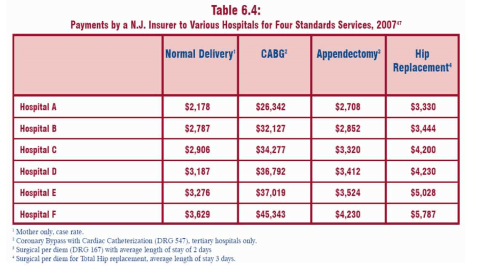
Interesting juxtaposed articles by Ewe Reinhardt and Paul Ginsberg at the Health Affairs site regarding the huge variation in payments by insurers to different hospitals for the same procedure. Imagine what an individual pays!

Here’s an example from Reinhardt’s article:

Medicynical note: These insurers are negotating with providers in a free market to provide the least payment possible for the service provided–so as to maximize the insurer’s profit. The insurers are unable to reach a consistent payment for the same services. The insurers presumably are knowledgeable and have the advantage of reams of information about payments to other providers for the same service and still cannot arrive at a consistent price.

This is the “free and open” market that our conservative friends talk about. They would argue that the consumer would have incentive to shop for the cheapest price and go to that facility, disregarding urgency, locale, quality, ability to understand alternatives, and convernience. This is not reality.

Powered by Zoundry Raven

Best Health Care in the The World–Our Myth

Our conservative friends have chosen the mantra that we have the best healthcare in the world as their basis for opposing reform. Facts, however, don’t support their claim.

This from the Congressional Research Service on quality:

“However, research comparing the quality of care has not found the United States to be superior overall. Nor does the U.S. population have substantially better access to health care resources, even putting aside the issue of the uninsured. Although the United States does not have long wait times for non-emergency surgeries, unlike some OECD countries, Americans found it more difficult to make same-day doctor’sappointments when sick and had the most difficulty getting care on nights and weekends. They were also most likely to delay or forgo treatment because of cost.”

We are number one (compared with other industrialized nations) in:

Bankruptcy caused by health care expenses

Excessive utilization of services and by inference inefficiency

Doctor’s salaries

Hospitalization costs

Drug costs

Insurance costs

The number of citizens who are uninsured.

The costs of emergency room services

NOT preventing preventable disease also here

Inequities of it’s health care system. It “ranks dead last on almost all measures of equity,” with the “greatest disparity in the quality of care given to richer and poorer citizens”

Perhaps because of the failures of our non-system, the World Health Organization ranked the U.S. health care system’s quality 37th in the world in 2000, if anything the situation is worse now.

Infant mortality–In 1960, the United States ranked 12th lowest in the world, by 2004, the ranking had dropped to 29th lowest.

The U.S. has been slipping for decades in international rankings of life expectancies as other countries are improving health care, nutrition and lifestyles, according to the AP/Daily Star. Countries that rank above the U.S. include Japan, most of Europe, Jordan and the Cayman Islands. A U.S. resident born in 2004 has a life expectancy of 77.9 years, placing the U.S. in 42nd place, down from 11th place two decades ago.”

“The U.S. ranks “near the bottom in healthy life expectancy at age 60” and 15th among 19 nations in deaths that would not have resulted “if treated with timely and effective care”

Outcome studies on a variety of diseases, such as coronary artery disease, and renal failure show the United States to rank not significantly better and in some cases worse than Canada and a wide variety of industrialized nations.

On the positive side however, the U.S. ranks “first in providing the ‘right care’ for a given condition” and high for preventive care but performs “poorly in coordinating the care of chronically ill patients, in protecting the safety of patients and in meeting their needs and preferences”;

Medicynical note: Our conservative friends say they want a more market oriented approach without bothering to correct the rotten “core” of our non-system. But market “competition” in health care doesn’t work. Our patent system provides a government sponsored protection to profits for drug companies and other new product developers for a generation. Such a scheme by definition is not free and open. Certainly there are benefits from patents but if the patent holders are irresponsible and abuse the privilege, the system fails, as our is in the process of doing. Drugs that cost over $10,000/month are simply not affordable by the system or individuals.

The “free market” approach to health care falls apart because the asymmetry in knowledge; the duress consumers face when utilizing the system (pay or die in some cases); and the lack of a reason for efficiency. Providers, institutions, insurers and manufacturers have operated on a cost plus basis for the past thirty years, piling on excessive costs without concern for value or for affordability.

The “free” availability of emergency room care is touted by our conservative friends as the solution to the lack of access for the uninsured. It’s at best ironic, and at worst cynical, that conservatives count on a government mandated safety-net program as an answer for our uninsured population. ER care is inefficient and expensive. As such it doesn’t answer our cost problems or the continuing care problems for 50 million of our citizens. How pathetic we are that this is a “serious” argument in the health care debate.

In summary: We have evolved into a healthcare non-system that is quite good for making money. Because of profit pressures our free wheeling approach encourages overutilization and inefficiency. Our costs are 1.5 -2 times that of other industrialized countries in the world, and approaching 16% of GDP. It’s simply not the best, but is the most expensive.

Powered by Zoundry Raven

Our Health Insurance System isn’t working–We MUST do something!!

This from today’s Seattle Times:

“In what is becoming an annual ordeal for policyholders, Regence BlueShield is raising premiums for 135,000 individual health-plan members in Washington by an average 17 percent on Aug. 1.”

“And it comes after two other insurers, Group Health Cooperative and LifeWise Health Plan of Washington, recently imposed similarly steep premium increases.”

In yet another strong argument for health reform it was noted:

“Hensley said,Regence is losing money on its individual plans and subsidizes them with earnings from its group plans.”

One patient noted that her premium is now $1400/month and is going to rise to $1700.

In a letter to the editor of the same Seattle Times, a patient made these comparisons between what goes on here and in the health care system of Canada. Yes, I know it’s just an anecdote, but what do think the other side cites when damning health care reform.

“Canadian health care would be a welcome change”

“Opponents of a public-health-insurance option caution that such a plan would result in “Canadian-style” health care. In support of this, here is a true story.”

“A cautious, self-employed Seattleite, I pay for the best private health insurance available. Good thing, because at 43 years old, after being diagnosed with an aggressive breast cancer, I received treatment at two top regional facilities: surgery at University of Washington Medical Center and chemotherapy at Seattle Cancer Care Alliance.”

“Weeks after my diagnosis, a lifelong friend in Vancouver, B.C., was diagnosed with a virtually identical cancer — same tumor size and characteristics, same lymph node status, etc.”

“After tumor discovery, I received diagnostic tests after more than 30 days.

Her tests took three. I waited five weeks for surgery; she was scheduled in two. Post-surgery, I waited five weeks to begin chemotherapy. Her chemo started in three.”

“In the end, my out-of-pocket expenses exceeded $30,000. Her bills were in the hundreds of dollars.”

“The UW just hired my reconstructive surgeon from the University of Toronto for his education in pioneering techniques. My friend’s surgeon was Canadian, too.”

“So will a public plan result in Canadian-style health care? I truly hope so.”

Medicynical note: What we have costs more and does no better, maybe worse in some areas. We’re bankrupting individuals and the “system” (I use the term system very loosely here).

Powered by Zoundry Raven

Targeted therapy in Lung Cancer: Which offers more value, Avastin, Erbitux or NEITHER!

Annotated abstract from the recent ASCO meetings.

This is a study comparing the cost of two very expensive, marginally effective treatments for lung cancer. The abstract purports to show that one of these drugs is less expensive and offers more “value” than the other. In fact neither is a “value” choice.

Title: A cost analysis (1) of treatment with bevacizumab plus cisplatin and gemcitabine (BCG) versus cetuximab plus vinorelbine and cisplatin (CVC) in patients with advanced or recurrent non-small cell lung cancer (NSCLC) in Germany

Authors: D. F. Heigener, C. Wiesner and R. Aultman

Affiliations: Krankenhaus Grosshansdorf, Grosshansdorf, Germany; Roche Pharma AG, Grenzach-Wyhlen, Germany; F. Hoffmann-La Roche, Basel, Switzerland

#: e17553

Background: Although new treatment options for advanced NSCLC can offer improved survival over standard treatment with chemotherapy (CT) they should also offer value for money.(2) Bevacizumab (BEV), a humanized monoclonal antibody (MAb) directed against vascular endothelial growth factor when combined with CT increases overall survival (median 13.6 months in the AVAiL study) and progression-free survival (PFS) in patients with advanced NSCLC when compared with CT alone.(3) Cetuximab (CTX), an IgG1 MAb which targets the epidermal growth factor receptor achieved a median survival time of 11.3 months when combined with CT in the FLEX study (4) and marketing authorization is anticipated in 2009. The aim of this study was to compare the costs of treating NSCLC with BCG or CVC in Germany. Methods: A Markov model was used to compare drug and administration costs associated with treating advanced or recurrent NSCLC with either BCG or CVC. The model assumes patients move from non-progressive to progressed disease prior to death, according to transition probabilities derived from an indirect comparison of the efficacy of BCG and CVC in terms of PFS using data from the respective pivotal trials and appropriate indirect comparison methodology. Cost data were derived from local sources. Drug cost assumed CT was given for up to 6 cycles, that CTX was administered at an initial dose of 400 mg/m2 followed by 250 mg/m2 weekly until progression and that BEV was administered at 7.5 mg/kg until progression. The model estimated average drug and administration costs per patient treated with either BCG or CVC. Results: The mean total costs of BCG treatment was Euro 4713 less per patient when compared with CVC (Euro 28342 vs. Euro 33055). The addition of BEV to CT was less costly than the addition of CTX to CT ( Euro 18796 vs. Euro 29502) and the administration costs were also lower (Euro 391 vs. Euro 1179). Conclusions: Targeted therapy using BEV is less costly than CTX in Germany and thus, from a budget perspective, offers the best value for money strategy for improving outcomes in patients with advanced NSCLC. Furthermore, costs savings with BCG in Germany are likely to be increased when gemcitabine comes off-patent in 2009.

Medicynical Annotations:

1. Cost Analysis: This abstract hardly describes a cost analysis. It is an attempt to encourage the use of bevacimimab (Avastin) instead of cetuximab (Erbitux). The study was sponsored by a drug company and the authors were company employees or recipients of financial support.

2. Value for money. It’s ironic to hear pharmaceutical company’s spokespeople tout value. In this case we are talking about two medications that are priced in the $10,000/month range. That’s more on an annual basis than the median and average incomes in the U.S. Yet these medication appear to have minimal positive effect in the setting described. That sure doesn’t sound like value!

3. Survival Benefit: The AVAIL trial found :

“At 12.5 months of follow-up, progression- free survival was significantly improved with bevacizumab, from 6.2 months in the placebo arm to 6.8 months with the 7.5 mg/kg dose (P = .0003) and to 6.6 months with the 15 mg/kg dose (P = .0456), Dr. Manegold reported.”

It also noted:

“No differences were observed in overall survival.”

Medicynical Note: The abstract doesn’t comment on the lack of a survival benefit. This omission is similar to the drug company’s press releases (google AVAIL study–press release here , and here .) But the various press releases do imply such a benefit when they claim: “Only first-line treatment to demonstrate extended survival in over a decade.” A claim that is marginal at best.

Dr. Manegold also furthers the fiction that there might be a survival benefit by stating that the 13 months survival was the “longest” for advanced NSCLC. However, he didn’t note that the survival in the group not receiving targeted therapy in his study was just as long

The only proven benefit from this expensive drug in the AVAIL study was a .6 month delay in disease progress.

(4) Compared with FLEX study: The other study referred to in the abstract is an ECOG (Easter Cooperative Oncology) group trial ( ECOG 4599 N Engl J Med 355:2542-2550, 2006). They compared carboplatin and taxotere with and without cetuximab (Erbitux). They found overall survival was 11.3 months in the cetuximab group and 10.1 months in the controls , an improvement of just 1.2 months. One-year survival was 47% in the cetuximab group and 42% in the control group.

Medicynical note: The AVAIL trial resulted in a .6 month delay in progression and no improvement in overall survival. The cetuximab trial shows slight benefit. These are hardly revolutionary improvements in patient care from drugs priced in the range of $100,000/year.

For what it’s worth the FLEX trials patients’ overall survival with cetuximab and chemotherapy was less than the control group (the group only receiving conventional chemotherapy) in the AVAIL trial.

The small delay in progression and improvement in survival (only found in the FLEX study) in these studies may be explained by patient selection, first study bias or simply be an indication of the limited efficacy of these agents in advanced lung cancer. Something that you would not know from the abstract or the PR releases.

Comparing the costs of very expensive agents with small benefits obfuscates whether they should actually be used in the first place.

It is a truism that drug companies market for profit rather than patient benefit.

Powered by Zoundry Raven

Rationing in Healthcare? It’s the American way

Nice summary of healthcare rationing in Economix.

Reinhardt notes:

“In short, free markets are not an alternative to rationing. They are just one particular form of rationing. Ever since the Fall from Grace, human beings have had to ration everything not available in unlimited quantities, and market forces do most of the rationing.”

“Let me remind rationing-phobes what they would find in the huge body of research literature and media reports on our health system, should they ever trouble themselves to read it:”

  • “Many Americans without health insurance or very high deductibles routinely forgo prescribed medicine or follow-up visits with a doctor because they cannot afford it, risking more serious illness later on.”
  • “A 2008 peer-reviewed study by researchers at the Urban Institute found that health spending for uninsured nonelderly Americans is only about 43 percent of health spending for similar, privately insured Americans. Unless one argues that the extra 57 percent received by insured Americans is all waste, these data imply rationing by price and ability to pay.”
  • “A few years ago, The Wall Street Journal featured a series of articles reporting how often uninsured middle-class Americans are charged the highest prices at pharmacies and in hospitals, and how sometimes they are hounded over medical bills to the point of being jailed for failed court appearances.”
  • “Studies have shown that solid middle-class American families – even ostensibly insured families -can lose all of their savings and sometimes their homes over mounting medical bills in the case of severe illness.”
  • “In its report Hidden Cost, Value Lost: The Uninsured in America, the prestigious Institute of Medicine a few years ago estimated that some 18,000 Americans yearly die prematurely for want of the timely health care that health insurance makes possible and that can prevent catastrophic illness.”
  • “A recent study by an M.I.T. professor found that uninsured victims of severe traffic accidents receive 20 percent less health care than equivalent, insured victims and are 37 percent more likely to die from their injuries.”

Powered by Zoundry Raven