Category Archives: Uncategorized

Caution urged with selenium

In 1996 a study looking at the effects of selenium supplements in prevention of skin cancer reported no effect on skin cancer but a decrease in the incidence of prostate cancer in the selenium group–parenthetically this same study showed less lymphoma in those who did not receive selenium. (Clark et al, JAMA 276:1957-1963, 1996)

For some reason, this very preliminary incidental finding was taken as gospel and since that time innumerable food and vitamin supplements purporting to support “prostate health”, whatever that is, have contained selenium.

In the June 15th Journal of Clinical Oncology comes an article and editorial with disturbing findings and a suggestion that perhaps less selenium supplementation would be better until more is know on all the potential effects.

“Selenium supplementation does not decrease risk except possibly in selenium-deficient populations. Supplementation possibly increases risk of prostate cancer, especially aggressive disease, in selenium-replete men or men with a particular genotype for antioxidant enzymes. These hypotheses and the questions posed above suggest the need for personalized risk prediction. At present, we do not know enough to determine how much selenium any man or woman should receive from the diet or a supplement.”

“This lack of knowledge supports the common public health recommendation of moderation with respect to supplements for men and women. Furthermore, we should encourage men and women to eat a wide array of foods, maintain normal weight, be physically active, not smoke, and drink in moderation if at all to prevent chronic diseases in general. Unlike the prospect of personalized chemo-prevention,”

Medicynical note: Sometimes less is better. It’s enough to make a medicynic smile!

Powered by Zoundry Raven

Ethics in Health Insurance–Only with Regulation, and/or a public option

Another article on inadequate health insurance coverage, this from the NY Times.

As noted in previous posts, the U.S. health care non-system is unique in the industrialized world. First, it’s does not provide for universal coverage. Furthermore, it allows, no it encourages, private for profit insurance companies to eliminate people who need coverage (the sick) from their roles.

I say encourages because the first responsibility of a private corporation is to make money. Having these people provide “health” insurance is an unstated sanction for them to cull their rolls of, or otherwise scam beneficiaries, particularly those who are sick and use health care. A paradox? No, it’s simply how insurers make money!

From the Times:

“Last week, a former Cigna executive warned at a Senate hearing on health insurance that lawmakers should be careful about the role they gave private insurers in any new system, saying the companies were too prone to “confuse their customers and dump the sick.””

“The number of uninsured people has increased as more have fallen victim to deceptive marketing practices and bought what essentially is fake insurance,” Wendell Potter, the former Cigna executive, testified.”

Also:

“He and the hospital say they were surprised to eventually learn that the $150,000 hospital coverage in the Aetna policy was mainly for room and board. Coverage was capped at $10,000 for “other hospital services,” which turned out to include nearly all routine hospital care – the expenses incurred in the operating room, for example, and the cost of any medication he received.”

Medicynical Note: The mythical free market in health care has never existed. And given the complexity of health care, the myriad conflicts of interest among the participants (patients, docs, institutions, patent holders, insurers), a so-called “free market”would never work to decrease costs. The proponents of such schemes inexplicably omit addressing the issues of the poor, the working poor, the sick and the asymmetry of information available (costs, options, outcomes) that would tend to distort such a “new” “free market” system.

So, if we are to reform health care coverage, we are left with what must be a highly regulated insurance scheme. Insurers would offering some standard government mandated clearly defined package of coverage using community rates (as opposed to individual ratings) with extra options at extra costs. They would compete with each other on price and service. To keep these people honest a competing public insurance program would provide an objective benchmark from which to rate the value of the private company’s offerings.

Powered by Zoundry Raven

Health Care Costs– Insurers really don’t Care

This today in the Seattle Times emphasizes the holes in todays health insurance policies. Insurers, particularly the for profit ones, are not about financing care but about assuring profits. What’s happens when you really are sick? Where can we draw the line on care?

“”It’s not just the uninsured. It’s people who have insurance that doesn’t protect them” who are fueling the hunger for reform, said Sara Collins, an economist and a vice president at The Commonwealth Fund, a private health-care foundation in New York.”

“Until about a year ago, Moody and Krull lived comfortably on her earnings as an associate broker for Windermere Real Estate. But despite their income and his seemingly gold-plated coverage, he can’t get either a second organ transplant or an expensive drug that might eradicate his hepatitis C without risking financial peril.”

:When she first enrolled in a Premera plan in 1995 after a di”vorce, she remembers that it cost only a few hundred dollars a month.:

“In 2000, she married Moody and added him to her policy. Though affordable at first, their premiums kept rising sharply. Their combined monthly premiums now total $1,746.”

Read the article to get the full flavor of their predicament. These are not the working poor or the uninsured.

Medicynical note: It is ironic that the goal of health insurers is to limit services to those who need health care most.

Forcing people onto the individual market (as opposed to providing group based rates) is the first step. Individuals have no leverage and are rated by their medical need. Premiums are routinely raised to exorbitant levels. As noted in the article people who need the most services are offered policies with unrealistically low limits and find their premiums raised to unaffordable levels (in the case cited over $1700/month).

Any new system should require community ratings. and a standardized coverage structure. both of which are anathema to the private insurance crowd or alternatively mandate a government sponsored program that will offer same.

Powered by Zoundry Raven

Faith? or Ignorance

In many instances whether a person opts for treatment or not the outcome will be the same.

Hodgkin’s disease, a type of lymphoma, is different. Treatment will cure the great majority of patients. Without it the disease is almost always fatal.

The story of the child in Minnesota, Daniel Hauser, with Hodgkins disease illustrates a parent making a bad decision based on faith, and fear. Hopefully the mother who is hiding somewhere with the child will come to her senses and give the child the best chance he has for cure, which is conventional chemotherapy and/or radiation.

The management of Hodgkin’s disease is one of the great successes of oncology and denying someone access to treatment is indeed criminal. Amazing that this should be happening in a modern country.

Powered by Zoundry Raven

Variation in care and Costs

Peter Orzlag on health care cost containment.

“The nation’s long-term fiscal balance will be determined primarily by the future rate of health care cost growth. If health care costs continued growing at the same rate over the next four decades as they did over the past four decades, federal spending on Medicare and Medicaid alone (Medicynical emphasis) would rise to about 20 percent of gross domestic product (GDP) by 2050-roughly the share of the economy now accounted for by the entire federal budget. Furthermore, controlling those federal costs over the long term will be very difficult without addressing the underlying forces that are also causing private costs for health care to rise. A variety of evidence, however, suggests that opportunities exist to constrain health care costs both in the public programs and in the rest of the health care system without adverse health consequences. Capturing those opportunities to reduce costs without harming health outcomes involves many challenges, including the time that may be necessary to generate significant savings-but even if reforms take time to generate savings, acting sooner rather than later can ultimately make a substantial difference.”

The geographic variation in Medicare costs is an opportunity.

Because more spending doesn’t mean higher quality care:

Medicare/Medicaid own the segment of the population that has the most morbidity, mortality and cost. The cost/quality variation indicates areas for improvement. We can continue our current haphazard laissez faire approach or try to become a system.

Our approach to costs, simply cutting fees, has squeezed providers (hospitals and practitioner’s) and assured insurer’s profits. This has created an atmosphere of cost shifting. Providers who lose money on certain type patients charge others more for care to make up the difference. In addition if you do more procedures, you earn more.

We should encourage efficiency and appropriate utilization and use the best approaches determined through comparison studies. Fees should be balanced to encourage use of primary care types over proceduralists. We need to control cost gouging by suppliers whether they are practitioners, hospitals, pharmaceutical companies (the fastest growing segment of costs).

Powered by Zoundry Raven

Health Reform–International comparisons

Ewe Reinhardt has some thoughts on health care reform:

“In Europe, as in Canada, that social ethic is based on the principle of social solidarity. It means that health care should be financed by individuals on the basis of their ability to pay, but should be available to all who need it on roughly equal terms. The regulations imposed on health care in these countries are rooted in this overarching principle.”

“First, these countries all mandate the individual to be insured for a basic package of health care benefits”

Medicynical Note: They have a coherent point of view.

“Many Americans oppose such a mandate as an infringement of their personal rights, all the while believing that they have a perfect right to highly expensive, critically needed health care, even when they cannot pay for it.”

Medicynical Note: We don’t.

Powered by Zoundry Raven

Graphics on Why Health Reform

From the Baucus plan:

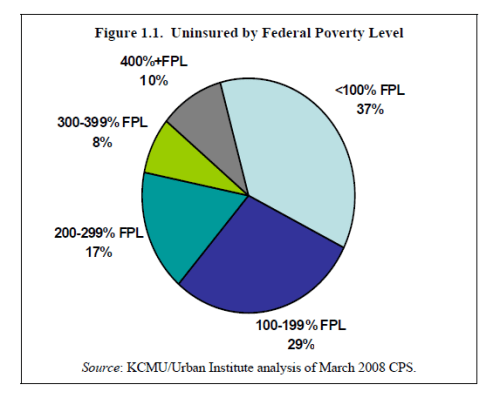
“The U.S. is the only developed country without health coverage for all of its citizens.3 An estimated 45.7 million Americans, or 15.3 percent of the population, lacked health insurance in 2007 – up from 38.4 million in 2000.4 Those without health coverage generally experience poorer health and worse health outcomes than those who are insured. Twentythree percent forgo necessary care every year due to cost. And a number of studies show that the uninsured are less likely to receive preventive care or even care for traumatic injuries, heart attacks, and chronic diseases. The Urban Institute reports that 22,000 uninsured adults die prematurely each year as a direct result of lacking access to care.”

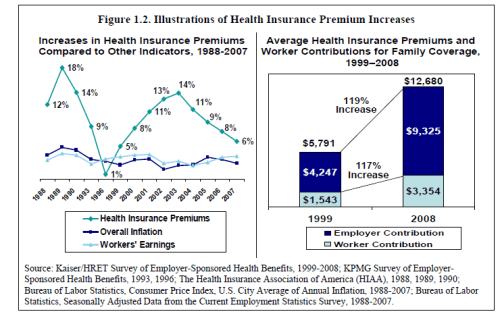
“Even before the current economic crisis, working families and individuals found their health care in jeopardy as the cost of employer-sponsored coverage rose beyond the means of businesses – particularly small businesses – and workers alike. As Figure 1.2 shows, health insurance premiums have increased faster than wages and inflation for most years between 1988 and 2007. Premiums have increased 117 percent for families and individuals and 119 percent for employers between 1999 and 2008.”

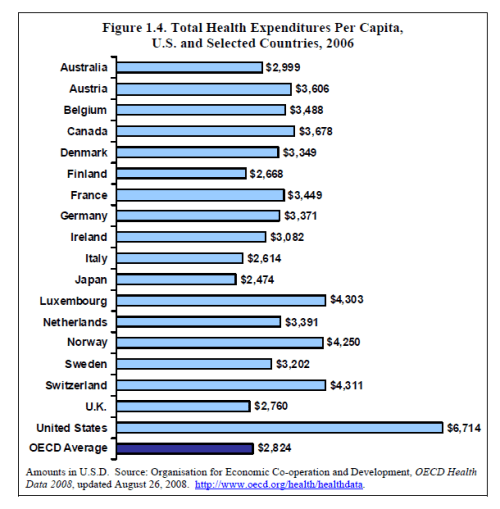
“In a study of global health care systems, journalist and author T.R. Reid found startling cost differences with the U.S. In Japan’s largely private system, the cost for magnetic resonance imaging (MRI) is less than $100, compared to $1,200 in the U.S. In Switzerland, home to profitable insurance companies and influential pharmaceutical companies, administrative costs represent 5.5 percent of total costs, compared to about 22 percent for coverage purchased in the private insurance market in the U.S.31 While there must be a uniquely American answer to the question of containing health care costs, other countries demonstrate the possibility of success.”

Powered by Zoundry Raven

What’s going on? 5 dead, 13 dead, 3 dead

3 Police Killed in Pittsburg

13 Dead in Binghamton

5 children, father found dead

There are 30,000 deaths from guns in the U.S. each year. In UK there are 50. That’s not a misprint fifty. Our conservative friends are concerned about their second amendment freedoms. This is freedom?

Powered by Zoundry Raven

The Sacred BIG PHARMA/Patient Relationship

Billy Tauzin was a Republican representative from Louisiana who on leaving congress immediately became a lobbyist for the pharmaceutical industry. He had a conference call the other day. As noted in The Treatment (TNR’s health care blog)

“PhRMA still has its own, very specific notions of what reform should look like. Giving everybody insurance? Sure, that’s great. Applying more scrutiny to effective treatments–a move most experts would argue is essential for bringing the cost of health care under control? Um, not so much.”

“He also said that reform should not interfere with the “wonderful, uniquely American experience in which doctors and patients make their decisions about health care.”

Medicynical note: By wonderfully unique, is Billy referring to the practice of the pharmaceutical industry providing salaries, gifts, and stipends to researchers, and doctors presumably to in some way influence their treatment recommendations and decisions? Or the relationship the industry has with pharmacies that allows it to monitor physicians’ prescribing behavior? Or is it the industry’s direct to patient advertising that doesn’t mention cost, alternatives, or outcomes. And manages to bury the most horrific toxicity in disclosures that only a medical professional could fully understand.

The formerly ethical pharmaceutical industry also collects information about people online without disclosing that they will use the information to recommend drug treatments. See article about RealAge (NY Times ).

“Pharmaceutical companies pay RealAge to compile test results of RealAge members and send them marketing messages by e-mail. The drug companies can even use RealAge answers to find people who show symptoms of a disease – and begin sending them messages about it even before the people have received a diagnosis from their doctors.”

Maybe Billy was talking about the sacred BIG PhRMA patient relationship–so much for doctors.

Powered by Zoundry Raven

Police Outgunned– Why in world do we have legal AK47’s

The four Oakland policemen killed last week were victims of an ex-felon who used an AK-47 in his rampage.

There are many open questions about this terrible episode. The most important to me is why we have such lethal weapons readily available in our society. In this case the gunman had more firepower than the policemen making the traffic stop. How could this happen? I don’t think the “founders” had this in mind with the second amendment.

Powered by Zoundry Raven