Category Archives: Health Economics

Individual Mandate: Be careful what you wish for

Be careful what you wish for.  This cuts both ways.

The incidental economist notes: (Austin Frakt)

If one wants to address the problems in health insurance markets and/or to get providers to accept payment reforms, the mandate–or something like it–is the political price. Yes, it’s about money. What else?

Put it this way, if one wants to retain a private market-based health insurance system (which ours largely is), it takes a mandate. Reject the mandate without replacement with a similar mechanism and the whole thing unravels, not just as a matter of health economics (adverse selection) but as a matter of politics.

Medicynical Note:  We’ve created the most dysfuntional, expensive healthcare non-system in the world.  Yes we’re number one.

Employer sponsored health care is a mess.  Employers don’t have to provide their employees health care–in many instances they can’t afford to provide it; “contractors” are not employees and don’t qualify for employer provided benefits;  if you get sick and can’t work, you lose your insurance.  Remarkable.

Our health care costs are twice that of many other industrialized countries and thousands more per capita/year.  We have 50 million uninsured and have a “system” that encourages “free” use of the most inefficient, most expensive health care provider in the country–emergency rooms.

We all pay.

Incomes and Health Care


Our non-system of health care has average per capita costs of $7000/year. I’t even more if you have a pre-existing illness.


Overselling technology, Avastin and Circulating Tumor Cells

For years, since the Nixon war on cancer, we’ve oversold our ability to treat cancer. This tendency continues today.

Health Affairs blog has a piece from the Manhattan Institute’s Paul Howard that criticizes the FDA’s revocation of the use of Avastin in breast cancer.  His point seems to be that the drug which in clinical trials has been shown not to improve survival and have significant toxicity appears to work in a small subset of patients.  At present, however, we have no reliable means of determining who will respond and who will only get side-effects.  This in a drug costing between $50,000 and $100,000/year.

The American Cancer Society’s Deputy Medical director Len Lichtenfeld has noted:

“But it is important to understand the decision was based on the advice of an independent panel of experts who noted that larger studies showed some women lives were actually shortened on the drug and that toxicities associated with the drug were significant,” Lichtenfeld says. “Meanwhile, the net benefit for women taking the drug was quite modest.”

“What we clearly need is a way for doctors to more accurately predict which women will have a better chance of benefiting from this important targeted therapy,” Lichtenfeld says. “Until that tool is developed, giving all women with metastatic breast cancer Avastin may harm more women than it helps.”

Howard also talks of using tests for circulating tumor cells (CTC’s) as a way to:

screen for cancer that can replace expensive or invasive tests like mammograms or colonoscopies; to tailor cancer treatments and adjust them based on how many or what type of CTCs are found in a patient’s bloodstream; or make physicians more comfortable adopting a “watch and wait” approach for elderly patients in cases where the underlying cancer may grow so slowly that it will never become life-threatening.

His analysis of the test is  incorrect.  While it may be useful in identifying those with more serious disease it does not appear to have utility as a screening test for early cancer.  When a tumor has reached the point that it’s cancerous cells are in the blood stream, the tumor is not  early  but rather one that is at high risk to  have spread and  metastasize.  I know of no study suggesting use of  CTC’s as a marker or screening test for early cancer–the ones most amenable to being cured.

Medicynical Note:  It would be of interest to know of Mr. Howard’s and Manhattan Institute’s pharmaceutical industry support.

Maybe We Can Learn Something From Canada

McClatchy points out:

Not a single Canadian bank failed during the Great Depression, and not a single one failed during the recent U.S. crisis now dubbed the Great Recession. Fewer than 1 percent of all Canadian mortgages are in arrears.

Also:

“This sounds very simple, but one of our CEOs has said we are in the business of making loans to people who will pay them back,” said Terry Campbell, vice president of policy for the Canadian Bankers Association in Ottawa.

And:

Even so, there’s plenty to learn from Canada’s conservative — yes, conservative — regulatory regime. It requires more rigorous loan underwriting standards and much bigger set-asides by banks for potential losses during market downturns.

Medicynical Note: We can learn from their health care system as well. They have 100% of their population covered by insurance and spend half of what we do. (2006 data, trend persists today) More here. Their outcomes measured by life expectancy, infant mortality, etc are better than ours.

So we pay more, have less coverage and outcomes that are no better than elsewhere. Our non-system is the best in the world? For whom?


25% Overuse of Implantable Cardioverter (ICD)

As noted in JAMA, implantable cardioverters are being overused. 25% of patients in the study cited did not have the accepted indications for this expensive procedure. Furthermore:

Patients who received a non–evidence-based ICD compared with those who received an evidence-based ICD had a significantly higher risk of in-hospital death (0.57% [95% confidence interval {CI}, 0.48%-0.66%] vs 0.18% [95% CI, 0.15%-0.20%]; P <.001) and any postprocedure complication (3.23% [95% CI, 3.01%-3.45%] vs 2.41% [95% CI, 2.31%-2.51%]; P <.001).

Medicynical Note: We think of the art of medicine as making treatment decisions using science as well as instincts based on the provider’s unique knowledge of the patient, local standards and what is medically indicated.

In the JAMA study 25% of patients received ICD’s did not have the established indications for the procedure and as a group these patients had worse outcomes. Presumably their doctors felt the use of the ICD indicated (applying the “art of medicine”). As costs have increased (an ICD procedure is $50,000 or more) and better tracking of outcomes reveal that overuse leads to more complications and worse outcomes, I’m not sure we can afford this type artistry.


The Game of Health Care — Another Great Moment in Medicine

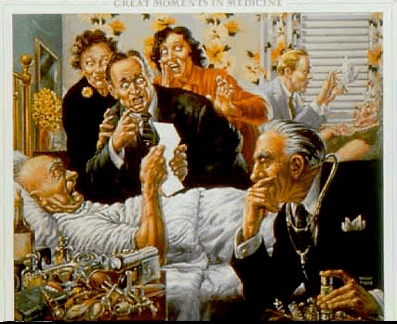
I can recall a MAD Magazine illustration series (drawn by Kelly Freas) called “Great Moments in Medicine.” It was a parody of one of the “ethical” pharmaceutical company’s ad campaigns. Except in the MAD magazine case the great moment was presenting the bill.


In today’s Times there is another great moment.   Drug companies distributing coupons to decrease co-pays on their expensive drugs so as  to increase their  use rather than equally effective less expensive generics. With the coupon the patient’s out of pocket expense was the same. but for  insurers the cost was many times more. Guess who pays for this with increased insurance premiums?

Drug companies say the plans help some patients afford medicines that they otherwise could not.

But health insurers and some consumer groups say that in many cases, the coupons are just marketing gimmicks that are leading to an overall increase in health care costs. That is because they circumvent the system of higher co-pays on costlier drugs that insurers use to encourage consumers to use less expensive products.

One example was a one a day patented formulation of the generic drug minocycline:

A month’s supply of Solodyn sells for more than $700 on drugstore.com, compared with about $40 a month for capsules of generic minocycline, which are generally taken twice a day.

Almost 20 times the cost.

Medicynical Note: Is it any wonder that our non-system of health care is bankrupting us?

Suppliers (and insurers at times) game the system to maximize profits. Patient care? Cost efficiency? Not our department.


Spinal Fusion Surgery — Big benefit to doctors, limited benefit to patients

Bloomberg has an interesting article on the limited medical benefit of spinal fusion to patients–but big financial benefits to doctors, medical practices and suppliers (Medtronic). The article documents at least the appearance of, if not actual, conflicts of interest; high costs $135,000 for the surgery (yes on one patient); $800,000/year incomes for the orthopedists–three times that of pediatricians.

The possibility that many of these and other surgeries are needless has gotten little attention in the debate over U.S. health care costs, which rose 6 percent last year to $2.47 trillion. Unnecessary surgeries cost at least $150 billion a year, according to John Birkmeyer, director of the Center for Healthcare Outcomes & Policy at the University of Michigan.

“It’s amazing how much evidence there is that fusions don’t work, yet surgeons do them anyway,” said Sohail Mirza, a spine surgeon who chairs the Department of Orthopaedics at Dartmouth Medical School in Hanover, New Hampshire. “The only one who isn’t benefitting from the equation is the patient.”

There’s lots to this article including evidence that fusion is no better than physical therapy for disc related pain in several studies–only a 47% success rate for surgery in one U.S. study;  high complication rates for surgery;  direct payments from the medical supplier (Medtronic) in the form of royalties and consulting fees to doctors (as high as $440,000/year to an individual doctor and 1.75 million to a practice in Minneapolis).

Medicynical note: Not a pretty picture of American medicine. Costly, open conflicts of interest, use of aggressive expensive unproven procedures over more conservative approaches–with the same or worse outcomes.  Is it any wonder that our costs are one and half to two times that of other industrialized countries.

The “free market” encourages entrepreneurs to find ways to take advantage of markets, sometimes that leads to better outcomes and more efficiency but in medicine it seems to encourage waste, high cost and over-utilization.

Doctor’s fees, Medicare and Value

Two interesting reads on controlling costs and maintaining quality of care.

Ewe Reinhardt discusses the problems with our current reimbursement system and his thoughts on changes:

Medicare raised physician fees only 7 percent (an average of 0.75 percent a year), while the Medicare Economic Index (or M.E.I.), which tracks costs incurred by medical practices, rose 34 percent (an average of 3.3 percent annually).

Even so, Medicare’s spending on physician services per beneficiary rose 61 percent, an average annual compound rate of 5.4 percent a year.

The bulk of this increase in medicare spending therefore was on procedures, both diagnostic and therapeutic rather than the evaluation and management. This explains the  low rate of increase in the incomes of primary care people–the ones most of us rely on for management or our problems. Correcting the imbalance in incomes between these doctors and proceduralists is the challenge for the future and is discussed by Reinhardt.

The traditional working assumption had been that, in treating their patients, physicians are impervious to such financial incentives. Many, most likely, are. But a growing body of research has chipped away at the general validity of that assumption – hence the growing disillusionment with the hallowed fee-for-service method of compensating physicians.

He also discusses the Rivlin-Ryan plan for medicare reform:

Under the Rivlin-Ryan plan, the problem of paying the providers of health care would no longer be visible and for government to solve. Instead, it would be the product of private and presumably secret deals between private health plans and the providers – and, indirectly, the elderly, who would be made to bear the risk of rising payments to providers.

Another approach is taken in an article in the New England Journal of Medicine, “What is Value in Health Care” and “Measuring Healthcare Outcomes.”

Achieving high value for patients must become the overarching goal of health care delivery, with value defined as the health outcomes achieved per dollar spent. This goal is what matters for patients and unites the interests of all actors in the system. If value improves, patients, payers, providers, and suppliers can all benefit while the economic sustainability of the health care system increases.

Value — neither an abstract ideal nor a code word for cost reduction — should define the framework for performance improvement in health care. Rigorous, disciplined measurement and improvement of value is the best way to drive system progress. Yet value in health care remains largely unmeasured and misunderstood.

Read the article for the author’s suggestion for incorporating value into the patient care question.

Medicynical Note: Unless we  find a way to incorporate value (bang for the buck) in medicine we’ll spend ever increasing amounts on health care; have more people uninsured as they can’t afford care; and continue on the path to explicit financial rationing of health care–and system failure.

The Future of Health Care — Reality Bites

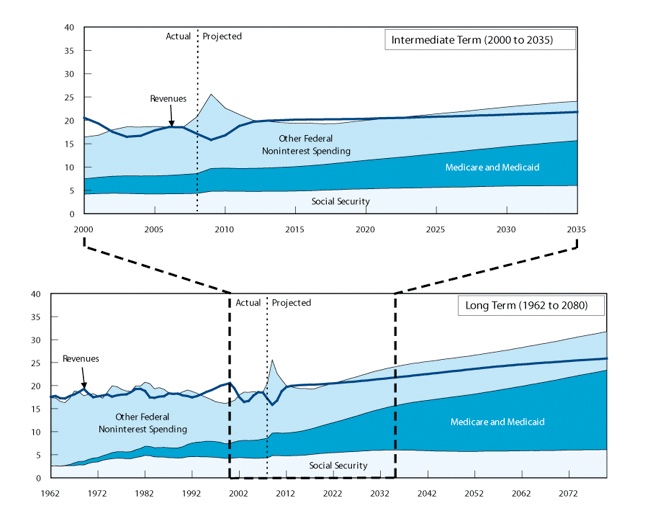
The following is from the CBO’s analysis of our economic future. (June 2009)

Holding down the spiraling levels of debt projected under either scenario could therefore result in significant economic benefits. However, accomplishing that goal would require some combination of substantial revenue increases and substantial spending decreases relative to current law. Those changes would have their own economic and social costs.

One policy that would prevent the increase in debt would be to raise revenues in line with the projected rise in spending. As evidenced by the estimated fiscal gap, the required increase in revenues under that approach would be large. If the increase occurred through higher marginal tax rates, incentives to work and save would be reduced and economic growth would slow.

An alternative policy would be to hold the growth of spending in line with the growth of the economy. That approach would require significant changes in the Medicare and Medicaid programs. Many experts believe that a substantial share of spending on health care contributes little, if anything, to the overall health of the nation, so changes in government policy have the potential to yield large reductions in federal spending without harming health. However, translating that potential into reality would require tough choices. It would ultimately depend on policymakers’ willingness to put ongoing pressure on the health sector to achieve efficiencies in the delivery of health care.

Reducing other federal spending significantly below the baseline levels would be difficult as well. Spending on Social Security has risen from almost 4 percent of GDP in the 1970s to almost 5 percent today and will increase to 6 percent in 2035 as the baby boomers retire. Other non-health, non-interest spending averaged almost 14 percent of GDP in the 1970s but has shrunk to about 10 percent of GDP over the past 15 years—aside from the current burst of spending in response to the recession and the financial crisis. Such spending is projected to decline further over time in CBO’s 10-year baseline.


Fine discussion by Brad de Long, (inflation economics lecture) of economic history, current high deficits and the decisions we face in meeting our economic commitments– and sustaining our health care non-system. The decisions and alternatives are enlightening.

He asks what we should do about it?

What do people think is the most likely outcome from this situation?
1. Come 2060 will we have raised taxes by a lot? We could double income taxes between now and 2060 and barely pay for extra government health spending.
2. Will we have cut doctors’ wages and enslaved them by drafting them into a socialist national health service?
3. Will we have abandoned our egalitarian healthcare beliefs?
4. Will the healthcare efficiency cost-effectiveness fairy have come and rescued us?
5. Or will the federal government as we know it will have collapsed and those of us who are still alive be involuntarily starring in a remake of Mad Max: Beyond Thunderdome?

Medicynical Note: Our non-system is not designed to deliver optimal care to our population but rather to provide excess profits to providers, suppliers and insurers. Over the years oversight, fiscal responsibility, efficiency and value have been degraded to the point of nonexistence. We therefore spend twice as much as most other places in the world; have reasonably good outcomes for those with access to care but mediocre population statistics (overall length of life, childhood statistics, prevention of preventable diseases, etc) presumably influenced by the 50 million people without insurance and those with limited access through such programs as Medicaid. We’re paying more but getting less benefit, this in the country that once fancied itself as the most productive and presumably efficient in the world.

We can continue to delude ourselves that we are the best in the world (as some radio hosts and 1/2 term governors do) or face reality that we are on an unsustainable path and do something.


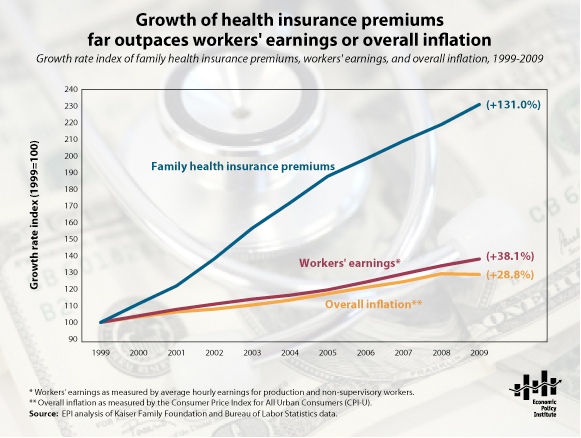
Health Care Costs vs Earnings

Wondering where our money for discretionary expenditures went?


What’s more:( From Sept 2010)

This morning’s release by the U.S. Census Bureau of the 2009 poverty and income data was yet another reminder of the severity of the Great Recession that began in December 2007. The data show that the poverty rate increased from 13.2% in 2008 to 14.3% in 2009, the highest rate since 1994. Furthermore, for the first time on record, the nominal (non-inflation adjusted) income of the median, or typical, household actually fell, from $50,303 in 2008 to $49,777 in 2009. Inflation was negative from 2008 to 2009, dropping by 0.4%, so real (inflation-adjusted) income did slightly better, dropping $335, or -0.7%, from $50,112 in 2008 to $49,777 in 2009.

Medicynical Note: Those expecting consumer spending to bail out the economy are kidding themselves.