Category Archives: Health Economics

Health Care in America: An Expensive Shell Game

Only in America would a company working to cut payments for health care not benefit the patient. The NY Time describes the scam. “The firm, MultiPlan, and the insurance companies it serves often collect larger fees when payments to medical providers are far lower than the amount billed.”

“The Times investigation found that MultiPlan had encouraged some insurers to use its most aggressive pricing tools, leaving medical providers with slashed compensation and employers with high fees — in some instances higher than the medical care payment itself. And left some “patients with unexpectedly high bills as they were asked to pick up what their plans did not cover.”

Medicynical Note: Everyone wins…… except the patient.

The health insurer pays less for care and makes more money. Multiplan makes money because it gets a fee and piece of the “savings.” Providers including hospitals and their health care groups, lest you worry about them, have their own ways of increasing billings and get paid one way or another. Check out the salaries of health care company CEO’s and execs if you doubt me. And guess who gets pay for it all.

These scams are a little like the shell game. The money keeps moving and the last concern is value, access, and affordability of health care. As a result of games like these and there are many, we spend more for healthcare than anywhere else by a wide margin. We are the only place in the world where people go bankrupt from health care costs.

America doesn’t have a healthcare system. Instead it has a sophisticated revenue generating system that does healthcare. In In it, income generation takes precedence over patient outcomes.

Republicans Aim to Cut Medicare, Medicaid and the Affordable Care Act. Meanwhile:

As a new year and presidential election approach, Americans face a worsening crisis: the affordability of healthcare. More Americans than ever, about 92%, now have health insurance – and simultaneously face enormous bills.”

“Over the last decade, insurers and employers have pushed more cost-sharing onto individuals and families. Now, squeezed by medical costs and inflation, more than 100 million Americans have medical debt and roughly the same proportion report avoiding a prescription because of it.”

Medicynical Note: Americans pay more for healthcare, by a wide margin, than folks in any other industrialized nation. We pay more for doctor visits, hospital stays, medications, medical devices, insurance, everything.

We are also the only industrialized nation where there is medical debt. Why? It’s not rocket science. In a for-profit healthcare system everyone involved wants to make……. a profit.

Why doesn’t the “marketplace” in our for-profit healthcare system work to control prices? Here, for a variety of reasons providers don’t have to compete on price, i.e. efficiency and value. And in any case, prices are not advertised or easily accessed. When you ask a hospital how much an operation or procedure will cost you will get a vague mostly inaccurate estimate or be told it “varies.” You literally can’t get an accurate total price for care. And lastly health care is not descretionary. When you really need it, you don’t have time, ability or motivation to shop for the “best” most economical option.

Adding insult to injury, one political party is planning make things worse and cut the already limited government supported health insurance programs if they win the next presidential election. They literally have no alternative plan for health care. Hint. That political party’s logo is an elephant.

Healthcare: Deceptive Pricing

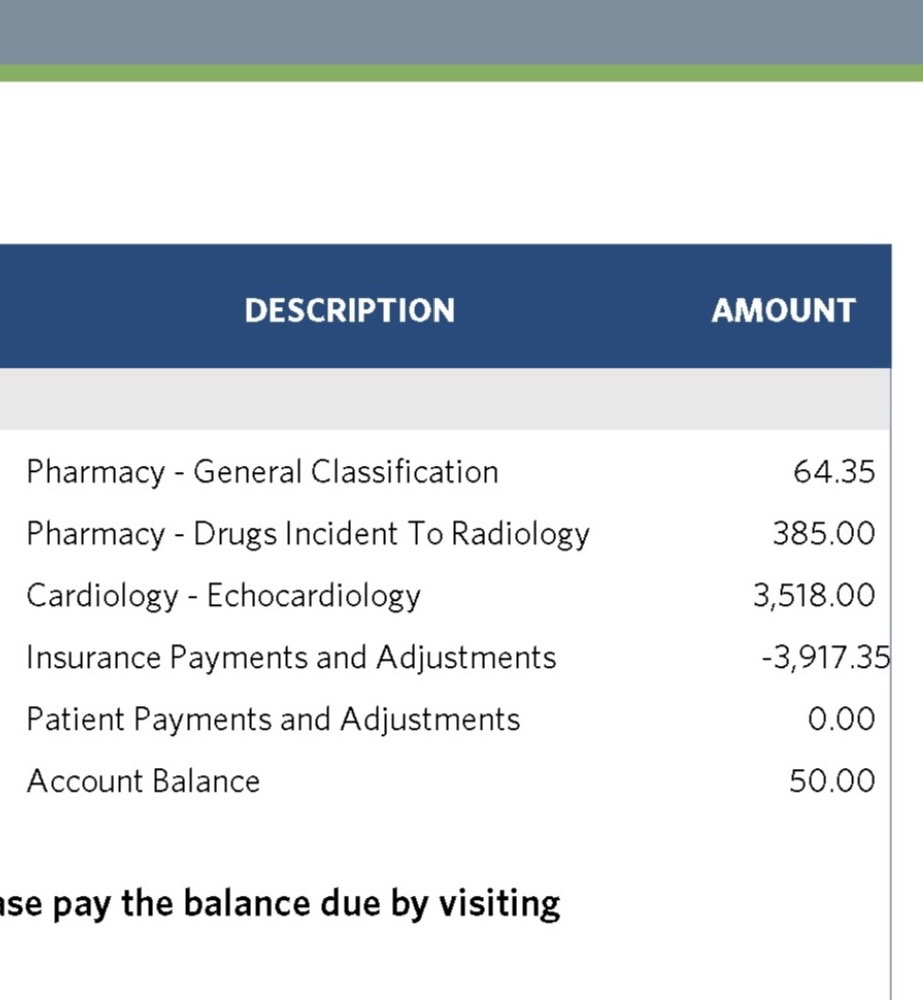
I recently had an outpatient medical ultrasound procedure. It took all of 30 minutes and was performed by a skilled technician. The bill came to something like $3900.

I don’t know how to value such a procedure but apparently my insurer does.

Below is the accounting of payments and “adjustments” to the price.:

Medicynical Note: Pricing of healthcare in the U.S. is more opaque and difficult to understand than the pricing at a new or used car lot. My sincere apology to car salesmen for the comparison.

Actually, hospital pricing makes the car dealers look good. But, unlike a car purchase, healthcare is not a discretionary expense and when needed, shopping for the best “price” is impossible because of time constraints and because the bottom line price is obscured.

In this case my insurer paid a total of around $900. The rest of the balance, something like $3,000 was an adjustment/discount. My total co-pay was $50.

A person without insurance, however, would have been billed the full $3,900 and would have had to pay that total or enter into some type of bargaining. I may be wrong but I doubt that the hospital would offer the same magnitude of discount even if a patient was savvy enough to ask for it.

In this case the medical facility used was one of the Catholic “non-profit” PeaceHealth facilities in the Northwest.

I’ve noted similar huge adjustments to bills ($25,000 bill discounted to $12,000 for example) in the past. These “adjustments” appear to be the standard operating procedure in hospitals in America.

American Health Care: Your Money or Your Life

Cancer drug pricing started, as I recall, to accelerate in the 90’s with the advent of Taxol (paclitaxel). This drug used mainly for breast cancer was priced at what now seems a “reasonable” $1000 for a dose. Prior to this “advance” the maximum cost for a drug was in the range of a few hundred dollars.

With better understanding of DNA and the genetic basis of cancer “targeted therapies arrived on the scene and prices rapidly spiraled. The first of targeted treatments, i.e. those that block a genetic defect, was Imatinib (Gleevac). A revolutionary advance, it was initially priced at between $26,000-and $40,000 (I recall the latter) for a year of treatment. A very big escalation. Now, FYI, that very same drug is sold at about 5 times the initial high price, $120,000 per year.

What’s amazing is that our so-called healthcare system paid up. Since then costs have spiraled. And todays example is just one of the extreme ultra-high priced medical “advances.”

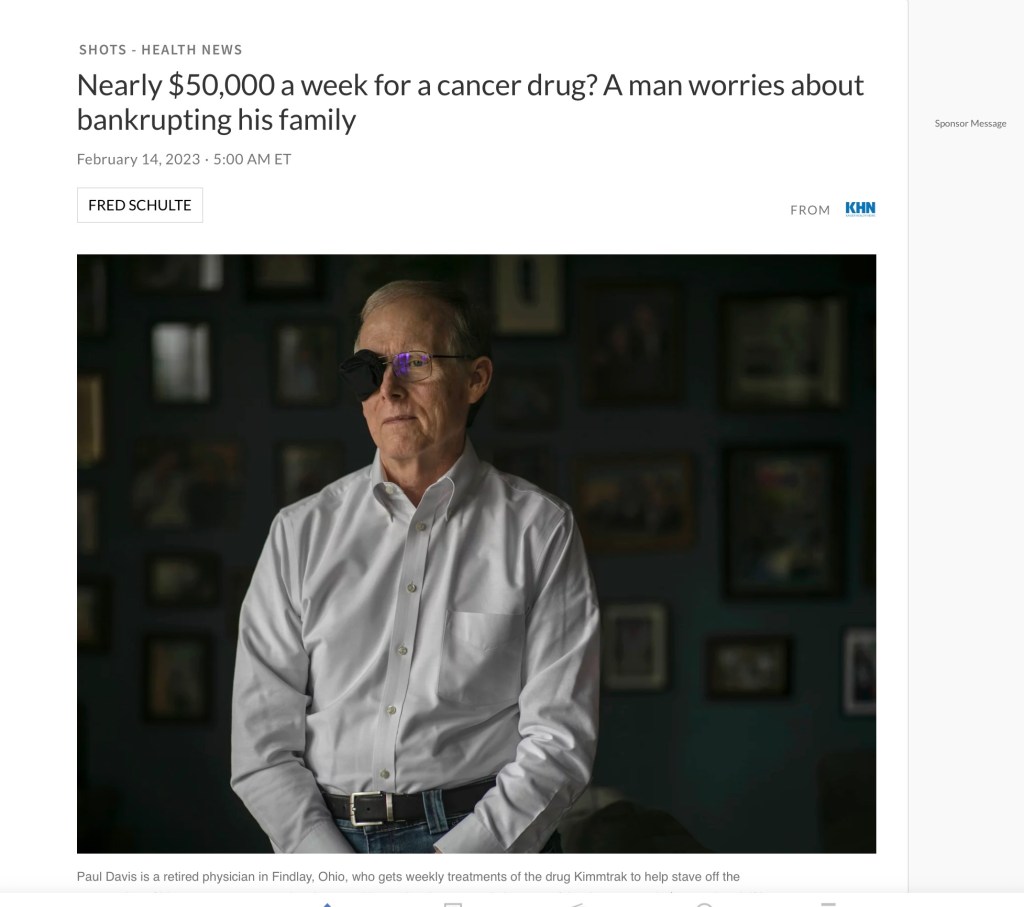
Approved by the FDA in January 2022 as the “first and only” treatment for metastatic uveal melanoma, Kimmtrak has kept his tumors stable, according to Davis. His oncologist told him he should stay on the drug “until it stops working.” Its manufacturer markets the drug’s power to deliver “6-month improvement in median overall survival.””

Medicynical Note: In cancer therapy the drug prices only partially reflect the actual cost of development. Companies price medication to maximize profits not to assure affordability or access. They consider the frequency of the disease as well as what any other drug for that disease will cost. When there is no other “effective” drug and the disease is severe and rare, the sky’s the limit.

The question remains who can afford it? How much can we afford to pay for 6 months of survival? Can insurers absorb the costs or is this the proverbial bridge too far?

Trump Tax Cuts and our National Debt: A Shell Game for Suckers

As Republican Trumpist radicals posture about our national debt remember their early actions during Trump’s first year in office that is constantly increasing our debt to the tune of over a trillion dollars over 5 years.

Medicynical Note: This is not rocket science nor advanced economics. The game plan is to play up the debt and try to pay for it by cutting Medicare, Medicaid, Social Security and other necessary domestic programs. Defense of course will be exempted from significant cuts.

After marching in lock-step to increase the debt under Trump by cutting taxes on the wealthy our republican faux libertarian radicals want to place the burden of the debt that THEY created on middle and lower income earners. Are we so stupid as a country to fall for this? ………. maybe. Watch the posturing over the next few weeks and find out.

American Health Care…… isn’t

Understanding health care coverage and costs requires a PhD. The folks in today’s health care fiasco bought coverage from a company that for two years doesn’t cover “pre-existing” problems…. and got burned.

‘The plans are often faith-based, whatever that means, and have surged in popularity in recent years because they can be cheaper than traditional insurance — the Kings said their plan cost $534 a month, plus an additional $118 a month to join a direct primary care medical practice.”

“But the sharing plans offer fewer protections than insurance and come with provisos. The Kings said their plan did not fully cover preexisting conditions like Jeff’s heart condition for the first two years of coverage — and he needed the surgery after 16 months.”

In this case the couple found they were liable were for the entire $160,000 billing.

Medicynical Note: Healthcare has become worse than buying a used car, in part because the car purchase is discretionary while in health care one’s very existence may be involved……..and, in part because the amount of money involved in healthcare is so much more.

The article notes: “Hospital charges are generally understood by health economists to bear little resemblance to the actual prices that are typically paid. Instead, they are more of an opening salvo in the high-stakes negotiations between hospitals trying to get as much money as they can for providing care and insurance companies trying to pay as little as possible.”

In this case after billing $160,000 the hospital knocked off $107,000 from their original pricing. This for a non-surgical Cath-lab procedure that probably required only an overnight stay. And FYI the hospital involved had a net revenue of over 800 million dollars and net income (2020) of over 57 million dollars. Not bad for a “non-profit.”

It’s sadly true in America that in America healthcare companies are more interested in income than outcomes.

Over the Counter Meds— Benadryl vs Diphenhydramine

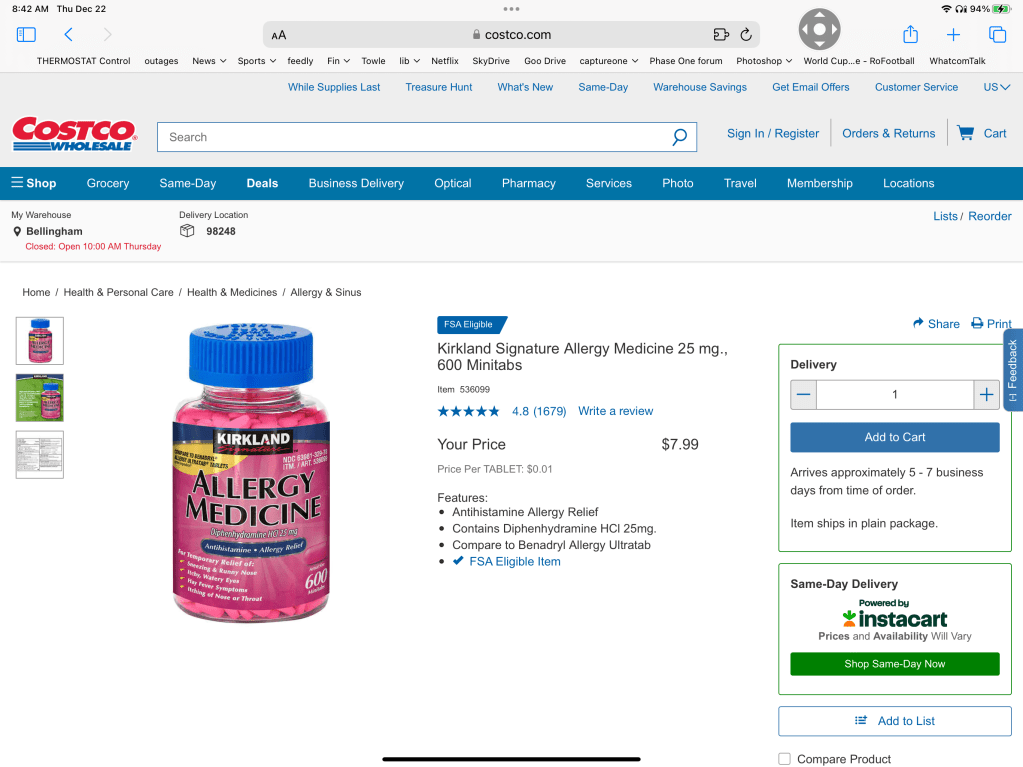
Below are ads for the anti-allergy antihistamine and sleep aid diphenhydramine, perhaps better known as Benadryl, from the internet on Dec. 22, 2022. This allergy medication has been on the market for over 50 years. It’s been available as a generic for almost all that time and yet it’s still marketed under it’s brand name, Benadryl. It’s priced from around a penny (Costco in-store price under $5.00) or two (Walmart) / pill for the generic diphenhydramine versus ten cents to 20 or 30 cents/pill for the branded Benadryl pills. And everyone selling the medication makes a substantial profit. That the magic of capitalism.

Medicynic Note: The actual cost for the diphenhydramine must be a fraction of a penny/pill— Neither Costco nor Walmart sell this drug at a loss.

However the brand name version still outsells the generic, so it’s no wonder that drug and pharmacy companies still sell the brand name version but at 10-20 times their actual cost for the medication.

CVS and Rite-aid also show the brand name with their own CVS/Rite-aid label generic version…..usually at 50-75% of the branded prices above.

Healthcare in America: Income over Outcomes!

America has a system of revenue generation that it calls healthcare. Many of it’s “healthcare” corporations work more diligently to improve revenue and income than on improving patient access, affordability and outcomes. That’s American private healthcare even if the company involved is supposedly “non-profit.” This article documents some of the actions of a large non-profit church run hospital system. In reality it is a cash cow that launders hospital income into huge privately held investments.

As noted in the article “But The Times this year has documented how large chains of nonprofit hospitals have moved away from their charitable missions.”

“Some have skimped on free care for the poor, illegally saddling tens of thousands of patients with debts. Others have plowed resources into affluent suburbs while siphoning money from poorer areas.’

And: “Today, Ascension operates in 19 states, mostly in the South and the Midwest. It serves about six million patients.”

“By many measures, Ascension is rich.”

“In addition to its billions in cash, it runs an investment company that manages more than $41 billion. Last year it paid its chief executive, Joseph Impicciche, $13 million.”

“Because of its nonprofit status, Ascension avoids more than $1 billion a year in federal, state and local taxes, according to the Lown Institute, a health care think tank.”

Medicynical Note: In large areas of the country, because of the tax advantage from their non-profit and church related status, hospitals like Ascensions’ have become the only provider of health care, dominating both inpatient and outpatient services. Besides scrimping on staffing and services to maximize return they also enforce health care religious proscriptions on their non-practicing patients and staff.

In the end America has a revenue generating rather than a health generating system of care. It’s interest is more in income than outcomes. Sad but true.

$35,500 Medication in U.S. …… $250 in the U.K. The U.S. Medical Scam

I’ve previously talked about the manipulation of medical prices through price gouging and medical code game playing. What follows is an example. Not unusual. It happens every day in the U.S. of A.

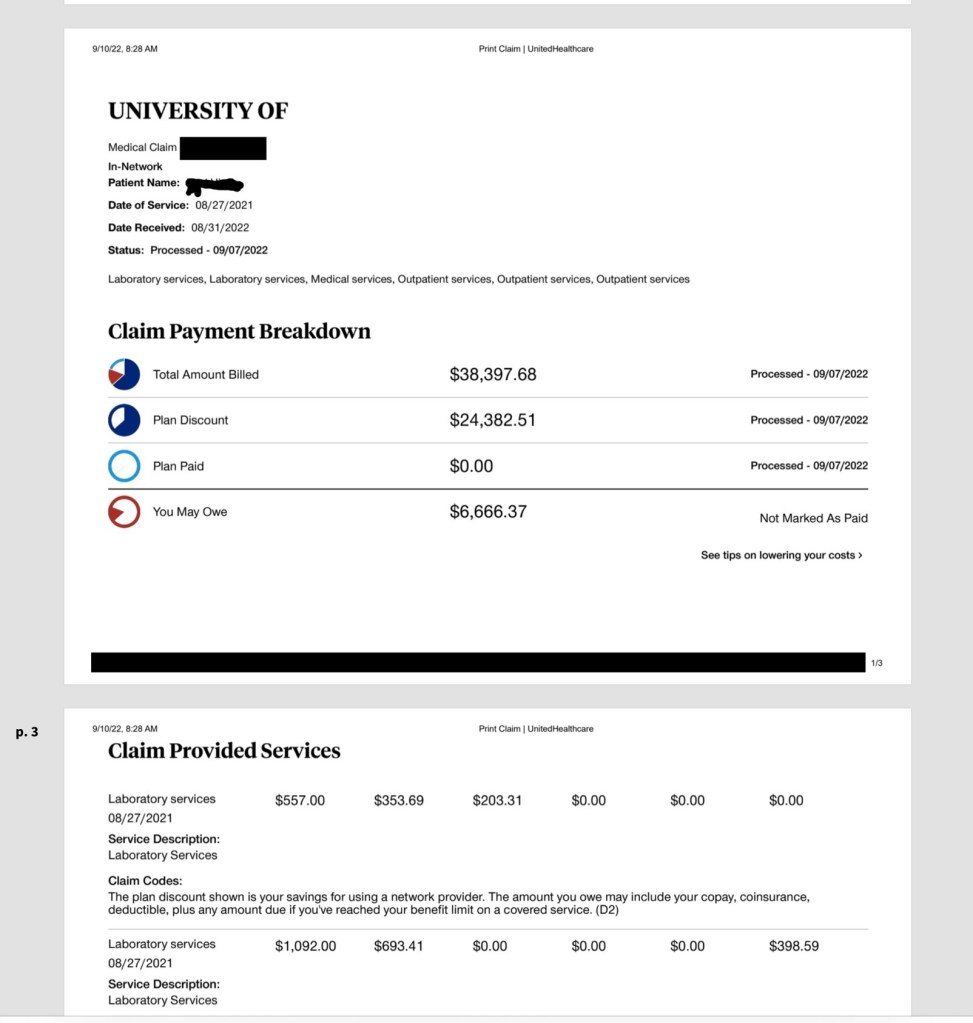
“Total Bill: $73,812 for the two shots ($35,414 for the first, $38,398 for the second), including lab work and physician charges. United Healthcare’s negotiated rate for the two shots plus associated fees was $27,568, of which the insurer paid $19,567. After Hinds haggled with the hospital and insurer for more than a year, his share of the bills was determined to be nearly $7,000.”

Medicynical Note: Almost everything on this bill is a manipulation of the system. First, the pricing of the lab tests. Each are inflated probably several times the actual cost of doing the test or the price of the test done for outpatients. Next, the cost of the medication leuprolide $35,000 (gasp!). This, for a drug developed in 1973 and priced at a few hundred dollar just a few years ago and costing $250 or less in overseas healthcare systems. Current pricing in various locales here. And lastly the use of codes to increase the billing i.e. separating the office visit fee from an “evaluation and management” fee. Both events, of course, happened simultaneously. Or consider the over $500 fee for a quick, less than a 1 minute, administration of a drug that has almost no immediate side effects. The nurse administering the drug didn’t even have to find a syringe to draw up the medication as it comes ready to go in a syringe.

Healthcare pricing has little to do with actual costs. This patient had insurance and paid a “negotiated” reduced but still excessive amount. But if he had no insurance he would have been billed and held accountable for the full amount, unless maybe he could claim poverty or was a skilled negotiator.

The finances of healthcare in the United States are worse than going to a used car lot and dickering for a car……and more expensive. When you understand that the CEOs’ of so-called health-care companies major concern is income not outcomes than you understand why we pay so much.

$80,000 and 5 ER Visits: In American healthcare it’s the INCOME not OUTCOMES

An encounter with our health care system is worse than going to a used car lot. In the latter case you more or less know before the purchase what your cost will be, albeit the route to the final price is galling.

In the U.S. healthcare non-system the sky is the limit as providers hide prices and arbitrarily raise them without consulting with the consumer. Needless to say the buyer of services is ultimately liable for the full price.

“Laub opted for the methotrexate injection. After getting the shot, patients need certain follow-up blood tests for several weeks to confirm that the pregnancy is ending or has ended. Laub returned to the emergency department for bloodwork and an ultrasound three days after the shot. She returned again three days later and was given a second shot of methotrexate since the pregnancy hadn’t terminated. The following week, she repeated the treatment in two more follow-up visits. On July 20, after 12 days and five emergency department visits, Laub was scheduled for laparoscopic surgery to remove her fallopian tube.”

“The total charges to date for the medical treatment: an eye-popping $80,000. Because her health plan had negotiated discounted rates with the hospital and the other providers, all of whom were in her provider network, Laub’s out-of-pocket cost will be a fraction of that total. It now appears Laub will owe a little more than $4,000.”

Medicynical Note: When I lived in a third world country years ago, little kids would approach me at the open market and ask for baksheesh. Every time, every single time. They’d ask whether or not I gave.

Our healthcare system is a rabbit warren of rules and regs a little like that open market. Providers always ask for the gift and diligently game the system to maximize billings. Hospitals hide prices and years ago learned that they made more by itemizing every little thing and overcharging for each item rather than by providing a comprehensive price for a service. Adding to the confusion, prices charged insurers vary widely are often tiny fractions of that charged to customers without insurance.

And yes, the multimillionaire CEO’s of healthcare companies and health insurers could care less whether you get affordable care or whether you survived your encounter with the healthcare system For them it’s the company’s income not patient outcomes that is important. That’s America.