Editorial in the NY Times. 98% of people in Massachusetts have insurance. There has been little fiscal strain, under 1% of the budget in 2010. The mandate works.
It’s pathetic that we can’t seem to get this right.

Editorial in the NY Times. 98% of people in Massachusetts have insurance. There has been little fiscal strain, under 1% of the budget in 2010. The mandate works.
It’s pathetic that we can’t seem to get this right.
Posted in General Cynicism
A new multibillion dollar drug, Benlysta (belimumab) for Lupus. It’s available in the U.S., approved by the FDA in November. And now is approved for marketing in Europe.
The drug is given IV every four weeks and costs $35,000 in the U.S. It has some efficacy but (from the Times):
Benlysta reduced symptoms in two clinical trials. But about 11 patients would have to be treated in order for one to benefit. The staff of the F.D.A. and some committee members questioned the drug’s effectiveness, pointing out that many patients with the most severe symptoms were excluded from the trial.
In the trial that did, Americans and Canadians did not seem to get as much benefit from the drug as people from other regions. Some panel members expressed concern that the trial did not include enough African-Americans, who tend to have more aggressive forms of the disease and did not appear to gain any benefit from Benlysta.
“It’s unsettling to me to contemplate approval of a drug for patients in the United States, for practitioners in the United States, that does not seem to work for patients in the United States,” said Dr. David Blumenthal, a committee member and rheumatologist at Case Western Reserve University. He voted against approval.
One company-funded study showed 43 percent of patients given a high Benlysta dose with standard therapies felt relief, and had no further organ damage after one year of treatment.
That compared with nearly 34 percent with a placebo and standard therapies, which typically include immunosuppressant drugs such as Roche’s CellCept and steroids such as prednisone.
Benlysta, known generically as belimumab, is given once a month by intravenous infusion. In the United States, the drug costs an average of $35,000 per patient a year.
The manufacturers have yet to set a price in Europe but Schoenebaum said he was assuming it would be around $23,000. Costly modern biotech medicines are often priced lower in Europe than in the United States.
Medicynical Note: One can only admire the chutzpah of drug manufacturers charging $12,000 more for a drug in the U.S. than elsewhere. A drug that has proven less effective in U.S. patients and one that proves only a slight benefit (9%) over standard therapy.
The pharmaceutical industry is a triumph of marketing over reason. Marginally effective drugs sold at a huge premium to desperately ill people.
We in the U.S. are perfect fools for paying more for these drugs than any other country in the world. American exceptionalism strikes again!
Posted in General Cynicism, Health Economics
A fine discussion of the coming food crisis by Lester Brown in Foreign Policy and discussed on Fresh Air:
Brown points out the effect of global warming on food production and the jockeying by various countries to control future harvests. Yes, Virginia, there is no doubt that there is global warming and that the consequences are very sobering.
Already in 2011, the U.N. Food Price Index has eclipsed its previous all-time global high; as of March it had climbed for eight consecutive months. With this year’s harvest predicted to fall short, with governments in the Middle East and Africa teetering as a result of the price spikes, and with anxious markets sustaining one shock after another, food has quickly become the hidden driver of world politics. And crises like these are going to become increasingly common. The new geopolitics of food looks a whole lot more volatile — and a whole lot more contentious — than it used to. Scarcity is the new norm.
More alarming still, the world is losing its ability to soften the effect of shortages. In response to previous price surges, the United States, the world’s largest grain producer, was effectively able to steer the world away from potential catastrophe. From the mid-20th century until 1995, the United States had either grain surpluses or idle cropland that could be planted to rescue countries in trouble. When the Indian monsoon failed in 1965, for example, President Lyndon Johnson’s administration shipped one-fifth of the U.S. wheat crop to India, successfully staving off famine. We can’t do that anymore; the safety cushion is gone.
And:
At the same time, the United States, which once was able to act as a global buffer of sorts against poor harvests elsewhere, is now converting massive quantities of grain into fuel for cars, even as world grain consumption, which is already up to roughly 2.2 billion metric tons per year, is growing at an accelerating rate. A decade ago, the growth in consumption was 20 million tons per year. More recently it has risen by 40 million tons every year. But the rate at which the United States is converting grain into ethanol has grown even faster. In 2010, the United States harvested nearly 400 million tons of grain, of which 126 million tons went to ethanol fuel distilleries (up from 16 million tons in 2000). This massive capacity to convert grain into fuel means that the price of grain is now tied to the price of oil. So if oil goes to $150 per barrel or more, the price of grain will follow it upward as it becomes ever more profitable to convert grain into oil substitutes. And it’s not just a U.S. phenomenon: Brazil, which distills ethanol from sugar cane, ranks second in production after the United States, while the European Union’s goal of getting 10 percent of its transport energy from renewables, mostly biofuels, by 2020 is also diverting land from food crops.
This is not merely a story about the booming demand for food. Everything from falling water tables to eroding soils and the consequences of global warming means that the world’s food supply is unlikely to keep up with our collectively growing appetites. Take climate change: The rule of thumb among crop ecologists is that for every 1 degree Celsius rise in temperature above the growing season optimum, farmers can expect a 10 percent decline in grain yields. This relationship was borne out all too dramatically during the 2010 heat wave in Russia, which reduced the country’s grain harvest by nearly 40 percent.
Read the entire article to understand the long term ramifications.
Medicynical Note: There are almost three billion people in the world, more than ever before. Warming deniers, if they can get past simple denial of warming, want to believe that the world has warmed before so what’s the big deal. The big deal is that this has never happened with some many people in the world. In some ways we’re remarkably like lemmings.
Posted in General Cynicism
Our conservative right to lifers believe that by not allowing women to choose whether or not to have children they are doing some good. There are however, other consequences of their short sighted views:
new study finds that the cost of unintended pregnancies is large, and much of the bill — about $11 billion per year — goes to government programs and ultimately taxpayers.
And:
They found that rates of unintended pregnancy are far higher among poor and near-poor women (those with incomes under twice the federal poverty level) than those with higher incomes. As a result, nearly two-thirds (64 percent) of the 1.6 million births resulting from unintended pregnancies in 2006 were paid for by public health insurance programs. Put another way, just over half of all births paid for by those programs, 51 percent, were the result of unintended pregnancies.
Medicynical Note: These “moral” people think nothing of impinging on the freedom of choice of women while condoning cutting support programs to these same mothers and children, sentencing them to a life of struggle and poverty. Not a very pretty picture.
An added consequence of this type budget cut will be it’s impact on contraception access and use which will add up to more unintended pregnancies and more of the above. The policy change is counterintuitive, sacreligious and not very smart.
But then again that’s America in the 21st century–continuous war, “enhanced interrogation,” 50 million uninsured, budget cuts to the poor and middle class, don’t raise the debt limit and, oh yes, according to reliable sources the world is to end on May 21st.
Posted in General Cynicism
From the Economic Policy Institute:
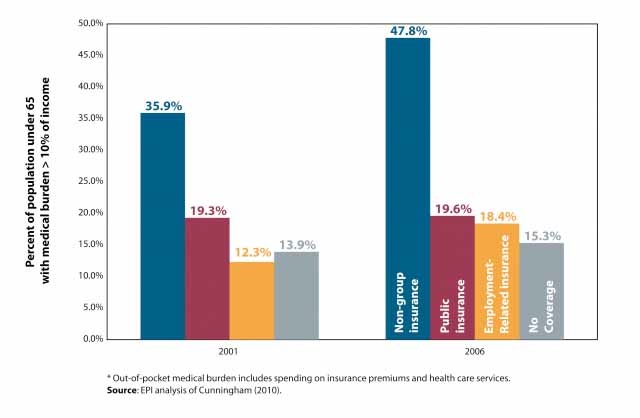
The graph shows the proportion of those covered with various types of Health Insurance paying more than 10% of their income out of pocket (not covered by insurance) for medical expenses.
Note the poor coverage offered by the non-group insurance when compared with the relatively stable public insurance.
Medicynical Note: Insurers would like us all to be in the individual group. Basing their premiums on a person’s pre-existing condition so as to charge those with illness more (perhaps so much that insurance is unaffordable). Incidious as it may seem their unstated goal is to make health insurance unaffordable for those who use it, and need it most. How else to explain the huge rate increases being requested in various locales by insurers on people with individual coverage.
Alternatively, insurers offer insurance that is less comprehensive with more out of pocket expenses as noted in the graph.
At a minimum insurers offerings must be based on community risk rather than individual risk. This assures insurability for those with the misfortune of having and developing problems. For this to work as has been noted by our government, economists and others caring about the issue, an insurance mandate is necessary–similar to that used in car insurance.
Posted in General Cynicism
The Health insurance industry, like the pharmaceutical industry, is enjoying record profits for the third year in a row.
There’s no recession when you can charge cost plus and eliminate those who need to use insurance:
The UnitedHealth Group, one of the largest commercial insurers, told analysts that so far this year, insured hospital stays actually decreased in some instances. In reporting its earnings last week, Cigna, another insurer, talked about the “low level” of medical use.
Yet the companies continue to press for higher premiums, even though their reserve coffers are flush with profits and shareholders have been rewarded with new dividends. Many defend proposed double-digit increases in the rates they charge, citing a need for protection against any sudden uptick in demand once people have more money to spend on their health, as well as the rising price of care.
Medicynical Note: Part of the reason is decreased demand for services because of high deductibles and co pays.
What’s also likely is that businesses are, increasingly, not offering insurance as an employee benefit and/or the insurance offered is too expensive for those in low paying jobs. Our non-system is cleverly designed to push those with illness out of work sponsored coverage and into the individual market. For example if you become ill and can’t work for a time, you lose your work sponsored insurance. You can purchase it through COBRA but that’s much more expensive as are policies on the individual market. For those with marginal income (probably most of the citizens in a country with a median income of $50,000/year) insurance suddenly becomes unaffordable and unattainable just when you need it most.
Devilously clever are those insurance guys!
Posted in General Cynicism
Hospitals in Indiana are dealing with the worst drug shortage in at least a decade, forcing them to briefly delay cancer treatments, scramble for supplies or use other medications.
The University of Utah’s Drug Information Service has tracked drug shortages for the past 10 years. Shortages have increased steadily during the past four years and now include chemotherapy drugs, antibiotics, painkillers and electrolytes used for liquid nutrition.
In 2007, the number of shortages shot up to 129 from 70 the previous year. Last year hit a high of 211. The first quarter of this year has already seen 89 drugs in short supply.
The reasons behind the shortages are as varied as the drugs involved. Many of the drugs are generics, which are less profitable than other drugs to produce, so a company may slow or stop production.
Medicynical Note: In our non-system patient care, efficiency and value are not our department. It’s about the money.
Costs are a dirty word in medicine. Physicians piously pronounce that they wouldn’t want money to influence their decisions and many patients become irate at the thought that their care might be modified somehow, even if it doesn’t effect outcome, by cost.
A modest study reported in the May Archives of Surgery (behind pay wall) and noted in Healthday found that simple reminders of cost led to more efficient use of a low cost procedure phlebotomy:
“The use of laboratory tests has been rapidly increasing over the past few decades to the point where phlebotomy is a substantial proportion of hospital expenditure, and much of it is unwarranted,” wrote Dr. Elizabeth A. Stuebing, of the University of Miami, and Dr. Thomas J. Miner, of Brown University in Providence, R.I.
At the start of the study, average per-patient daily costs were about $148 and the overall weekly cost was $36,875. During the study, the lowest per-patient phlebotomy charge was $108 (27 percent lower) and the lowest overall weekly cost was $25,311. By the end of the 11-week study, about $55,000 had been saved, according to the researchers.
Medicynical Note: Our non-system provides incentives for utilization not savings. As a result it’s the most expensive and inefficient in the world. We are number one!
Imagine if providers were asked about need and alternatives for expensive interventions and treatments? And reminded about the costs of “necessary” procedures? Imagine if insurers were reminded about costs, administrative costs, duplication and executive salaries.
We do things in health care that make little medical or economic sense. We can continue on the current path, and continue to ration care economically (the republican solution) or do it more rationally.
Posted in General Cynicism, Health Economics
A friend of a friend recently had a hip replacement and during her recovery began to feel week and enervated. She was on coumadin to prevent blood clots, iron and hydrocodone.
She became alarmed with the fatigue and called her surgeon and promptly was referred to the ER.
It turned out her problem was a early urinary infection and moderate dehydration.
Medicynical note: Our non-system is blithely unaware of cost. This patient’s issue did not require an ER visit. It was a simple outpatient problem.
But her surgeon was not prepared to care for his surgical complication even if it was minor and easily handled (and during office hours). Instead the patient and her insurer will bear the expense of a new patient evaluation in an ER and whatever expenses that were incurred. Remember ER care is the most expensive and least efficient in our non-system, particularly for non-emergencies.
This is good ole American ingenuity at work. Efficiency? Value? Not our department. Everyone makes money.
Maybe this will change with Accountable Care Organizations?
Posted in General Cynicism, Health Economics, Uncategorized
In a political year appeasing public opinion becomes increasingly important. Politicians are risk averse and their motivation to innovate is inversely proportional to the time to voting. They will undoubtedly take note of this Kaiser Foundation data:

However, changing health care is an inevitable task. Our non-system is unsustainable and far too expensive. Why is government involved? Because the private sector’s primary interest is making money not care. For example private insurers don’t have an overwhelming desire to provide coverage for those needing it most, the sick and elderly.
Since Medicare is a major reason for the large and rapidly growing national debt, growth in Medicare spending must be brought into line with growth in the gross domestic product (GDP). The most effective strategy for reducing health care expenditures is fundamental reform of the incentives provided to both patients and health care professionals. Medicare’s open-ended fee-for-service payment system is a major contributor to the high level and rapid growth of spending. In 2009, the Massachusetts Special Commission on the Health Care Payment System said that fee for service “rewards overuse of services, does not encourage consideration of resource use, and thus cannot build in limitations on cost growth.” The commission concluded that “risk-adjusted prospective global payment models that provide appropriate incentives for efficiency . . . should serve as the direction for payment reform.”1
There are good reasons to expect such incentives reform to bring a substantial cost reduction in Medicare. Prominent experts have estimated that at least 30% of U.S. health care spending represents waste or pays for poor-quality care that doesn’t benefit patients.5 In the RAND Health Insurance Experiment, the Group Health Cooperative, a prepaid group practice with global payment, provided high-quality care at a cost 28% lower than that of the fee-for-service approach. In addition to reducing the direct cost of care, global prospective payment would eliminate large paperwork burdens. Physicians and hospital managers frequently say that they could reduce costs without harming patients and would do so if the fee-for-service system didn’t punish them with reduced revenue. In Madison, Wisconsin, where many cost-conscious state employees choose plans featuring global payment, prices are significantly lower, and premium growth significantly slower, than elsewhere in Wisconsin, where fee for service is more prevalent.
And some principles to achieve cost control and coverage:
PRINCIPLES OF MANAGED COMPETITION
• Guaranteed right to enroll in the plan of the consumer’s choice
• Same price to all consumers for same coverage
• Periodic open enrollment for covered beneficiaries, managed through an exchange • Consumers fully responsible for premium differences
• Risk-adjusted payments by government or employer (adjusted for age, sex, health conditions, and geographic area) that are high enough to keep the least costly plan affordable
• One or a few standard coverage contracts to make comparisons easy and simplify provider billing
• Reliable and unbiased accessible information on prices, quality, and consumer satisfaction • Insurance transactions through an exchange to facilitate consumer choice and achieve economies in marketing
WAYS TO CUT COSTS WITHOUT REDUCING THE QUALITY OF CARE
• Implement best practices for prevention of infections • Strengthen primary care for prevention, early detection, and treatment
• Align incentives of providers with needs of members for affordable care
• Use active management of chronic diseases to reduce need for inpatient care
• Match resources used to the needs of population served
• Share comprehensive longitudinal medical records to improve physicians’ knowledge of patients’ history and eliminate duplication of tests
• Outcomes management: track patient outcomes and feed results back into decision making
• Implement effective evaluation, selection, and purchasing of drugs and devices
• Substitute less costly personnel where equally or more effective
• Continuously improve quality and redesign processes
• Rely on evidence-based guidelines to eliminate unwanted variation and accelerate application of the latest science
• Use information technology for caregiver support tools such as reminders, alerts, and secure messaging between doctors and patients
Posted in General Cynicism, Health Economics
 Medicynic