For Profit Hospices: Taking Advantage

It’s hard to imagine that our non-system could subvert the concept of Hospice care. But as we know, money make people (and corporations) do funny things. Hospices lobbying:

The nation’s two largest for-profit hospice companies, Vitas and Gentiva, have together spent $1,188,100 on lobbying this year, records show. Their top priority is a bill by Sen. Ron Wyden, D-Ore., that would require the Centers for Medicare and Medicaid Services, which runs the Medicare program, to test a new payment system for two years

and:

Vitas paid $390,000 to Washington lobbyists, according to lobbying reports. The company receives 90% of its revenue from Medicare and Medicaid, according to its filings with the Securities and Exchange Commission. The document shows they are lobbying because “Medicare and Medicaid programs are increasing pressure to control health care costs and to decrease or limit increases in reimbursement rates.”

Medicynical Note: Lobbying to keep their profits up, Medicare costs up, and to presumably protect themselves from a series of fraud investigations for which they have paid multiple fines. These institutions care more for the “comfort” of their bottom lines than that of their patients.


Medicaid Pays less than Medicare for drugs

One would think that drug company pricing to government health care programs (Medicare and Medicaid) would be the same. Guess again!

Medicaid gets much deeper discounts on many prescription drugs than Medicare, in part because Medicaid discounts are set by law whereas Medicare prices are negotiated by private insurers and drug companies, federal investigators said Monday in a new report.

And:

Medicaid and Medicare receive discounts in the form of rebates, which are paid by drug manufacturers when their products are dispensed to people enrolled in the programs.

The inspector general, Daniel R. Levinson, found that rebates reduced spending on 100 widely used brand name drugs by 19 percent in Medicare and by 45 percent in Medicaid. After taking account of the rebates, Mr. Levinson said, Medicaid paid significantly less than Medicare for the same drugs.

Medicynical note: Negotiating for higher discounts would save an estimated 49 billion dollars over ten years.

A billion here and a billion there, soon we’ll be talking real money.

Why Don’t the New “Targeted” Cancer Drugs Work Better — Because It’s Complicated

Every wonder why the new cancer advances, such as bevacizumab (Avastin), gefitinib (Iressa), cetuximab (Erbitux), trastuzumab (Herceptin) and so on, don’t work in most patients? Why their benefit is often hardly measurable? And why they cost so much (up to and over $100,000/year)

The reason is that cancer is complicated: (From the American Association for Cancer Research Meetings and the NY Times):

Through a series of random mutations, genes that encourage cellular division are pushed into overdrive, while genes that normally send growth-restraining signals are taken offline.

With the accelerator floored and the brake lines cut, the cell and its progeny are free to rapidly multiply. More mutations accumulate, allowing the cancer cells to elude other safeguards and to invade neighboring tissue and metastasize.

And:

But recent discoveries have been complicating the picture with tangles of new detail. Cancer appears to be even more willful and calculating than previously imagined.

Most DNA, for example, was long considered junk — a netherworld of detritus that had no important role in cancer or anything else. Only about 2 percent of the human genome carries the code for making enzymes and other proteins, the cogs and scaffolding of the machinery that a cancer cell turns to its own devices.

Medicynical Note: Read the article. It’s fascinating and makes clear that there are many unanswered questions and that a “cure” for cancer is not likely to happen soon.

Regarding cost, drug companies simply take advantage of the sick and infirm and overcharge.


Medical Bribery: Boston Scientific and Payments to Cardiologists

A whistleblower at Madigan Army Medical Center believes he is a victim of retaliation for his efforts. For a time, two cardiologists at Madigan received payments from a medical device manufacturer (Boston Scientific). The cardiology department at the time insisted only on using devices from that manufacturer. The cardiologists, who were found in conflict with the Army’s policy, maintain their patient care judgment was not prejudiced.

Subsequently

Eisenhauer (Medicynical note: the whistleblower) says his own reputation and career came under attack from his supervisors at Madigan, located at Joint Base Lewis-McChord, south of Tacoma. “Not only did they do nothing to correct the situation, they participated in a scheme to run me off,” said Eisenhauer, who was awarded a Bronze Star service medal for his duty in Iraq in 2009. “It was easier to discredit me than address the criminal activity.”

It should be noted that:

investigation resulted in a guilty plea by Maj. Jason Davis, then Madigan’s chief of cardiology, who admitted to taking more than $4,800 in illegal payments from Boston Scientific.

The long-standing practice of drug companies and medical-equipment manufacturers offering doctors free trips, speaking honorariums and other payments is controversial. Critics say the money may often represent kickbacks for favoring a company’s drugs or devices.

Still, in civilian practices such payments are generally considered legal. In the military, however, doctors are prohibited from taking such payments. (Medicynical Note: Not very reassuring)

Read the article for details on the hassles Eisenhauer faced and the reasons he left the military.

Medicynical Note: The problem was deeply rooted at Madigan, and according to Eisenhauer 1.2 million dollars in sole-source acquisitions, presumably in cardiology alone, were pushed through. Imagine the cost if similar practices are extant at other military facilities–as they undoubtedly are.

Consider also the cost implications of such bribery (for lack of a better description) on the more massive civilian health care sector.


Trovan, Nigerian Children and Pfizer’s Inappropriate Drug Trial

Pfizer is in a long running dispute with the Nigerian government and parents regarding children who died during a meningitis epidemic in 1996.

For background from a 2009 article:

Kano’s infectious diseases hospital, a small collection of concrete buildings inside a sandy compound, was overwhelmed, even after teams from Médecins sans Frontières arrived. They were dealing with not one but three epidemics – measles and cholera had broken out as well. Children were being seen and treated in overcrowded halls and corridors. It was chaos.

And then a chartered DC-9 flew in from the US. On board were doctors from Pfizer, the world’s biggest pharmaceutical company, and better medical equipment than the African town had ever seen. They had come to conduct a trial of an oral antibiotic called Trovan, which they wanted to test in children with meningitis against the “gold-standard” treatment of the western world, ceftriaxone. They took over part of the hospital and dosed 200 children, half with Trovan and half with ceftriaxone. And then they left, leaving behind some surplus drugs and equipment for the hospital.

Using a local facility for the purposes of testing a new unproven drug already raises ethical questions. Arriving and in cold-blooded fashion selecting just 200 patients for participation in the trial and then leaving with the epidemic still raging is at least insensitive and at worst, a damning example of the drug company’s opportunistic quest for profits.

Even worse, the Pfizer never intended the drug for use in Africa, the testing against meningitis there was simply a quick and very dirty way to accrue patients.

But the drug is not to be found in African pharmacies. It was trialed on African children, but never intended for Africa. Pfizer aimed to sell it in the USA and Europe – and yet its licence was withdrawn in Europe because of concern over liver toxicity. It is not licensed anywhere for children.

Pfizer maintained that what they did was “ethical” and that they provided the drug free of charge during an epidemic.

A suit is has been in progress in Nigeria and in the process of being settled.

The world’s biggest research-based pharmaceutical company announced on Thursday that it had made payments of $175,000 (£108,000) to each family. More such compensation settlements are expected to follow.

Also:

Legal action filed against the company alleged that some received a dose lower than recommended, leaving many children with brain damage, paralysis or slurred speech.

US-based Pfizer had argued that meningitis and not its antibiotic had led to the deaths of 11 children and harm to dozens of others. But in 2009 it reached a tentative out-of-court settlement with the Kano state government worth $75m.

And:

The cable reported a meeting between Pfizer’s country manager, Enrico Liggeri, and US officials at the Abuja embassy on 9 April 2009. It stated: “According to Liggeri, Pfizer had hired investigators to uncover corruption links to federal attorney general Michael Aondoakaa to expose him and put pressure on him to drop the federal cases.”He said Pfizer’s investigators were passing this information to local media.”

Pfizer has subsequently denied the contents of the cable.

Medicynical Note: Pfizer’s insensitivity is quite remarkable. What’s more cynical than delaying resolving this mess for 15 years? What’s more cynical than testing a drug in a place where you never intend to market it–because it will be too expensive? What’s more cynical and opportunistic than flying in a research team in the middle of an epidemic to do drug trials……and then leaving?

It’s enough to give us all, my profession and the formerly “ethical” drug manufacturing companies, a bad name.

New Gene Therapy — Hype for Funding?

Nice articles, here and here, on a new appoach to chronic leukemia. In a phase 1 study (study to evaluate toxicity) the approach seems to have activity.

Two participants in the Phase I trial have been in remission for up to a year. A third had a strong anti-tumor response, and his cancer remains in check. The research group plans to treat four more patients with CLL before moving into a larger Phase II trial.

Just 3 patients have been treated. That there is evidence of efficacy is hopeful but certainly not conclusive.

It should also be noted that:

All of the funding for the University of Pennsylvania’s gene therapy work has come from the academic community, but the work is expensive.

“We are looking for corporate partners as we head into Phase II trials,” Kalos said.

Medicynical Note: The study does give hope for a new approach to refractory leukemias, and it may well be applicable to other tumors.

The funding for this study, the basic research and initial phase 1 trial in all likelihood came from public money, federal grants and such–“from the academic community.” As implied, the researchers are courting corporate sponsors to fund further studies.

In our “system” you and I fund the training and research of basic scientists and their advances and then allow, and, yes, even encourage them to sell their advance to industry for commercialization. If the drug is useful, even marginally so, we get to pay the inflated price demanded by Pharma for a generation (the patent protected time period), with no credit for the funding of the initial advance.

It heads you lose, tails they win.

Our Non-system of Health Care: International Comparisons

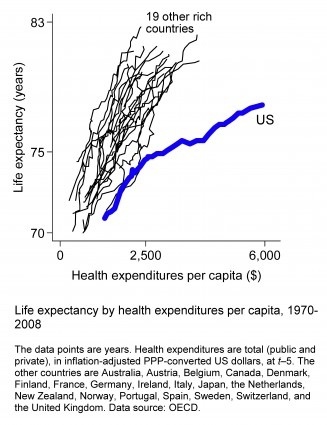
Out health care costs are out of control. We pay more and get limited benefit from our huge expenditure. We lead the world in health care related bankruptcy, hospital expenditures, drug costs, physicians pay, and the proportion of our population without health insurance. We are number 1.

The 2011 analysis of the US health care (non) system suggests that the reasons for our expenditures are “substantially higher prices and more fragmented care delivery that leads to duplication of resources and extensive use of poorly coordinated specialists.”

And concludes that:

Despite much higher spending, U.S. performance in terms of quality is variable relative to other countries. While cancer care in the U.S. seems to be of particularly high quality based on five-year survival rates, the high rates of hospital admissions for chronic diseases suggest opportunities for improvement.

Some graphics from the study:

On Hospital spending:


On comparative costs:


On Cancer survival:


Medicynical Note: It’s wonderful that our cancer survival is somewhat better than elsewhere, but if we accept that as true we also have to accept the shortcomings identified in the study and noted above.

The debate on the conservative side hinges on whether health care in the US should be a right of citizenship. It’s seems somewhat irrational to maintain such reasoning, tantamount to trying to reclaim virginity, when these same conservative friends continually laud U.S. Health Care for providing “free” access to ER’s for all. Is this not a form of defacto health care for all albeit inefficiently and poorly instituted.

Their reasoning, in some ways, is not surprising. After all, what other form of care would the most expensive inefficient health care non-system provide? And it goes without saying that it is not free. Can’t we do better?


Drug Prices

It’s an amazing fact that we pay more, much more than any other country in the world for medications(read the Incidental Economist link). More than double what New Zealand pays:

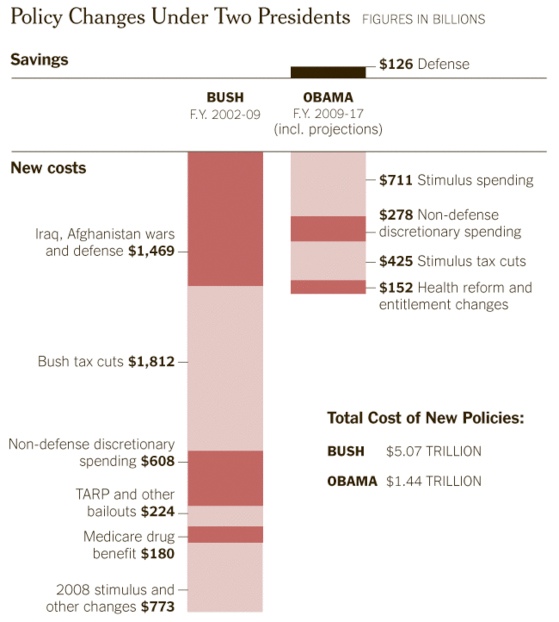
Medicynical note– Our republican congress during the Bush years wouldn’t agree to negotiating prices with drug companies when Medicare part D passed. After all we wouldn’t want to stress the poor drug company’s profits. Health care? Quality? Value? Not our department.

Creationism Evolving? Intellectual Respectability at Stake?

It’s difficult to believe that in the early part of the 21st century there should be finding the debate amongst evangelicals regarding the existence of Adam and Eve or that it should be of any interest. Perhaps this is a significant moment for American church people that will allow them to reclaim a modicum of intellectual respectability……….or not.

But now some conservative scholars are saying publicly that they can no longer believe the Genesis account. Asked how likely it is that we all descended from Adam and Eve, Dennis Venema, a biologist at Trinity Western University, replies: “That would be against all the genomic evidence that we’ve assembled over the last 20 years, so not likely at all.”

And:

Evolution makes it pretty clear that in nature, and in the moral experience of human beings, there never was any such paradise to be lost,” Schneider says. “So Christians, I think, have a challenge, have a job on their hands to reformulate some of their tradition about human beginnings.”

Medicynical Note: Who knows what’s next? That earth is billions of years old? Acceptance of evolution as the best explanation of man and life on earth? Acceptance of the bible as a book of nice stories?

Or perhaps, more likely, banishment and ostracism of the heretics.

Money, Profits and Hospice — Undermining an Essential Program

A review of Hospice spending shows an alarming change in mission goals from patient care and comfort to profits;

From 2005 through 2009, Medicare spending on hospice care rose 70% to $4.31 billion, according to Medicare records.

A recent report by the inspector general for Health and Human Services, which oversees Medicare, found for-profit hospices were paid 29% more per beneficiary than non-profit hospices. Medicare pays for 84% of all hospice patients.

The article highlighted the investigation of the two largest corporate hospice providers and their alleged fraudulent claims.

Medicynical Note: Trolling nursing homes for “hospice appropriate” patients apparently has become a way to increase revenue. It’s bizarre that Hospices thought it necessary to offer services to patients already in full-time nursing facilities. Two service providers, the nursing home and the hospice, being paid for providing what are, for the most part, the same nursing and support services is a irresistible recipe for waste and in this case fraud.

It should be evident that industry seeks to maximize profit. That’s what capitalism is about. In health care that means leveraging control over products and services by testing the limits of programs–in this case illegally increasing the patient base. It’s an irresistible urge that CEO’s simply can’t resist.

Patient care? Value? Cost Efficiency? Not their department.