
Category Archives: Health Economics

Health Care for all–errr, for all who can afford it

Employer based insurance is failing. It doesn’t work for employers, many of whom can’t afford to provide coverage, particularly those with lower income employees. And it doesn’t work for the employee who either has no insurance or has to spend a significant proportion of income to buy coverage.

McKinsey Quarterly notes that :

“In 2005, employer-paid health benefits covered 22 percent of households in the bottom-income group, contrasted with 56 percent of the lower-middle, 81 percent of the upper-middle, and 89 percent of the top income group”

To understand the magnitude of costs relative to income:
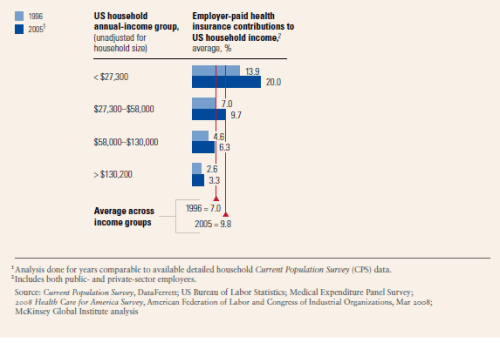
You will note for those earning under $27,000 dollars/year, health insurance costs are in the range of 20% of income, while for those earning over 130,000/year it’s just 3.3%.

Meanwhile Ramesh Ponnunu (of the National Review) in an OP-ED, advocated a move away from employer provided health insurance. Medicynical note: Can’t argue with that as I believe the employer based insurance system has failed.

His approach, however, would allow employers to drop health insurance and provide a tax credit to the employee to buy insurance on the private, individual market. He argued that this will bring market forces to bear on health care costs.

His plan discounts the high cost of insuring those with illness, that of course is the whole point of health insurance saying vaguely that they would be provided subsidies to buy coverage. He also neglects the issue of below average income people (after all that is 50% of the population) and the high cost of health insurance, relative to income.

His tax credits, as I understand it, will provide a decrease in the amount of taxes paid. But it won’t provide relief for a significant part of our population. For example, families and individuals with $27,000 or less income have no tax liability (see here).

We can do better than this.

Powered by Zoundry Raven
A Misguided Argument Against Universal Health Care

An oped in the NY Times claims the quest for universal health care is misguided. Ramesh Ponnuru’s arguments, McCain revisited, are notable for what they don’t say.

” For people with pre-existing health problems, for example, direct subsidies would probably be more efficient than rigging insurance markets to make sure they are covered.”

Medicynical note: Sooner or later everyone will have a health problem. At that point the insurer will be “free” to increase the patient’s premiums and force those unable to afford the new higher rate out of the policy. Imagine a health insurance system demoniacally rigged to protect the insurer not the beneficiary. Guess who would provide the direct subsidy? A solution that solves nothing. Brilliant!

He follows immediately with

“As Michael Cannon, a health policy analyst at the Cato Institute, has written, “There is no evidence that a dollar spent on universal coverage will save more lives than a dollar spent on clinics, or reducing medical errors, or nutrition, or fighting poverty, or even improving education.” And if universal coverage generally reduces the quality of care or retards medical innovation, it could end up being bad for everyone, including the poor.”

Medicynical note: This is irrelevant to the argument preceding. It should be noted that our friends at Cato have not shown much enthusiasm for any of the mention interventions–nutrition, fighting poverty or improving education.

He then argues for a non-employer based system without any protections that the coverage will meet minimum needs:

“The existing tax break for employer-provided insurance could be replaced with a tax credit that applies to insurance purchased either inside or outside the workplace. At the same time, state mandates that require insurers to cover certain conditions, which make it expensive to offer individual policies, could be removed”

Medicynical note: Private health insurers salivate at the idea that they would be allowed to offer policies to the healthy that do not meet the needs of those with illnesses. What better way to force high cost patients out of their system. This is not health insurance it’s highway robbery.

In Ponnuuu’s world the employer’s current contribution to health insurance disappears into the employer’s profits. Employees are offered the sop of a tax credit to pay for new coverage obtained in a “not so free market.” No mention is made of the insurer’s ability to increase rates on individuals with chronic illness, cancer, heart disease, you name it. The market is not at all free to those with illness or without savings. The superficiality of the proposal is amazing.

Powered by Zoundry Raven

Medical Tourism and HSAs– Fatally flawed or healthy competition?

Today’s NY Times has an article on medical tourism.

It reports on a patient who went to Costa Rica for double hernia surgery. The financials on his decision were as follows:

“No longer covered under his former employer’s insurance and too young to qualify for Medicare , Mr. Schreiner has a private health insurance policy with a steep $10,000 deductible. Not wanting to spend all of that on the $14,000 his operation would have cost stateside, he paid only $3,900 in hospital and doctor’s bills in Costa Rica.” Medicynical note: Plus airfare and accommodations.

Proponents of Health Savings Accounts often use the medical tourist to illustrate that the market can work in health care and to promote the notion of HSAs as a fix for our dysfunctional health care system.

For whom does a high deductible health insurance product work?

Who in our culture can afford a $10,000 deductible? If this wealthy retired bank executive didn’t want to pay it, how will those families earning less than the median income manage?

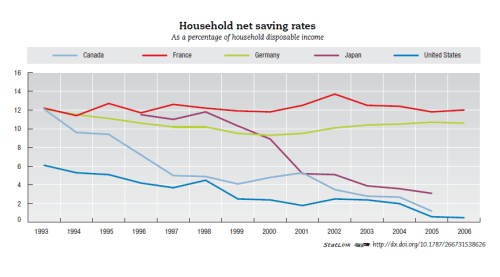
HSA proponents postulate that if used over many years the savings aspect of the HSA would be able to cover the deductible. In the real world however, half or more of our population do not have the discretionary income to put such money away–check out the rate of savings (see above) in the U.S. over the last 15 years. Furthermore, have look at the costs of care in the U.S. system. How long will savings in an HSA last in any significant illness? How will the savings needed for an HSA affect retirement savings of families living with incomes below the median ($50,000/year)?

HSA’s are designed to finesse the system, they are marketed heavily by various conservative organizations and insurers who believe free markets work in health care–no evidence anywhere in the world that this is so. Why do insurers like HSAs? Because HSA’s offer an opportunity to segment the health care market and skim off the lowest risk customers. HSA’s, with high deductibles and lower premiums, attract the young who are a low risk of illness, the healthy who do not expect to be sick and the wealthy for whom out of pocket expenses are not a problem.

However for the health care system as whole, for those who are chronically ill and those without money, HSAs are a dead end that create more problems than they solve. Consider the patients seen at a free clinic, as described in this LA Times article. They’re not quite as chirpy and self satisfied. They are stuck in a non-system of care that doesn’t work for them. HSA’s are not a consideration for them.

What happens to those with an HSA who become ill, lose their job and can’t afford the high deductible? What happens when a sick person with an HSA receives his next insurance bill and notes his rate has doubled? Where do those who can’t afford the financial outlays that an HSA demands get their care (Hint, read the LA Times article)?

Care to guess who ultimately pays? We can do better.

Powered by Zoundry Raven

Costs, the elephant in the universal health care closet

The Massachusetts health plan is looking at better ways to finance their universal system. With universal coverage expenditures/capita have risen above the already outrageous national average of about $8,000/year.

“They want a new payment method that rewards prevention and the effective control of chronic disease, instead of the current system, which pays according to the quantity of care provided.

It appears it was a mistake not to control costs in the first place:

“Those who led the 2006 effort said it would not have been feasible to enact universal coverage if the legislation had required heavy cost controls. The very stakeholders who were coaxed into the tent – doctors, hospitals, insurers and consumer groups – would probably have been driven into opposition by efforts to reduce their revenues and constrain their medical practices, they said.”

Some good things are happening:

“Frankly, it’s very hard for the average consumer, or frankly the average governor, to understand how some of these companies can have the margins they do and the annual increases in premiums that they do,”

“Insurers seeking to participate in the state’s subsidized insurance program, Commonwealth Care, recently submitted bids so low that officials announced last week that they would keep premiums flat in the coming year.”

But:

“Some health policy experts argue that changes in payment practices will not be enough to slow the growth in spending, even when combined with other cost-cutting strategies. To truly change course, they say, the state and federal governments may need to place actual limits on health spending, which could lead to rationing of care.”

Medicynical note: In a system that has institutionalized excess expenditure at every level change is difficult. We need to look at every level in the supply chain and question costs and demand more efficiency. Cutting some of the fat out of the insurance business is a start. I’ve focused on reforming patents in the past and that’s also a possibility.

Lastly we already ration care by cost. In oncology for example, patient delay is a significant cause of morbidity and mortality. People who can’t afford to pay simply delay or completely forgo treatments.

Powered by Zoundry Raven

Health care Value Gap

The Business Round Table seems to think we have a health care crisis.

“Americans spend $2.4 trillion a year on health care. The Business Round table report says Americans in 2006 spent $1,928 per capita on health care, at least two-and-a-half times more per person than any other advanced country.”

“What’s important is that we measure and compare actual value – not just how much we spend on health care, but the performance we get back in return,” said H. Edward Hanway, CEO of the insurance company Cigna. “That’s what this study does, and the results are quite eye-opening.”

“Higher U.S. spending funnels away resources that could be invested elsewhere in the economy, but fails to deliver a healthier work force, the report said.”

Medicynical note: As expected, despite the waste in our private system, this group recommends health care remain largely as is  with a government safety net for low-income people. What they neglect to mention is that the private, for profit, system is designed to make us all low-income people by fostering the waste of duplicated administrative services, overuse of unproven approaches and not evaluating the cost effectiveness of interventions.

Powered by Zoundry Raven

Patents and Generic Drugs

President Obama is addressing the issue of moving generic drugs more quickly to market. Big PHARMA has had it’s way for the last 60 years with cost increases for medications far above the inflation rate. We now have drugs, single medications, that cost more than automobiles and over a lifetime more than the average home. Imagine, a single drug being the most expensive purchase of a lifetime. That’s the unsustainable monster we’ve created. More here from the Washington Monthly.

A medicynical approach would be to have market based patent durations. If priced reasonably a full patent would be awarded, if priced excessively the length of patent would be proportionally reduced. The devil, of course, is in the details.

Powered by Zoundry Raven

Legislative License to Practice?

I don’t understand how state lawmakers have the license to legislate the use of specific tests and in some cases procedures, without a consensus from the medical community. Yet that’s what’s happening in the Washington State legislature where a requirement that patients in hospitals be screened for resistant staphylococcus is currently being considered, over the objections of the medical community.

Indiscriminate testing is a slippery slope. For example, should we also test all people in nursing homes? How about periodic screening of all health care providers? Caregivers? Visitors? Where does this lead?

Does mandated testing have a role when when the “epidemic” of staph in our hospitals, in Washington State, appears to be coming under control with the incidence of the disease dramatically declining. Should we accept legislative grandstanding that mandates testing and likely expensive expenditures? Or should we consult with and trust our best clinicians and accept their recommendations?

Powered by Zoundry Raven

Comparison Studies in Medicine

Our current pharmaceutical company financed research system is an elegantly designed facade that elevates drug marketing over science. It is a fact that more is spent on marketing than research. Big PHARMA finances “safe” studies that often don’t compare results with the best available alternatives–often much less expensive. Afterall why take the chance that a new and very expensive medication/advance is not better?

It’s hard to believe that we needed legislation for this.

Powered by Zoundry Raven

A Corrupt System of Care

This, in the Wall Street Journal, describes the reality of the uninsured and under-insured. Guess who will ultimately pay?

“Hospitals are adopting a policy to improve their finances: making medical care contingent on upfront payments.”

“The bad debt is driven by a larger number of Americans who are uninsured or who don’t have enough insurance to cover medical costs if catastrophe strikes. Even among those with adequate insurance, deductibles and co-payments are growing so big that insured patients also have trouble paying hospitals.”

“Asking patients to pay after they’ve received treatment is “like asking someone to pay for the car after they’ve driven off the lot,” says John Tietjen, vice president for patient financial services at M.D. Anderson. “The time that the patient is most receptive is before the care is delivered.”

Medicynical note: For these patients with cancer it is pay or die. One can only speculate on what happens to those who can’t pay. Is this what we, as a society, desire?

Powered by Zoundry Raven

Litigate to delay

Pay to delay is strategy of pharmaceutical companies whereby the owners of a drug patent pay (bribe?) generic manufactureres to not market generic competition for their patented agent.

“lucrative settlements between generic and branded drugmakers have flourished. According to the FTC, nearly half of all settlements between 2006 and 2007 involved payments to keep low-cost drugs off the market.”

Imagine, our non-system facilitates keeping drug costs high. What a system.

Powered by Zoundry Raven