Category Archives: Health Economics

Avastin fails to Prevent Colon Cancer recurrence

Genentech has released preliminary results on the use of Avastin in adjuvant therapy of colon cancer. The treatment failed. (Adjuvant treatment is given to selected patients, generally Dukes 3 colon cancer, after complete resection in hopes of preventing recurrence) Details will be presented at the ASCO meetings in May.

The article in the NY Times notes:

“The existing chemotherapy already keeps about 70 percent of colon cancer patients free of the disease three years after their surgery.”

However, it’s not correct to state that current treatment keeps 70% of people free of cancer. If people who receive treatment were compared to those who did not, the benefit would be about 10%. That is, the recurrence rate would be around 40% for those not treated and 30% for those receiving treatment. That means 30% will recur no matter what we do and 60% wouldn’t recur (in the time period) without therapy.

This article notes the limited efficacy of treatment vs placebo.

“1526 patients with resected B (56%) and C (44%) carcinoma of the colon were enrolled and 1493 were confirmed as eligible. 736 were assigned to the treatment group and 757 to the control group. Fluorouracil/folinic acid significantly reduced mortality by 22% (95% CI 3-38; p = 0.029) and events by 35% (22-46; p < 0.0001), increasing 3-year event-free survival from 62% to 71% and overall survival from 78% to 83%. Compliance with treatment was good; more than 80% of patients completed the planned treatment.”

More recent regimens don’t appear to do much better:

“Oxaliplatin has significant activity when combined with 5-FU-leucovorin in patients with metastatic colorectal cancer. In the 2,246 patients with resected stage II or stage III colon cancer in the MOSAIC study, the toxic effects and efficacy of FOLFOX4 were compared with the same 5-FU-leucovorin regimen without oxaliplatin administered for 6 months.[27] The preliminary results of the study with 37 months of follow-up demonstrated a significant improvement in DFS at 3 years (77.8% vs. 72.9%, P = .01) in favor of FOLFOX4. When reported, there was no difference in overall survival.”

I don’t want to imply that treatment is completely ineffective as some people do not recur after therapy. It is however inefficient in that the great majority of patients receive no benefit.

Using a very expensive drug such as Avastin ($50-100,000 for a course of therapy) for this indication should lead to concerns about cost efficiency and the cost of a QALY (Quality Adjusted life Year). In this case the drug failed but drug companies view adjuvant use as one of the most profitable, and I don’t necessarily mean beneficial, areas and will continue trials.

Powered by Zoundry Raven
Pharmaceutical Patents Part of the problem

Drug companies claim the U.S. patent system encourages development of new drugs and that the high prices are a necessary corollary. (see this) Others have questions regarding the monopolistic practices legalized by the system. This FDA Backgrounder, and this chapter from Against Intellectual Monopoly by Michele Boldrin and David K. Levine offer more background information.

Wikipedia defines a patent as a “set of exclusive rights granted by a state to a person for a fixed period of time in exchange for the regulated, public disclosure of certain details of a device, method, process or composition of matter (substance) (known as an invention) which is new, inventive, and useful or industrially applicable.” The right to produce the product protected by the patent is subject to further regulation by various regulators.

The regulator of drug patents in the United States is the FDA. Over the years the rules governing drug patents have evolved. Some milestones include:

1938 Federal Food, Drug, and Cosmetic Act : For the first time it was required that a drug be shown safe.

1962 Kefauver-Harris Drug amendment: Required that the drug be proved effective before marketing.

1980 Dole-Bayh– Prior to this products developed under federal grants were in the public sphere. To encourage commercial development of these advances individuals and institutions were allowed to patent these developments and even license or sell the patent to private companies.

Products developed to a major extent with public funds, such as imatinib (Gleevac) and bevacizumab (Avastin), are taken private and the public then gets to pay whatever the drug company or developer wishes for the technology. The result of Dole-Bayh has been medical progress at a tremendous cost. Basic research has suffered as workers are continually looking for something to take private-akin to hitting the lottery. We’re talking tens to hundreds of millions of dollars in fees to the individuals and the sponsoring university of such research. This has literally changed the landscape of medical research and not all for the better. See this article for the rationale and the unintended consequences.

In part because of Dole-Bayh, prescription prices in the past 25 years have increased astronomically. The price of newly patented oncology medications has increased to 50-100 times the level of the seventies, 15-20 times that of the 80’s. Between 1990 and 2001 the average price of all types of prescriptions tripled. Not surprisingly drug profits, after paying all costs of development including research and drug promotion, are at the unprecedented level of 18-20 % of revenue. Some think Dole-Bayh as currently applied is a giveaway to the industry. They further maintain that the law has provisions calling for reasonable pricing of government financed inventions. It’s never been enforced.

1984 Hatch-Waxman act–extended the length of patents up to 5 years (normal patent length is 20 years) to make up for the time the drug took to be approved by the FDA. It also provides for accelerated approval of generic drugs by not requiring generic companies to repeat the original research that proved them safe and effective.

Drugs that are clearly effective and safe are FDA approved and marketed promptly and do not qualify for additional patent time sanctioned by Hatch-Waxman. On the other hand many of the drugs needing additional time for approval and wanting patent extensions have marginal efficacy and/or questions regarding toxicity. That’s what delayed their approval. Ironically, the terms of Hatch-Waxman will extend patents most for drugs that may deserve it least.

The law is gamed by patent holders through legal loop holes and payments to generic manufacturers that actually delay the marketing of competing generics. It’s been a boon to lawyers. A company with a patented drug for example has been able to delay a generic by 30 months simply by raising an objection to marketing it-this was done multiple times in some instances. In addition it allowed hundreds of millions of dollars in payments between the patent holder and generic companies to delay the release of generics. There has been some attempt to control this. The Greater Access to Affordable Pharmaceuticals law passed the Senate in 2002 and was reconsidered in 2003. The FDA revised the rules of Hatch Waxman to address this issue, but the affect of these changes remains unclear. This article from the July 1 2006 Times and this from the July 3, Washington Post indicate that the pharmaceutical industry continues to game the system.

Among the criticisms of patents is the notion that patents create monopolies which almost always result in inefficiencies, stifle competition (by definition), cause higher prices, lower quality and shortages.

It’s clear that our system of care has problems with inefficiency and pricing from the patent monopoly. We have the most costly health care system in the world but have mediocre results. Prices of pharmaceuticals have reached unprecedented levels. Medicynic has previously noted pricing of new cancer drugs/year exceeds the median and average incomes in the U.S. and more. The issues of lower quality and shortages apply because of aggressive marketing of mediocre patented drugs and because people lack access because of price–a pernicious form of health care rationing.

Powered by Zoundry Raven

Big PHarma and Families USA–A Unholy Alliance

Politico reports Families USA and PHarma working together on reforming Medicaid.

Medicynical note: Medicaid reform is probably a good idea but should not take the place of a more fundamental review of health care policy, with particular emphasis on cost containment.

PHarma has one and only one goal. To promote and protect the profits of pharmaceutical companies. That’s their responsibility as the lobbying arm of the industry. It’s as close to a fiduciary responsibility as there is. They oppose a public insurance plan, oppose comparison studies of efficacy, oppose negotiation of prices for Medicare part D, oppose patent reform and by inference oppose cost containment if it effects company profits

PHarma doesn’t want reform they want surrender to their goals and objectives.

Powered by Zoundry Raven

Lilly Gross Profit of 84%– Show No Mercy

Lilly announced an earnings increase of 23% over last year’s results.

“Lilly, which reiterated its 2009 earnings target, is among a slew of pharmaceutical firms that have raised some prices aggressively.” in recent months even as government and private insurers struggle to rein in health care costs.”

“Gross margin rose to 83.8% from 76.9% (Medicynical emphasis) as the stronger dollar eased international sales costs. Total sales costs slumped 27%.”

Investopedia defines gross margin as “A financial metric used to assess a firm’s financial health by revealing the proportion of money left over from revenues after accounting for the cost of goods sold.Gross Profit = Revenue − Cost of Goods Sold.”

Medicynical Note: Big profits, seemingly defying the pull of gravity (the current financial crisis). It would seem to me that 86% margin is excessive. But then what is excess profits in a capitalistic society? The larger question is can we afford this level of profits in health care? How to limit? Should we limit?

New advances that we cannot afford have the same impact as trees falling in the woods.

Powered by Zoundry Raven

BIG PHarma–price increases over twice the rate of inflation!!

AARP is not the most reliable unbiased source, given it’s Medicare D insurance business. But it notes:

“manufacturer prices for widely used brand name prescription drugs jumped by nearly nine percent (Medicynical emphasis) in 2008, marking the largest average annual increase in six years and far exceeding the general inflation rate of just 3.8 percent.”

Big Pharma just can’t resist.

Powered by Zoundry Raven

Cost Containment

The Columbia Journalism Review has an interview with Medicare expert Marilyn Moon, vice president of the American Institutes for Research, and a former trustee of the Medicare system:

“No one has really solved the cost containment problem in this country, but Medicare has done as well as any other effort. Rising costs are not a Medicare problem but a health system problem. We have not been willing to make sure we are getting value for the dollars we spend. We have not been spending money wisely. Until everyone-providers, patients, and others who have a stake in manufacturing drugs, devices, new treatments-becomes realistic in what the system will bear, we are not going to see any reduction in the growth of health care spending.”

Medicynical Note: What will get their attention? Patent reform? The threat of a single provider system? Increased regulation of insurers? More out of pocket expenses (HSA’s)? What’s clear is something needs to be done. LBJ had an approach: “Son, it’s really simple. You grab ’em firmly by the balls. Their hearts and minds will follow.”

Powered by Zoundry Raven

Graphics on Why Health Reform

From the Baucus plan:

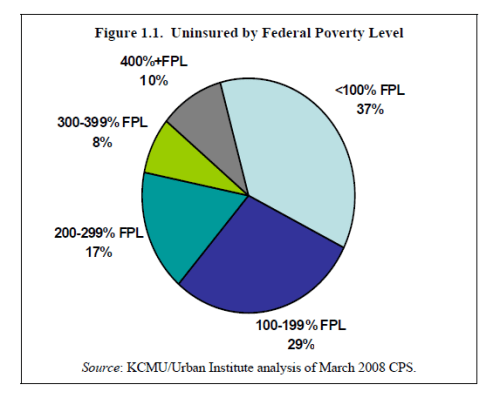
“The U.S. is the only developed country without health coverage for all of its citizens.3 An estimated 45.7 million Americans, or 15.3 percent of the population, lacked health insurance in 2007 – up from 38.4 million in 2000.4 Those without health coverage generally experience poorer health and worse health outcomes than those who are insured. Twentythree percent forgo necessary care every year due to cost. And a number of studies show that the uninsured are less likely to receive preventive care or even care for traumatic injuries, heart attacks, and chronic diseases. The Urban Institute reports that 22,000 uninsured adults die prematurely each year as a direct result of lacking access to care.”

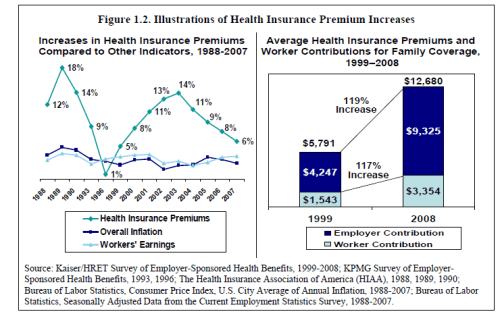
“Even before the current economic crisis, working families and individuals found their health care in jeopardy as the cost of employer-sponsored coverage rose beyond the means of businesses – particularly small businesses – and workers alike. As Figure 1.2 shows, health insurance premiums have increased faster than wages and inflation for most years between 1988 and 2007. Premiums have increased 117 percent for families and individuals and 119 percent for employers between 1999 and 2008.”

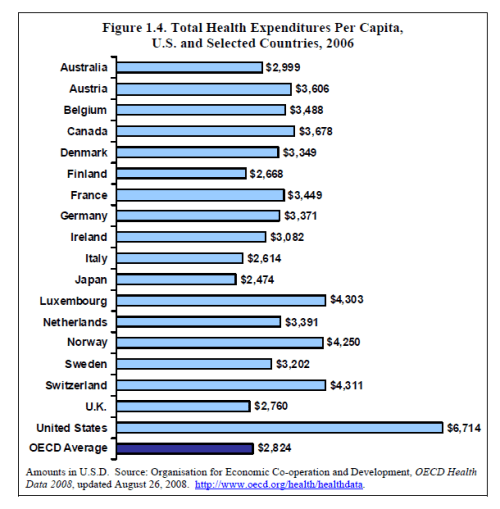
“In a study of global health care systems, journalist and author T.R. Reid found startling cost differences with the U.S. In Japan’s largely private system, the cost for magnetic resonance imaging (MRI) is less than $100, compared to $1,200 in the U.S. In Switzerland, home to profitable insurance companies and influential pharmaceutical companies, administrative costs represent 5.5 percent of total costs, compared to about 22 percent for coverage purchased in the private insurance market in the U.S.31 While there must be a uniquely American answer to the question of containing health care costs, other countries demonstrate the possibility of success.”

Powered by Zoundry Raven

Arguing Against Comparison Studies– Anti-intellectualism or Greed?

It’s hard to believe that one can argue against learning what works. But that’s exactly the position of drug and device makers in this article in the Wall Street Journal. It’s hard to believe that this is an issue.

At a minimum such studies will guide physicians in explaining benefits of, risks from and alternatives to various treatments. Comparisons will also help with analyzing the cost-effectiveness of various interventions. Whether insurers will use such data to decide what they will and will not cover is an open question.

My question is when new drugs are prohibitively expensive and have minimal effect on disease course, should insurers pay for their use? Should doctors recommend their use? Should there be limits on “choice” in health care when someone else is paying?

Powered by Zoundry Raven

Why Insurers Need Regulation–Because of the Money!

An example of the problems with “free” markets in health care–lack of coverage for expensive oral medications used in cancer care. For a number of years, oral medications have been increasingly used in cancer treatment . From Xeloda (oral 5 FU) to Gleevac (imitinab) expensive oral agents have become an integrated into treatment.

Gleevac (imitinab) one of the early targeted drugs (tyrosine kinase inhibitor in Chronic Myelogenous Leukemia) costs anywhere from $40,000/year to $90,000/year depending on dose and indication. Over a lifetime this drug becomes more expensive than most homes. Average families (Median U.S. income about $50,000/year) cannot afford such expense unless insurance provides coverage or they receive free drugs from the company.

Medicare took care of this problem with it’s Part D drug coverage. The issue with Medicare is the donut hole in coverage which requires a yearly $3,000 payment and the 5% copay after the donut payment is completed. In some cases this 5% payment can be considerable as noted in the article.

Most private insurers have lagged in providing this coverage. Oregon has now required insurers to provide equal coverage for IV and oral chemotherapy medication. The rest need more adult supervision.

Another issue is the price demanded by pharmaceutical companies. You and I grant these companies monopoly status for a generation (a patent). This is an industry/government sanctioned imfringement on free “markets”This restraint on open competition is granted theoretically to “encourage development of innovative agents.”

However, drugs priced at more than the yearly income of citizens have become simply unaffordable–by individuals as well as insurers. In other industrialized nations these same medications are priced significantly less. These countries negotiate and otherwise review new drugs and require more appropriate pricing. We need patent reform here as well.

Powered by Zoundry Raven

The Challenge of Cost Containment

Most people believe we spend too much on health care. From the April 7 Annals of Internal Medicine:

“The United States spends more than any other country on medical care. In 2006, U.S. health care spending was $2.1 trillion, or 16% of our gross domestic product. At the same time, more than 45 million Americans lack health insurance and our health outcomes (life expectancy, infant mortality, and mortality amenable to health care) are mediocre compared with other rich democracies. We spend too much for what we get.”

The Obama administration’s approach to control costs focus’s on “improving medical practice and health outcomes and changing the structure of the health insurance marketplace.”

In the category of improving medical practice Obama appears want to improve prevention services, promote health information technology (HIT), better manage chronic diseases, offer payment reforms that would pay providers on the basis of outcomes, and compare effectiveness different approaches. Yet as the article notes none of these interventions offer significant savings though they may improve outcomes and the process of health care.

Some savings are achievable through insurance reform:

“Insurance regulation can reduce costs (in principle) by limiting the resources that private insurers put into avoiding sales to less healthy customers and charging them much higher premiums. By prohibiting such medical underwriting and by requiring insurers to accept applicants regardless of health status, President Obama’s health reform approach could produce some administrative savings. An effective insurance exchange (a new agency that would offer Americans a choice of health insurance plans while also regulating insurers) can lower the high administrative costs that are typical in the current individual and small group insurance markets. In addition, the Obama platform proposed more direct limits on insurance overhead. It promised to “force insurers to pay out a reasonable share of their premiums for patient care instead of keeping exorbitant amounts for profits and administration.”

Medicynical note: This reform saves money by encouraging increased efficiency while ensuring equitable coverage.

The Annals then goes on to explore what works in other settings and concludes:

“If the United States is to control health care costs, it will have to follow the lead of other industrialized nations and embrace price restraint, spending targets, and insurance regulation. Such credible cost controls are, in the language of politics, a tough sell because they threaten the medical industry’s income. The illusion of painless savings, however, confuses our national debate on health reform and makes the acceptance of cost control’s realities all the more difficult.”

Medicynical note: We have a medical industrial complex as well organized and resistant to change as the military industrial complex that Eisenhower warned about. To achieve cost savings will require altering our cost structure and profit assumptions that have been increasingly entrenched over the past 50 years.

This article points out some false assumptions and the difficulties ahead.

Powered by Zoundry Raven