Category Archives: Health Economics

The Fatal Contradiction : The Difference between Medicare and Private Insurance

Nice summary of the philosophic difference between health insurance developed to provide care for those with illness versus insurance whose primary goal is making money.

Medicare is designed to absorb risk,  serving individuals who have or may have costly and complex medical needs as well as the relatively healthy, whereas commercial insurance is required to protect its business interests by avoiding those most likely to use medical care.  That’s why Medicare was first enacted. People over 65 were unable to buy commercial insurance because they use three times more medical services than working people; it was unaffordable or insurers simply refused to provide it.

and:

The belief that competition among private health insurance firms can produce cost savings or higher quality care represents the victory of illusion over evidence.

Read the rest of the piece, send it to your conservative friends and legislators. 

Alzheimers: Bexarotene 1200/day (Please note retraction)

I’m a bit embarrassed.  While checking on comments which were critical of this post I inadvertently deleted the original.  It was not  intended  and I am chagrined that it vaporized into the ether.

In any case the questions raised by commenters on the $1200/day pricing for the drug that I posted, appear valid.   The drug may well  cost substantially less.

My source for that pricing was from an ABC news story  which quoted an “expert:”

“The drug will cost between $1,200 and $2,500 per day out of pocket,” said Dr. Sam Gandy, director of the Mount Sinai Center for Cognitive Health in New York. Gandy said families who said they have “nothing to lose” could risk money and “unexpected side effects of a dangerous treatment, and loss of the loved one rather than the gradual deterioration from the disease.”

As noted in the original post, there is no data that indicates this drug is effective at all in humans or that the Alzheimers model in rats behaves similarly to the disease found in humans.

That said I certainly would hope for a response to treatment.

Accountable Care Organization/Global Payments Hand in Glove–Explanation

Nice clear explanation of accountable care and global payments:

  It is widely acknowledged that continued growth in health care spending is threatening the viability of the U.S. health care system. Although there are no clear comprehensive solutions to this problem, most observers see payment reform as the next best hope for reining in out-of-control costs. Our current fee-for-service payment system provides incentives to physicians to increase the delivery of services, which results in excessive utilization. Moreover, neither individual physicians nor the patients receiving the services bear the brunt of these utilization decisions. Rather, they’re reflected in ever-rising health insurance premiums or tax-financed government expenditures shared by all. Many observers are therefore calling for fundamental redesign of the ways in which physicians and hospitals are compensated for the care they provide. Most options call for bundling payments to physicians; specific approaches range from prospective payments for discrete episodes of care (e.g., coronary-artery bypass surgery) to global payment or risk-based models of care.

And:

Conceptually, global payment represents an important opportunity for changing the perverse incentives inherent in our current fee-for-service system. To be successful, however, ACOs must pass these incentives along to their member physicians, who continue to be responsible for most utilization decisions. Although organizations can implement various managerial strategies to influence physicians’ decision making (e.g., radiology decision support and prior authorization), ACOs are unlikely to reduce the rate of increase in health care spending without some essential changes in the behavior of member physicians — and therein lies the rub. The fundamental questions become how ACOs will choose to divide their global budgets and how their physicians and other service providers will be reimbursed. Thus, this system for determining who has earned what portion of payments — keeping score — is likely to be crucially important to the success of these new models of care.

Read the article to understand the ACO’s and our global payment future.

Medicynical Note:  What’s missing from these interventions is control of the constant upward pressure on health care costs from suppliers, often with patent protected monopolies. 

It’s hard to imagine a single diagnostic test costing thousands, single drugs of any sort, much less ones of questionable efficacy, costing more the average and median family income for a year.  Yet that is the reality in our current non-system.  Until these excessive and irrational cost issues are addressed the system will continue to fail.  Health reform is a start but reining in profit expectations at all levels and patent reform are additional needs. 

But, always a but, with our Congress in the pay of medical industrial complex real cost containment seems a long shot.

Whatcom County Washington: Health Monopolies and Pricing

In Whatcom County, Washington, as in other smaller more rural venues,  there is one dominant healthcare provider. 

PeaceHealth describes itself:

We carry on the healing mission of Jesus Christ by promoting personal and community health, relieving pain and suffering, and treating each person in a loving and caring way.

At PeaceHealth, the fulfillment of our Mission is our shared purpose. It drives all that we are and all that we do. To those who embrace the spirit of these words and our commitment to Exceptional Medicine and Compassionate Care, we offer the opportunity to learn and grow as a member of the PeaceHealth family.

Sounds great and I certainly don’t doubt the dedication of individuals in the PeaceHealth System, but, always a but, it has become a near monopoly. 

In the early 90’s Peacehealth bought out the only other hospital in the county and  has been the only show in town for hospitalized care.  It has had a strategy to dominate the health care in the county.  At present they account for over 60% of medical billings (probably higher).  They completely own the radiology, pathology, pediatrics,  oncology (both radiation therapy and medical oncology) and for the most part internal medicine services for our region.  They recently purchased the dominant cardiology practice in Northwest Washington as well.  

Shopping for care  in the county is impractical as the nearest alternative facility is between 45 minutes and two hours away (depending on where you live in the county).

PeaceHealth  maintains it is doing community service by owning these medical facilities and certainly one cannot complain about the quality of care offered.  It appears to be quite acceptable. 

Peacehealth though appears to be doing well, while doing “good,”   As monopolists will do, Peace Health has taken advantage of their control of services to keep costs high and raise them whenever they can.  For example, after purchasing the medical oncology service in town the hospital moved the outpatient infusion center into the hospital proper.  Patients reported a significant  increase in their billings.  Similarly with the completion of the purchase of the county’s dominant cardiology provider, many interventions that were previously done outside the hospital were moved into that facility resulting in a dramatic increase in costs. 

Medicynical Note:  PeaceHealth is a quality provider but a high cost one.  It’s  practices are not unique as noted in this recent article by Uwe Reinhardt.  (“To a man with a hammer, everything looks like a nail.”—even to a “non profit” hospital system)

In December of 2010, the American Health Insurance Plans (AHIP), the national association of private health insurers, published an eye-opening report on the actual prices private insurers paid to hospitals in California and Oregon (American Health Insurance Plans, 2010). Figures 7 and 8 are based on the data in that report. 

That hospitals in Oregon were able to raise their prices thus in a period when the US economy was sliding into the deepest recession since the Great Depression in the 1930s is astounding and raises the question why private insurers accepted these price hikes. (Reinhardt, 2011b). 

One theory is the one advanced in this paper and elsewhere (Reinhardt, 2011b), namely that in most market areas in the USA, private health insurers have relatively less bargaining power than do hospitals or the larger physician groups. The alternative theory, highly popular among insurers, hospitals, and employers, is that government is the culprit behind the high prices paid by private health insurers (Dobson, 2006). This ‘cost-shift theory’ holds that whenever government insurance programs reduce the ‘reimbursement’ rates (i.e. prices) they pay the providers of care, hospitals shift any shortfall of public ‘reimbursement’ from their cost of treating publicly insured patients (Medicare or Medicaid beneficiaries) to private payers who are made to cover the short fall by being charged higher  prices in effect,that the government is indirectly raising taxes on the private sector (Gelfand, 2010). It is assumed to be so even for physicians. Of course, the logical extension of the theory is that large private insurers with more bargaining power also shift costs to smaller insurers with less market clout and to middle-class uninsured Americans who, as noted, often are charged the highest prices.

The “private”market has it’s flaws.  Companies at every level compete to gain market dominance, and when they have achieved their goal they take advantage.  Guess who pays?

More on Avastin (bevacizumab) in Breast Cancer– $400,000/patient

There has been much written about the rather minor improvement in breast cancer outcomes with Avastin (bevacizumab).  My last post pointed out one theoretical problem with use of this drug in cancer.

In this week’s NEJM there  are two studies, reporting a small beneficial effect with bevacizumab in patients with early HER2-negative breast cancer.  The authors of one study  note:  (other study here)

The addition of bevacizumab to neoadjuvant chemotherapy significantly increased the rate of pathological complete response among patients with HER2-negative early-stage breast cancer. Efficacy was restricted primarily to patients with triple-negative tumors, in whom the pathological complete response is considered to be a reliable predictor of long-term outcome.

In the study 1948 newly diagnosed breast cancer patients were randomized to receive chemotherapy alone or with concomitant bevacizumab before surgery (neoadjuvant treatment).  The results showed that pathological complete response  was 18.4% in patients receiving bevacizumab and 14.9% without it.  A difference of 3.5%, hardly significant.  In patients with triple negative tumors (ER, PR and HER2 negative) the results were more impressive with 27.9% pathologic complete remission without bevacizumab and 39.3%   with it.  There was no difference in the 1262 ER PR positive patients.  (7.8 and 7.7%)

We don’t know at this time whether the improved CR rate in these patients will translate into improved survival and hopefully cures.

Medicynical Note:  What we can determine however is the cost of the intervention.  Consider the 663 patients that were triple negative.  I assume that about half (I don’t have full access to the article), let’s say 330 patients received bevacizumab.  Then lets take the 39.3% complete response rate,11.6% more than those not receiving the drug, and do a rough estimate of cost. 

39.3% of 330 is 129.69 patients achieved complete remission.  11.6% or 38.38 patients was the incremental benefit.  Assuming a cost in the range of $50,000 for a 3-5 month course of treatment, the total cost of treating these 330 patients with the best outcome in the study would be (paying market prices for the drug) in the range of 16 and a half million dollars.  Dividing that by the incremental benefit of 38.38 the cost of the benefit/patient  was $429,911.

Cost is a real problem for a health care non-system that spends 17% of GDP on health care,  almost twice that of other countries.  Can we afford an intervention that costs over $400,000/patient who benefits?  

I have no particular bias against Avastin (bevacizumab) except for the fact that it (and other similar drugs) appears to have very limited efficacy and is so expensive.  If it were a drug costing $5000-10,000 for a course of treatment I’d say give it a try.  At the present cost and level of efficacy it’s hard to find a strong argument for it’s use, except that it must make the manufacturers and their stockholder a great deal of profit.

Avastin (bevacizumab), Sutent (sunitinib)– Fundamental Problems in Cancer Treatment

There is wide documentation of the relative ineffectiveness of Avastin (bevacizumab) in breast cancer.  The drug simply doesn’t extend the lives of those treated significantly. 

Why?  It ‘s been an open question with the drug company maintaining that the drug costing between $75,000 and $120,000/year for treatments has some effect and that is enough to warrant it’s continued use.  The FDA differed and removed the breast cancer indication, though some insurers for some some reason continue to pay.

There is now an explanation why the drug failed.

Antiangiogenic therapy has been thought to hold significant potential for the treatment of cancer. However, the efficacy of such treatments, especially in breast cancer patients, has been called into question, as recent clinical trials reveal only limited effectiveness of antiangiogenic agents in prolonging patient survival. New research using preclinical models further suggests that antiangiogenic agents actually increase invasive and metastatic properties of breast cancer cells. We demonstrate that by generating intratumoral hypoxia in human breast cancer xenograpfts, the antiangiogenic agents sunitinib and bevacizumab increase the population of cancer stem cells. 

If the finding is confirmed it provides an explanation of the mediocre results in breast and other cancers for this drug.  It raises question about it’s continued use and certainly would argue against using it alone either as a primary treatment or maintenance therapy option.

Medicynical Note:  One hopes this is new information and that the drug company was not previously aware of the increase population of stems cell generated by presumed antiangiogenic caused hypoxia. 

More broadly, how can it be that our pharmaceutical industry sells drugs (sometimes even effective drugs) at twice the median and average income of citizens.  This is not a sustainable model either for business or for health care.

There’s obviously something wrong with our drug development system; drug patents: our non-system of health care; and our payment schemes.  If we ultimately want to reform health care these issues need to be addressed.

High Deductible Plan: Changes Behavior, Delays Care

Nice review of an article in the Journal of General Internal Medicine at the Incidental Economist.  The article documents delays in care by people with chronic illness and high deductible coverage. 

It was pointed out:

  that people aren’t very good at discriminating between necessary and unnecessary care. This is fine if you’re healthy, when pretty much all care is unnecessary. If you’re sick, though, then across the board care cuts can be bad.

And they found:

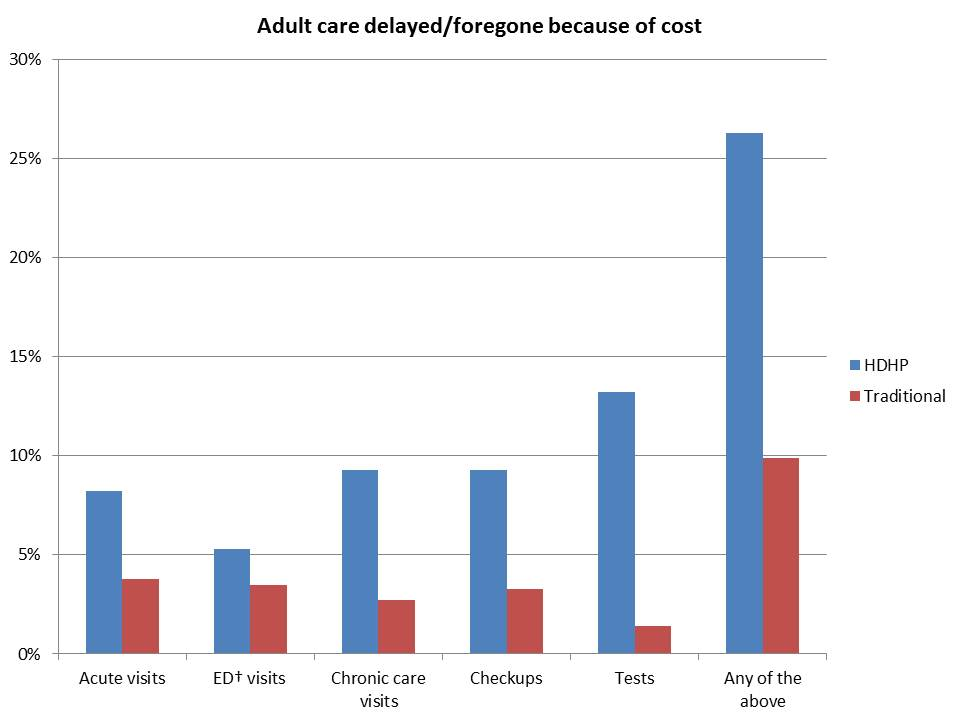
image

More than a quarter of adults had delayed or went without care because of cost. Adults were specifically more likely to delay or forego acute care visits, chronic care visits, checkups, and tests.

There were similar findings for care in children whose families had this type coverage.  The delays were particularly noted in those below 400% of the poverty line. 

Medicynical Note:  I’ve previously expressed reservations regarding high deductible insurance  and Health Savings Accounts.    

For those at or below the median wage, high out of pocket expenses influence whether or not to seek care—a form of implicit financial rationing.  In this setting the least knowledgeable, most emotionally involved get to decide whether or not to go for expensive interventions  for which they will have to pay. 

This might work if our costs were affordable, but they’re not.

GDP increase from Health Spending: Decreased Discretionary Spending the Result

It’s reported that consumer spending has increased since the 1960’s  from 61% to  71% of the the gross domestic product.  However, most of the increment is health care costs. 

Medical payments now account for about 16 percent of total consumer spending, more than food and clothing combined, which make up about 11 percent, or housing, which accounts for about 15 percent. The rising cost of health care means it will consume an even bigger share of the world’s largest economy as the population ages, according to economists like Jay Feldman.

“At the consumer level, it may squeeze out other discretionary spending,” Feldman, an economist at Credit Suisse in New York, said in an e-mail. “At the government level, rising Medicare and Medicaid spending will inevitably put pressure on other government spending priorities. At the business level, it could curtail investment, or more likely, suppress wages.”

Capture

Medicynical Note:  Increased discretionary consumer spending as a proportion of GDP (over the last 50 years in the U.S.) is an oxymoron.

Health Spending Growth: Regressing or on Hiatus

Uwe Reinhardt has some thoughts on the “moderation” of health spending.  He notes:

First, depending on the beginning and end points one chooses for calculation, the average percentage points by which the annual growth in health spending has exceeded the average annual growth in G.D.P. over the chosen period – a difference known among health policy analysts simply as “excess cost growth” – can vary quite a bit. One really needs charts like these to study the phenomenon, not point-to-point averages.

Second, the annual growth in real health spending per capita appears to have fluctuated around a long-run trend that has declined ever so gently over the longer period (see the blue line in Chart 3). That trend reflects in part that the annual growth in real G.D.P. per capita has also fluctuated around a gently declining trend line. As is shown in Chart 4, the trend line around which excess growth fluctuates is virtually flat.

The graphs show a huge yearly difference in the rate of increase in health care spending.  Read the article to view them.

Medicynical Note:  What’s missing from the article is a comparison of the increase in costs of health care with increases (or lack thereof) in income over the same period.  GDP increments miss entirely the huge disparities in wealth that have evolved in the past 30 years and the resulting poverty, decreases in real income, and decreases in the ability to pay for anything, including health care. 

The dilemma of U.S. health care is seems obvious.  Our costs have exceeded our individual and collective ability to pay.  How to resolve the disparity is the issue.

Great Moments in Medicine: Outpatient shocked by $45 billion dollar hospital bill

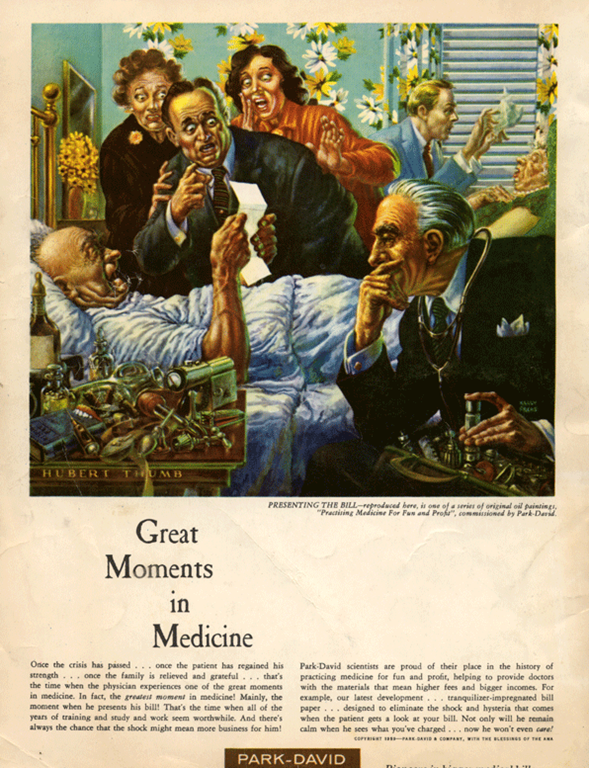
Mad Magazine famously pointed out the inflation in medical costs in the late 60’s with a parody on ads by Parke Davis (By Ken Freas). 

image

Parody sadly has become reality:  Outpatient shocked by $45 billion bill.