Category Archives: General Cynicism

The 42nd Best Health Care Non-system in the World — The U.S.

Sad but not surprising news regarding the U.S.’s child mortality being reported in Lancet (full text online May 24 and available with registration). The report notes declines in the rate of child death worldwide but our rate of decline (the U.S.’s) is significantly less than elsewhere. Currently 6.7 child deaths/1000 occur here. In most of Europe and Canada the rate is now under 5–in Singapore it’s under 3. There appears no good explanation for this discrepancy other than the unevenness and cost of our non-system.

Underscoring historic recent gains in global health, the number of children younger than 5 who die this year will fall to 7.7 million, down from 11.9 million two decades ago, according to new estimates by population health experts. But as much of the world makes strides in reducing child mortality, the U.S. is increasingly lagging and ranks 42nd globally, behind much of Europe as well as the United Arab Emirates, Cuba and Chile.

Singapore, the country with the lowest child mortality rate in the world at 2.5 deaths per 1,000 children, cut its rate by two-thirds between 1990 and 2010. Serbia and Malaysia, which were ranked behind the U.S. in 1990, cut their rates by nearly 70% and now are ranked higher.

The data instead suggest broader problems with the nation’s fragmented, poorly planned healthcare system, Murray and other healthcare experts say. Although the U.S. spends nearly twice as much per capita on healthcare as most other industrialized countries, researchers are finding substantially higher levels of preventable deaths from diseases such as diabetes and pneumonia.

Other countries with slow rates of decline include Britain, New Zealand and South Korea, which have all fallen in the international rankings since 1990. All three are still ahead of the U.S.

link: Child mortality rates dropping, study finds, but U.S. lags

Medicynical Note: The article in the LA Times puts some faith in notion that the newly enacted health care law will approach our uncoordinated non-system that costs twice as much as elsewhere. That remains to be seen as many in our culture don’t feel there is a collective responsibility to assure access to affordable health care. In this we remain a remarkable outlier in the world.


Drug Marketing –Novartis sex discrimination

Our non-system of health care has multiple levels of opportunity for abuse. How about sex and drug marketing!!

Medicynical note: It’s not about the patient or health care, it’s the money stupid!


Why Abstinence Doesn’t Work — Because………

The evangelical movement believes abstinence is the answer to teen pregnancy, the problem of unwanted babies, HIV infection and the list goes on.

They are of course correct, if people are abstinent then there would be no problem with all of the above. But……


You recall that at the same time as this instructional video was made, Souder and the interviewer Tracy Jackson, both married but not to each other, were having an extramarital affair.

Medicynical Note: It appears that abstinence is no more effective in preventing extramarital escapades amongst evangelicals than than it is in preventing pregnancy and HIV–both here and abroad. And Medicynic here.


Monetarization of Medicine

Of interest during the recent news flurry regarding Provenge was finding most of the information about the FDA approval and the drug in the financial, not health or medical sections of news sources. The biggest news seemed to be the impact of the drug’s approval on Dendreon’s bottom line, not the limited benefit of a very expensive drg.

Continuing the theme that profits trump health care is the piece in The Economist bemoaning the pressure the new health reform bill puts on insurers.

The insurance industry, meanwhile, is in a fighting mood about another measure that cuts deep into its profits. A “medical loss ratio” (MLR) provision in the new law dictates that insurers spend most of the money they earn from premiums (at least 85% in the case of group policies) on actual medical costs, rather than administrative overheads or fat-cat salaries.

Medicynical Note: Imagine having more concern about health care than profits. Revolutionary!


Martina’s “cancer” free –Is DCIS cancer?

It’s good news but not at all a surprise that Martina Navratilova is cancer free. She was diagnosed with a benign, actually a pre-cancerous minimal risk lesion, DCIS (Ductal Carcinoma in Situ). The in-situ terminology means that this lesion was localized. As a matter of fact many would say she never had cancer.

The finding of DCIS is not in itself dangerous and no one dies of this. Of those not treated for DCIS about 25% of those with the most aggressive form (high grade DCIS) will develop invasive cancer at some time in the future–and the great majority of those patients, if being monitored with mammography will have local curable disease.

Medicynical Note: In some discussions (ACS) of breast cancer, DCIS is included as a type of “breast cancer” and shows a 100% cure rate. Including DCIS with invasive breast cancer is misleading and many think now that it leads to over treatment.

So it is not at all surprising that Marina is “cancer” free.


Health Insurers Profits — The Most Expensive Health Care in the World

Interesting new profit statements from insurers:

WellPoint Inc., UnitedHealth Group Inc., Aetna Inc., Humana Inc. and Cigna Corp. reported combined net income of $3.2 billion, a 31 percent leap from the same period in 2009. Premiums grew faster than medical costs, while most insurers lowered the share of premium dollars spent on actual health services. The five insurers together set a full-year profit record in 2009 despite the worst economic downturn since the Great Depression. Now only a few months later, Wall Street analysts have been marveling at the first quarter of 2010.

As noted earlier drug companies have had a banner year as well.

Medicynical Note: The only one not doing well in health care are the patients. After all what’s the system for, care of the sick or profits? In the U.S. guess what?


Cancer Costs Study — Why publish now?

A flawed analysis of cancer costs appeared yesterday in numerous outlets:

It found that cancer treatment costs rose from nearly $25 billion in 1987 to more than $48 billion by the end of 2005. Medicynical note: Remarkably outdated information since the ACS is reporting expenditures of $93 billion in 2009. With indirect costs of an additional $18.8 billion. Which means a doubling or more of costs since 2005.

Better and more advanced treatments mean more people with cancer are remaining alive, so the spending increases represent money well spent, said Kenneth Thorpe, a health policy researcher at Emory University who has focused on the cost of health care.

“It seems like we’re buying increases in survival,” Thorpe said. Medicynical Note: I think most of the survival gain has to do with diagnosing cancer earlier (lead time bias) and/or changes in definition such that inherently more benign tumors are now lumped with cancer? (DCIS, Gleasons 5 prostate cancer for example).

The analysis of costs in this study stopped in 2005. In the last 5 years (since 2005) costs for cancer care have shown a remarkable acceleration associated with a decrease in those insured and a decrease in the quality of insurance. The data in this study is historical and probably not fully relevant.

As noted in the article.

Recent government reports have found that the percentage of Americans with private health insurance has been shrinking and recently hit its lowest mark in 50 years. Yet the study found that the proportion of cancer treatment costs paid by private insurance rose.

And companies have been tightening or cutting employee benefits, causing out-of-pocket costs to go up for many patients. Yet the study found that the proportion of bills paid by patients declined.

He alluded to widely reported increases in personal bankruptcies prompted by medical bills. “There’s no question that the out-of-pocket costs for some patients have risen dramatically,” Lichtenfeld said.

The study did not add in the cost of diagnostic tests and scans, which are cost drivers. And the data does not include the last five years, which saw some extremely pricey cancer drugs come on the market. Medicynical note: A PET scan costs in the range of $5000, more than the entire treatment course of the 1970’s.

Medicynical Note: Why publish this out of date analysis now?

This study might have been relevant 5 or 6 years ago, but it’s been overtaken by events. Health costs for cancer doubled between 1987 and 2005 (the period studied) AND remarkably have doubled again (see ACS data cited above) between 2005 and the present.

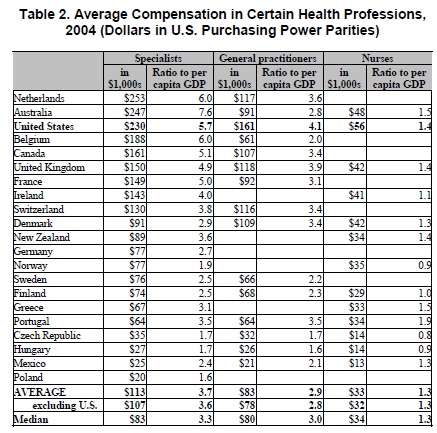
Meanwhile median and average salaries in the US declined in the last 10 years. Amazing and sobering.


Uganda, HIV — The Success that Wasn’t

Not too long ago we were touting the wonders of abstinence education and the HIV control program in Uganda. More here and here. You may recall the emphasis of the Ugandan anti HIV education program, encouraged by the Bush administrations, away from use of condoms to abstinence. They claimed, prematurely it seems, to have the HIV epidemic under control.

However:

In the 1980s, Uganda earned renown for pushing its infection rate to 6 percent from 18 percent. Many here still remember the pounding drums on the radio and the slogans “Practice ABC” and “zero grazing” — no extramarital sex.

But infection rates are creeping back up. Casual sex is on the rise, epidemiological surveys say.

Condom use, never very high, has dropped. Even among people who know they are infected, only 30 percent consistently use condoms.

link: In Africa, Cultural Obstacles to Safe Sex Drive HIV Infections – NYTimes.com

Abstinence education if it isn’t accepted by the population didn’t work. And while the epidemic is reasserting itself the international community is suffering from HIV assistance fatigue.

Uganda is the first country where major clinics routinely turn people away, but it will not be the last. In Kenya next door, grants to keep 200,000 on drugs will expire soon. An American-run program in Mozambique has been told to stop opening clinics. There have been drug shortages in Nigeria and Swaziland. Tanzania and Botswana are trimming treatment slots, according to a report by the medical charity Doctors Without Borders.

The collapse was set off by the global recession’s effect on donors, and by a growing sense that more lives would be saved by fighting other, cheaper diseases. Even as the number of people infected by AIDS grows by a million a year, money for treatment has stopped growing.

link: In Uganda, AIDS War Is Falling Apart – NYTimes.com

Medicynical Note: In fact, the emphasis on abstinence was wrong. It confused the education message and in doing so undermined the use of condoms as a mechanism to prevent spread. The “great success” of Uganda never was.

We now add to the continuing disastrous legacy of the Bush administration, the collapse of the anti-HIV campaign in Africa. Can you imagine starting a long term expensive treatment program that in addition to treatment forced the use of unproven prevention method, abstinence, without implementing a mechanism to pay for it. Amazing!


More on Provenge –How beautiful the Emperor’s Clothes?

Provenge is innovative, very expensive and minimally effective. It won’t cure disease but will provide a very slight 9% improvement in those alive at 3 years–that’s less than a 1 in 10 benefit.

The cost is $93,000 for a full treatment. It’s not clear whether repeat courses can be given.

To put in perspective consider that a more conventional chemotherapeutic agent docetaxol (Taxotere) provides a 3 month benefit at significantly less cost.

Here is a detailed review of this drug’s efficacy:

The two trials used 2:1 randomization, with patients to receive Provenge or placebo three times, with 2 weeks between each treatment. Study 1 randomized 82 men (median age 73; 89% white) to Provenge and 45 (median age 71; 93.3% white) to placebo. The treatment group had a nonsignificant median time to progression of 11.0 weeks, compared with 9.1 weeks in the placebo arm (P = .085). (Medicynical emphasis)

After study 1 failed to meet its primary endpoint, researchers halted enrollment in study 2 following accrual of 98 of 120 planned patients with similar age and racial characteristics as those in study 1. (The difference in time to progression in the second study also was nonsignificant, 10.9 weeks for Provenge vs 9.9 weeks for placebo (P = .719). The two trials found no significant regression in tumor size among the treated patients. (Medicynical emphasis)

Although neither study specified overall survival as an endpoint, a post hoc analysis of the study 1 data showed an overall median survival benefit for the Provenge arm, compared with placebo, of 25.9 months vs 21.4 months (P = .01). “

An analysis of study 2 found a median overall survival of 19 months for the treatment arm vs 15.7 months for the placebo group, a difference that failed to reach statistical significance (P = .331). “It should be noted that the survival time in this study was shorter than the counterpart in study 1, which suggests that significant populations in these two studies may not be exactly the same,” remarked FDA clinical reviewer Ke Liu, MD, PhD. Dendreon also presented combined overall survival data from the two trials, showing a significant advantage for Provenge, 23.2 weeks vs 18.9 weeks for placebo (P = .011)

link: Substantial Evidence for Provenge Efficacy: FDA Panel – Cancer Network

And this from a later study:

In clinical trials, Provenge extended survival by a median 4.1 months — about half of patients were below that amount and half were above. But some of the patients remain alive years after the treatment. In the most recent trial, 32% of Provenge-treated patients remained alive three years after treatment. Only 23% of placebo-treated patients survived that long. (Medicynical Emphasis– It’s not stated whether patients receiving placebo also remain alive years after the treatment)

link: FDA OKs Provenge for Prostate Cancer Therapy

Of interest is that more patients in the study group received docetaxol (Taxotere) 57% vs 50.3% in the placebo group after signs of disease progression. As in many drug comparison trials the matching up of the groups is essential to the validity of the study. It’s conceivable given the small size of the study that normal biologic variation in the diseases course and the differences in patient management could account for much of the “evidence” of efficacy.

There is a long history of study results often sponsored by drug companies that were viewed as “significant” that later turned out to be simply artifact–see Premarin and erythropoietin data to name two examples.

Medicynical Note: After three years survival in the treated group was 9% better than those receiving absolutely nothing–a placebo.

Provenge does not appear to work with the more malignant Gleason 8-9 varieties of the disease.

However, according to information supplied by Dendreon, analysis of the data for pre-specified variables revealed Gleason score as the single most important predictor of response to Provenge®. In patients with a Gleason score = 7 who received Provenge®, the likelihood of remaining progression free and free of cancer-related pain while on study was over twice that of men who did not receive Provenge®. In addition, those patients receiving Provenge® whose disease had not progressed six months after randomization, had a greater than eight-fold advantage in progression-free survival compared to those patients who received placebo (35.9% versus 4%). In contrast, the benefits of Provenge® therapy were not seen in patients with a Gleason score = 8.

link: Prostate Cancer Research Institute – Update on Provenge Trials


This is an advance but it also is a very limited benefit from a very expensive drug. Would you buy a car for $100,000 that lasted months? Would you go into debt to get this drug? Would you sell your house to raise funds to have access?

Drug companies became alchemists in the mid 90’s when they discovered that patients with fatal illness were neither cost aware nor cost sensitive. Any minor advance that offer a modicum of success even as little as a 10% chance of living a month or two or four longer was worth spending huge sums of money. They don’t justify the pricing by their costs or the efficacy of the drug, they simply point out that other drug companies charge similarly for similarly ineffective agents.

Drugs like Provenge, that have interesting mechanisms of action with minimal efficacy are money cows for the pharmaceutical industry. The question is how much longer can they ride this gravy train, before the emperor is shown to have no clothes? And/or the system crashes?

More here.


Change in Health Insurance: At long last.

It’s hard to believe that this was common practice for health insurers before health reform.

The health insurance industry has decided to end its practice of cancelling claims once a patient gets sick next month, well before the new health care law would have required it, the industry’s chief spokesman said Wednesday.

Congressional Democrats and Health and Human Services Secretary Kathleen Sebelius had pressured companies to end the practice early. The overhaul plan will ban the practice in September, except in cases of fraud or intentional misrepresentation, and subject it to a third party review.

Medicynical Note: The best health care system in the world? For health care, no! As a system to generate money, yes! We have a long way to go.