
Category Archives: General Cynicism

Spinal Fusion Surgery — Big benefit to doctors, limited benefit to patients

Bloomberg has an interesting article on the limited medical benefit of spinal fusion to patients–but big financial benefits to doctors, medical practices and suppliers (Medtronic). The article documents at least the appearance of, if not actual, conflicts of interest; high costs $135,000 for the surgery (yes on one patient); $800,000/year incomes for the orthopedists–three times that of pediatricians.

The possibility that many of these and other surgeries are needless has gotten little attention in the debate over U.S. health care costs, which rose 6 percent last year to $2.47 trillion. Unnecessary surgeries cost at least $150 billion a year, according to John Birkmeyer, director of the Center for Healthcare Outcomes & Policy at the University of Michigan.

“It’s amazing how much evidence there is that fusions don’t work, yet surgeons do them anyway,” said Sohail Mirza, a spine surgeon who chairs the Department of Orthopaedics at Dartmouth Medical School in Hanover, New Hampshire. “The only one who isn’t benefitting from the equation is the patient.”

There’s lots to this article including evidence that fusion is no better than physical therapy for disc related pain in several studies–only a 47% success rate for surgery in one U.S. study;  high complication rates for surgery;  direct payments from the medical supplier (Medtronic) in the form of royalties and consulting fees to doctors (as high as $440,000/year to an individual doctor and 1.75 million to a practice in Minneapolis).

Medicynical note: Not a pretty picture of American medicine. Costly, open conflicts of interest, use of aggressive expensive unproven procedures over more conservative approaches–with the same or worse outcomes.  Is it any wonder that our costs are one and half to two times that of other industrialized countries.

The “free market” encourages entrepreneurs to find ways to take advantage of markets, sometimes that leads to better outcomes and more efficiency but in medicine it seems to encourage waste, high cost and over-utilization.
Doctor’s fees, Medicare and Value

Two interesting reads on controlling costs and maintaining quality of care.

Ewe Reinhardt discusses the problems with our current reimbursement system and his thoughts on changes:

Medicare raised physician fees only 7 percent (an average of 0.75 percent a year), while the Medicare Economic Index (or M.E.I.), which tracks costs incurred by medical practices, rose 34 percent (an average of 3.3 percent annually).

Even so, Medicare’s spending on physician services per beneficiary rose 61 percent, an average annual compound rate of 5.4 percent a year.

The bulk of this increase in medicare spending therefore was on procedures, both diagnostic and therapeutic rather than the evaluation and management. This explains the  low rate of increase in the incomes of primary care people–the ones most of us rely on for management or our problems. Correcting the imbalance in incomes between these doctors and proceduralists is the challenge for the future and is discussed by Reinhardt.

The traditional working assumption had been that, in treating their patients, physicians are impervious to such financial incentives. Many, most likely, are. But a growing body of research has chipped away at the general validity of that assumption – hence the growing disillusionment with the hallowed fee-for-service method of compensating physicians.

He also discusses the Rivlin-Ryan plan for medicare reform:

Under the Rivlin-Ryan plan, the problem of paying the providers of health care would no longer be visible and for government to solve. Instead, it would be the product of private and presumably secret deals between private health plans and the providers – and, indirectly, the elderly, who would be made to bear the risk of rising payments to providers.

Another approach is taken in an article in the New England Journal of Medicine, “What is Value in Health Care” and “Measuring Healthcare Outcomes.”

Achieving high value for patients must become the overarching goal of health care delivery, with value defined as the health outcomes achieved per dollar spent. This goal is what matters for patients and unites the interests of all actors in the system. If value improves, patients, payers, providers, and suppliers can all benefit while the economic sustainability of the health care system increases.

Value — neither an abstract ideal nor a code word for cost reduction — should define the framework for performance improvement in health care. Rigorous, disciplined measurement and improvement of value is the best way to drive system progress. Yet value in health care remains largely unmeasured and misunderstood.

Read the article for the author’s suggestion for incorporating value into the patient care question.

Medicynical Note: Unless we  find a way to incorporate value (bang for the buck) in medicine we’ll spend ever increasing amounts on health care; have more people uninsured as they can’t afford care; and continue on the path to explicit financial rationing of health care–and system failure.

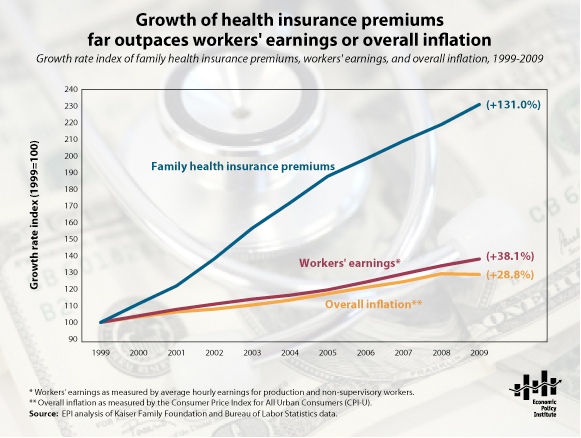
Health Care Costs vs Earnings

Wondering where our money for discretionary expenditures went?


What’s more:( From Sept 2010)

This morning’s release by the U.S. Census Bureau of the 2009 poverty and income data was yet another reminder of the severity of the Great Recession that began in December 2007. The data show that the poverty rate increased from 13.2% in 2008 to 14.3% in 2009, the highest rate since 1994. Furthermore, for the first time on record, the nominal (non-inflation adjusted) income of the median, or typical, household actually fell, from $50,303 in 2008 to $49,777 in 2009. Inflation was negative from 2008 to 2009, dropping by 0.4%, so real (inflation-adjusted) income did slightly better, dropping $335, or -0.7%, from $50,112 in 2008 to $49,777 in 2009.

Medicynical Note: Those expecting consumer spending to bail out the economy are kidding themselves.


Hospital Saves Mother, Loses Catholic Hospital Status

When churches do religion they apparently do it well. When they choose to practice medicine they bungle, despite their “infallibility.”

In this situation the hospital, after doing an appropriate ethical review, saved the life of a woman having life threatening complications from a pregnancy– hypertension, probably eclampsia.

The church’s reaction to this life saving act:

The Roman Catholic Diocese of Phoenix stripped a major hospital of its affiliation with the church Tuesday because of a surgery that ended a woman’s pregnancy to save her life.  

The woman is in her 20s had a history of abnormally high blood pressure when she learned of her pregnancy. After she was admitted to the hospital with worsening symptoms, doctors determined her risk of death was nearly 100 percent.

Medicynical note: If a loved one were pregnant, I would not advise using a hospital blindly adhering to the catholic church’s wishes. Medieval notions in the modern era unfortunately lead to remarkable distortions which in this case threatened life.

Market Manipulation (Compath)

Campath, a drug used for chronic lymphatic leukemia, has been found to have some activity in multiple sclerosis. The manufacturer, Genzyme Corp., is under pressure of a hostile buyout and is in discussions with Sanofi regarding the liklihood of future profits for this drug, as noted here. In the article the difference in pricing for Campath as a leukemia drug and as a potential MS treatment was noted:

Most MS drugs, such as Biogen Idec Inc’s (BIIB.O) Tysabri, cost more than $40,000 a year. A new oral drug made by Novartis AG (NOVN.VX) called Gilenya costs roughly $50,000 a year.

Campath sells for a fraction of that. As a result, Genzyme has to persuade governments and insurance companies to pay a higher price for the drug as a treatment for multiple sclerosis than it does as a treatment for cancer.

Genzyme says it is confident it can find a way to do it — possibly by withdrawing the drug from the market as a cancer treatment and providing it for nothing.*

Medicynical Note: Drugs costing tens of thousands of dollars per year trade on the desperation of patients with serious illness and are part of reason our health care expenses are soaring. (17% of GDP) From the above it’s clear that Compath was profitable at the lower price charged chronic leukemia patients. Seeing an opportunity to charge more for a larger patient population the company of course does what any for for profit enterprise would do, gouge their customers.

Shouldn’t health care be different? Can such market manipulation be legal, after all these drugs are protected by a government provided monopoly (patents)? Or perhaps should this type government intervention in “free” markets (patent protection) be done away with?

*Addendum: I note on December 22 that the above discussion of pricing has been removed from the Reuters article. Why? Too embarrassing?

However, the quote can be found on the CNBC site here. (and also on other sites by googling the text)


Economic Rationing of Health Care

No death panels for us. Just more uninsured who can’t afford health insurance……and care.

This is happening in Washington State but is not unique:

The Basic Health Plan, which provides subsidized insurance for the 66,000 working poor, gone.

Medicynical Note: It should be noted that Washington State voted down an income tax on high earners and passed an initiative requiring a two thirds majority to increase taxes. So rather than ask those who can afford it to pay more we’ll simply tax those who can’t and remove their safety net.

And if they get sick? Tough love and tough luck.


Hospital Based Infusion Treatment versus Office Based — Or how the “free market” manipulates our health care non-system to increase their profit

Our local hospital, a part of the Peacehealth system in Washington State, has been purchasing medical practices and incorporating them under their brand. It is the only hospital in town, the next one is about 25 miles south.

In addition to general physicians specialists are being added. All the the oncologists in town were added last fall and the cardiologists (except one) this year.

The medical oncologists had a new well-equipped infusion center at their practice which is located a few miles from the hospital. Last month with minimal discussion, the infusion center was moved to the hospital. No explanation was given but one can assume this “non-profit” made the decision because they can bill more for services at the hospital than in an office setting.

I’ve discussed this previously. In addition to a facility charge the reimbursement for services is significantly more for most billing codes in hospital outpatient settings

Medicynical note: At some point cost and value will need to be addressed and gaming of payments stopped. It doesn’t appear however, that this will happen soon as businesses have a fiduciary responsibility to maximize profit and consumers are insensitive to pricing when someone else pays and health issues are involved.

Addendum 12/16 PM — It’s hard not to be offended by organizations manipulating health care procedures to increase billings and ultimately patient cost.  Value, patient convenience,  efficiency does not seem to be in their vocabulary.


Drug Shortages — It’s about the Money

A number of necessary drugs are in short supply. While the full list is unavailable, one can assume that the drugs needed are off patent and lower priced.

From cancer treatments to surgical sedatives to standard emergency-room remedies, the pharmaceutical supply cabinet is increasingly bare of the drugs of choice, according to doctors, advocacy groups, and the FDA

Those include intravenous Lasix, a diuretic commonly used to treat congestive heart failure, and Cisatracurium, a muscle relaxant used in surgery, he said. Medicynic: lasix off patent for years, cisatracurium off patent this year.

As of Dec. 1, there had been shortages of 199 drugs, she said, two more than all of last year, the previous high. Anecdotally, others say, the situation is the most acute it has been in more than a generation.

Medicynical note: In a “market driven” money oriented non-system of health care drugs that are not money makers and I mean big time profit makers will not be manufactured.

If our system were truly market driven we would not be providing generation long patent protection to drug companies. Rather the drugs would compete based on merit, efficacy and cost. Given that this is not likely to change perhaps there should be a quid pro quo required of drug companies that requires manufacturing of less expensive needed medications in order to qualify and maintain patents on their expensive drugs.


Herceptin, Tykurb in Breast Cancer : What wasn’t reported

Tis the season of the San Antonio Breast Conference and the season of overstatements–most often by people with drug company ties.

There was an interesting report on combining Herceptin (trastuzumab) and Tykurb (lapatinib) in Her2neu positive breast cancers.

The report studies neoadjuvant use of targeted treatment in breast cancer. That is, treatment prior to surgery with the goal of shrink tumors, making breast conservation more possible and hopefully improving patient survival.

What wasn’t noted in the report:

1. Neoadjuvant therapy with conventional drugs alone results in drug shrinkage and complete response in about 25% of patients,and improves breast conservation rates, but shows no survival advantage after several years study.
2. Neo adjuvant treatment including Tykurb and Herceptin (the current study) shows shrinkage of tumors and improved ability to do breast conservation surgery. BUT, despite the hooplah, no survival studies have been completed. It is not known whether the drugs actually improve survival.
3. The drugs are only effective when used on the small group, 15-20% of breast cancer patients, who have overexpression of Her 2 neu.
4. The cost of the two drugs in combination is at least $10,000/month, probably more. Added to the other drugs used, doctors fees the cost for this treatment is probably around $20,000/month.

Medicynical Note: I recall a patient of mine who informed me, when told he would have to pay $38/pill for a new anti-nausea drug, that he’d rather throw up than pay that. He seems somewhat prosaic given the current inflation of cancer drug costs.

You better believe that cost is a major issue, particularly in a non-system that is bankrupting us. In what other area of consumer commerce would $20,000/month be spent?

In this study half the patients apparently have little or no response. So let me rephrase the question. In what other area of consumer commerce would $20,000/month be spent on a product which only works half the time (if every one of the responding patients lived longer, which is extremely doubtful). Consider also the impact of 13 months treatment at $20,000/month (4 months pre-surgery and 9 months post), that is $260,000 for drugs alone–not counting the costs for the 50% of patients that don’t respond, a minimum it seems of 4 months of treatment, $80,000.

The issue now and in the future is likely cost. Who will pay? How? A further issue is how can an industry produce and market drugs so inefficiently that costs are so high?

Stiglitz on Brown — What went wrong!

Joseph Stiglitz reviews Gordon Brown’s book on the financial crisis which Brown calls the first crisis of globalization (tell that to the chronically unemployed)

As soon as Northern Rock began to teeter, he realized there were deep structural problems with the financial sector and he tried to act on what he saw. He grasped immediately that the problem was not just one of liquidity but of a weakness in the financial sector built on years of mismanagement, lax regulation and reckless speculation.

Read the article.

Medicynical note: There is a message here about the greed of unregulated markets that applies to our medical non-system. How else to explain our out of proportion, unaffordable costs–50-100% more/capita than in other industrialized nations; the mediocre outcomes; the 50 million or so people who are uninsured.

The problems in health care also were built on years of mismanagement, lax regulation and endless speculation (that people will pay more for anything related to health) and a cost plus mentality.  Value?  Cost efficiency?  Not anyone’s department.