
Category Archives: General Cynicism

Multiple Sclerosis Medications — Overpriced? Effective?

Drug companies take advantage of chronically ill patients and their families by aggressively marketing modestly effective drugs at inflated prices, especially in the U.S. This is commonplace for cancer patients who are coerced into paying $50,000-$100,000/year for drugs offering very limited benefit.

The same appears to be true in multiple sclerosis:

The drugs include beta interferons (brand-names like Avonex, Rebif and Betaseron), glatiramer (Copaxone) and natalizumab (Tysabri). They are given by injection or infusion and can help prevent MS symptom flare-ups and delay long-term disability from the disease. But the price tag is large, with each drug now costing upwards of $3,000 a month in the U.S.

And a study in the journal Neurology estimates:

They would gain an extra two months or less of good health over 10 years, the researchers say, compared with using only therapies that help ease MS symptoms — like medications for pain, fatigue and muscle spasms. Overall, the study estimated, DMDs cost close to $1 million for each year of relatively healthy life a person with MS could expect to gain with 10 years of use.

And if the drug is started earlier in the course of the disease:

The researchers estimate that starting the drugs before any noticeable disability makes the medications more cost-effective — though they still hover above $700,000 for each good-quality year of life gained.

It should be noted that while there is no hard and fast rule regarding cost-effectiveness in the U.S., costs exceeding $150,000 for a year of good quality life are consider excessive. Consider also that the average and median incomes in the U.S. are in the $50,000-$60,000 range.

And in the U.S. we get to pay more for the drugs!

Both Noyes and Smyth said the findings highlight a wider issue: the high price Americans pay for prescription drugs.

Avonex, for example, cost Americans with MS about $34,000 for the year in 2010. The price in the UK was equivalent to about $12,000 — because that’s all the National Health Service will pay for the drug.

Medicynical Note: Is it any wonder the PHarma doesn’t want to negotiate prices with Medicare and pays our congressmen and women handsomely in the form of campaign support to maintain the pricing structure in the U.S. It may be “speech” of some sort, but it certainly isn’t free.

Medical Conflicts of Interest: Part of the Problem

It’s difficult to measure the insidious effect of money on medical practices but this case provides evidence that we have a problem. The medical board of Maryland revoked a cardiologists medical license for implanting unnecessary medical stents.

The issue was first brought to the public’s attention in late 2009, when St. Joseph Medical Center sent letters to Midei’s stenting patients, explaining that their stents may have been implanted unnecessarily. The letters became the subject of an article in the Baltimore Sun.

“This report sets forth alarming evidence that patients at St. Joseph Medical Center received unnecessary and potentially harmful stent implants time and again -– a pattern that is shocking, disturbing and shameful,” wrote Sen. Max Baucus (D-Mont.), chairman of the committee.

Abbott paid Midei nearly $31,000, put him on its list of top stent volume cardiologists, and paid for a barbecue and a crab dinner at his home, according to the Finance Committee report. (Medicynical emphasis)  After St. Joseph barred him from practicing in 2009, Abbott hired him to prepare safety reports in China and Japan.

Medicynical Note: Previous posts have highlighted similar unethical behavior of psychiatrists, urologists, and researchers.

The medical industrial complex’s interest is in making money. Quality of care, ethics and value are not their concern.

Our republican congress wants less regulation.  This case would seem to indicate we need more and closer oversight.


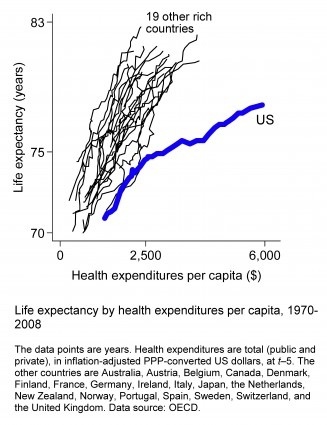
Less for More–A System to Assure PHarma’s Profits Not Our Health

A a graph says it best:

20110715-123720.jpg

Medicaid: An Ongoing Public Health Disaster

The NEJM reviews the limitations of Medicaid, which is about to get worse whether or not there is agreement on debt extension:

Since Medicaid was enacted in 1965, its coverage guarantee for millions of the poorest Americans has faced a substantial vacuum in actual access to health care. Multiple factors contribute to this problem: severe shortages of physicians and hospitals in many low-income inner-city and rural communities; low rates of participation in Medicaid among available providers, owing to low payment rates; state administrative practices that drive providers away; and the economic, clinical, educational, and cultural characteristics of Medicaid beneficiaries. Where they are operating, federal programs such as community health centers, federally funded family planning agencies, the National Health Service Corps, local public health agencies, and public and children’s hospitals help to mitigate the situation. But thousands of U.S. communities lack such programs, and even where they do exist, they don’t address the specialized long-term care needs of beneficiaries with severe disabilities.

Medicynical note: This in the “best” and most expensive non-system of healthcare in the world.

Health Care in the US: Follow the Money

Health care in the U.S. a money scam?

Today, the United States spends more on health care per person than any other country in the world by far. The health insurance companies and the big pharmaceutical corporations are raking in gigantic mountains of cash and yet the quality of the health care that we receive in return is rather quite poor.

As you read this, there are hordes of health bureaucrats and greedy corporate fat cats that are becoming incredibly wealthy while the rest of us go broke trying to pay for our health care. In the United States today, health care bills cause more bankruptcies than anything else does. Millions of Americans are afraid to go to the hospital because they know that even a short visit would be a huge financial burden.

Check out these health care statistics.


Our Sad State of Affairs: Offensive Republicanism, 20 Billion for air conditioning in Afganistan

This from Kevin Drum:

But then, for about the thousandth time, my mind wanders over the past ten years. Republicans got the tax cuts they wanted. They got the financial deregulation they wanted. They got the wars they wanted. They got the unfunded spending increases they wanted. And the results were completely, unrelentingly disastrous. A decade of sluggish growth and near-zero wage increases. A massive housing bubble. Trillions of dollars in war spending and thousands of American lives lost. A financial collapse. A soaring long-term deficit. Sky-high unemployment. All on their watch and all due to policies they eagerly supported. And worse: ever since the predictable results of their recklessness came crashing down, they’ve rabidly and nearly unanimously opposed every single attempt to dig ourselves out of the hole they created for us.

Medicynical Note: We’ve lost our mojo and have an almost totally dysfuntional political system.

As an aside, I listened to one of the best of Today BBC podcasts yesterday. They interviewed Retired Brigadier General Steven Anderson, formerly General Petraeus’ logistician. He revealed that the U.S. spends 20 billion, yes billion dollars on air conditioning in Afganistan. The money, in part, is used to buy fuel which costs the military $45/gallon delivered. The air conditioning is among other things used to cool tents. The commentator noted that this is 1/3 of the total British military government.


Avastin (bevacizumab), Provenge (sipuleucel-T) Two More Reasons Why Health Care is Bankrupting Us

The drugs Avastin (bevacizumab) and Provenge (sipuleucel-T) are two of the most expensive drugs in the world. Bevacizumab costs in the range of $100,000/year for treatment and simuleucel $93,000 for a course of treatment.

Neither cures patients. In studies in breast cancer bevacizumab has been found minimally effective, if at all. When compared to outcomes of patients not using the drug, It appears to delay progression by a few months and survival by even less then that (between no survival advantage to a few months). Sipuleucel-t gives about the same degree of response in prostate cancer. Despite this apparent lack of efficacy, and the advice of an FDA advisory board, Medicare has decided to continue to pay for the use of these agents.

The problems with these drugs are two-fold. One, they do very little to improve survival. And second, they are outrageously priced.

Regarding pricing, we’ve allowed drug companies to price drug grotesquely by:

  • Providing them government sponsored monopoly (a patent) for a generation. (so much for free markets)
  • Allowing drug companies to take drugs developed in part with government research funding private without offsetting the government’s investment by requiring licensing or reasonable pricing of the drug
  • Prohibiting Medicare from negotiating price with drug companies. This was part of the Medicare D law and has resulted in the inexorable upward spiraling of drug prices. We pay more for drugs in the U.S. than anywhere else in the world. WE ARE NUMBER 1!
  • Cost effectiveness is not in our health care system’s vocabulary. We regularly use drugs with limited to no effectiveness.

Medicynical Note: For many years as an oncologist I used drugs with limited efficacy just on the chance that my patient might benefit. Desperate people accepted remarkable levels of toxicity in the hope that they will be the lucky ones and have a long survival benefit. During treatment, they all thought the drug was working, until it became clear that the disease was progressing. In retrospect very little of the “response” (and I’m thinking of patients with colon cancer treated with 5FU during the 70’s and 80’s) was tumor regression due to the drug. We almost never saw tumor’s decrease in size. Rather each cancer has a biology that affects how rapidly it will grow and recur. There are other poorly understood factors such as the patient’s immune system’s affect on tumor growth that also may come into play. But what was clear from comparison studies of 5 FU and no treatment was that very few patients benefitted. It should be noted that at the time 5FU in 500 mg vials cost $5.00.

Medicare has now announced that despite the proven limited efficacy of these drugs (bevacizumab and sipuleucel-T they will continue to pay for them–at the price demanded by the manufacturer.

If we are unable to rationally use these grotesquely expensive agents we will undoubtedly be rationing through increased co-pays, increased cost of insurance, and lo ball insurance that does’t cover such agents.


Drug Costs and Prostate Cancer: Charging a Premium for Minimal Efficacy

The Times has an article highlighting the costs of new drugs for prostate cancer. Mind you, these are drugs that have a very limited ability to extend life in patients with advanced disease.

In the last 15 months, three new drugs that extended the lives of prostate cancer patients in clinical trials have been approved by the Food and Drug Administration and several other promising medicines are in clinical trials.

And:

Men with that late-stage cancer had a median survival of about a year and a half using docetaxel. The new drugs each added two to five months to median survival when tested in clinical trials. Doctors say that men taking more than one of the drugs in succession would be expected to live more than two years. (Medicynical note: The last sentence is completely unproven and highly doubtful if it means to live 2 years beyond the original 18 months achieved by docetaxel alone. One wonders which doctors are saying this?)

And:

Provenge costs $93,000 for a course of treatment, while Zytiga costs about $5,000 a month. Another of the new drugs, Sanofi’s Jevtana, costs about $8,000 every three weeks.

With other pricey drugs on the way, said Joel Sendek, an analyst at Lazard, “We could be talking easily $500,000 per patient or more over the course of therapy, which I don’t think the system can afford, especially since 80 percent of the patients are on Medicare.”

Medicynical Note: New drugs are protected by a government sponsored monopoly (patents), allowing a generation of exclusive use to the developer of the advance.

Health care of course is different from computers or other consumer products. There is limited choice about both the timing, source and type of treatments available, particularly in diseases that have fatal consequences.

As such it’s a wonderful set-up for manufacturers. They have exclusive rights to a product that their customers feel they must have. The customer is buffered from the true cost by his/her insurance coverage. The insurer is under huge pressure from the patient to cover everything that they need and simply passes the costs on to policy holders.

Cost efficacy is not a consideration. Patients believe that they will be the one who will benefit and have excellent results. This is the situation even where 1/2 the patients treated get little or no benefit and the treatment at best provides minimal life extension–as in these drugs. It should be re-emphasized that the judgement that these drugs could provide years of survival is completely untested and likely false.


Bevacizumab (Avastin) for Breast Cancer, Expensive and Mediocre

Todays NY Times reports that Genentech will try to pressure the FDA to continue the bevacizumab (Avastin) indication for treatment of breast cancer.

It should be stated up front that the drug can be used for breast cancer without FDA approval. The question is whether medicare and other insurers should should be forced (by virtue of the FDA approving the indication) to cover a wildly expensive ineffective treatment.

The data on this drug’s lack of efficacy is clear. It was originally approved in a study which showed a delay in progression of disease. At the time of approval, little was known whether patients so treated would actually live longer. Genentech wanted accelerated approval and agreed that followup studies would be done to confirm its efficacy, not only in delaying progression but also in improving survival.

The F.D.A. approved the drug for advanced breast cancer in February 2008, after one clinical trial showed that combining Avastin with another drug, paclitaxel, delayed the median time before tumors worsened by 5.5 months, compared with using paclitaxel alone. But the women who got Avastin did not live significantly longer than those who got only paclitaxel, which is also known by the brand name Taxol.

and:

Subsequent trials, in which Avastin was combined with different chemotherapy drugs, showed a much smaller delay in tumor progression, ranging from less than 1 month to 2.9 months. And again there was no improvement in survival for those receiving Avastin.

Yet another trial showing this drug’s huge costs and limited efficacy was reported on at ASCO 2011, we commented on this trial here. The study reported .49 years delay of progression free survival and just .135 years (about 1.5 months) of life extension–a cost of $745,000 for a QALY (quality adjust life year). Hardly evidence of a cost-effective intervention, or for that matter a drug that works.

This controversy is in part due to the erosion of standards in clinical trials. At one time patients were deemed to show a response if the tumor decreased in size by 50%. The gold standard for an effective treatment was an improvement in survival, not a mere delay in progression.

It turns out unfortunately that a delay in progression often means little in regard to survival and in the case of bevacizumab (Avastin) even that delay is open to question as repeated studies show a more limited delayed progression as well the lack of a significant survival benefit.

Medicynical Note: With drugs as expensive and ineffective as this one is in breast cancer, it’s easy to understand why health care costs are out of control.


ASCO 2011: Cost effectiveness Zoledronic Acid (Zometa) vs Denosumab (Prolia, Xgeva)

There were very few cost efficacy studies at the recent ASCO meetings.

One set of three studies sponsored by the drug company (Novartis) compared zoledronic acid with denosumab made by Amgen. The abstracts looked at the cost of a QALY (quality adjusted life year) in patients with metastatic prostate cancer (abstract 1), and breast cancer (abstract 2). The third was an economic evaluation (abstract 3) comparing the costs of preventing a skeletal related event in prostate cancer. Not surprisingly, since they were sponsored by Novartis, these studies “confirmed” that zoledronic acid was more “cost effective.”

The studies found that while zoledronic acid is slightly less effective than denosumab in preventing skeletal related events, denosumab is more expensive.

From abstract 1:

Compared to ZOL (Table), Dmab resulted in fewer SREs, more QALYs, and lower SRE-related costs, but higher drug-related and total costs ($5,313). Overall, Dmab resulted in an incremental cost of $1,250,000 per QALY gained.

From abstract 2:

Dmab resulted in fewer SREs, more QALYs, and lower SRE-related costs, but higher drug-related and total costs vs. ZOL, resulting in an incremental cost of $6,884/pt (Table). The cost per QALY gained was $644,000 when excluding SAEs ($613,000/QALY when including SAEs).

It is telling, and perhaps reflects a “strategic” omission, that neither abstract 1 or 2 reveals zoledronic acid’s cost of a QALY gained.

However, abstract 3 gives a better indication of the relative costs and efficacy of the approaches.

The total costs incurred over one year were estimated at $37,854 for denosumab and $30,499 for ZA, with an incrementally higher cost of $7,355 for denosumab. The estimated number of SREs during the one-year period was 0.56 for denosumab and 0.67 for ZA, where the denosumab patients had 0.11 fewer SREs.

QALY= quality adjusted life year
SRE= Skeletal related event

Medicynical Note: What is unstated in these cost comparison studies is that none of the current generation of treatments to prevent bone events including zoledronic acid and the newer monoclonal, denosumab, meet the guideline for cost effectiveness. (a QALY at a cost of less than $50,000-$100,000.

A study in the Journal Urology in 2004 compared the outcomes of patients getting zoledronic acid with patients receiving placebo and noted:

The nominal cost per skeletal complication avoided was US dollars 112300 (95% CI US dollars 6900 to US dollars 48700) and the cost per additional patient free of skeletal complications was US dollars 51400 (95% CI US dollars 26900 to US dollars 243700). Nominal within-trial cost per quality adjusted life-year was US dollars 159200, which varied widely in sensitivity analyses.

To put it in perspective, in 2004 when drug costs were much lower than now, the health care non-system in the U.S. spent over $50,000 to save one additional skeletal complication. That approximates the yearly median income in our country.