Category Archives: General Cynicism

High Deductible Plan: Changes Behavior, Delays Care

Nice review of an article in the Journal of General Internal Medicine at the Incidental Economist.  The article documents delays in care by people with chronic illness and high deductible coverage. 

It was pointed out:

  that people aren’t very good at discriminating between necessary and unnecessary care. This is fine if you’re healthy, when pretty much all care is unnecessary. If you’re sick, though, then across the board care cuts can be bad.

And they found:

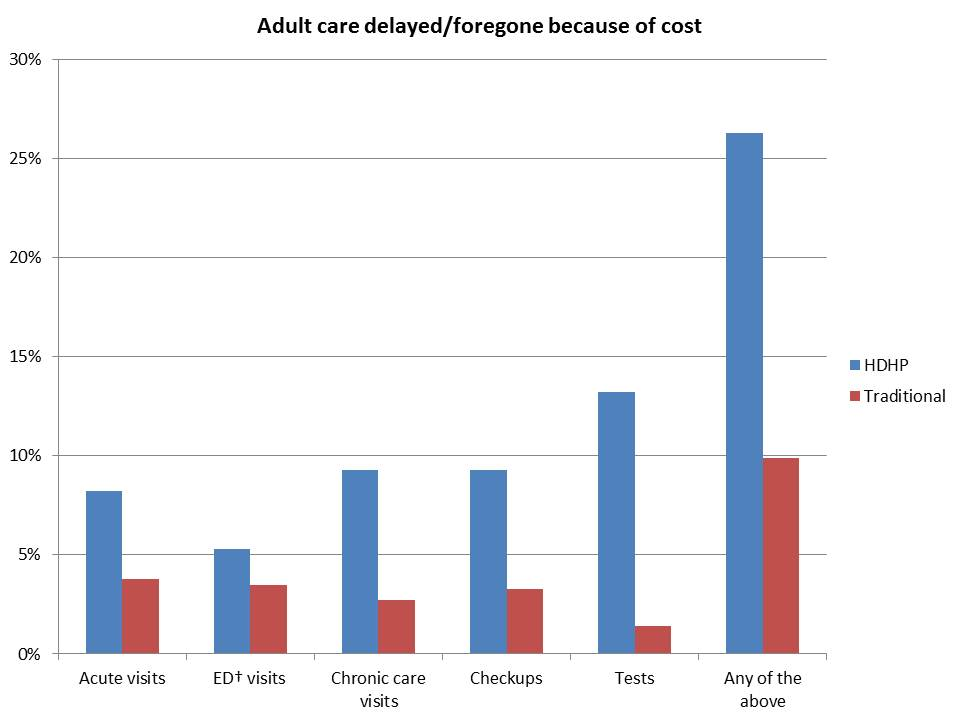
image

More than a quarter of adults had delayed or went without care because of cost. Adults were specifically more likely to delay or forego acute care visits, chronic care visits, checkups, and tests.

There were similar findings for care in children whose families had this type coverage.  The delays were particularly noted in those below 400% of the poverty line. 

Medicynical Note:  I’ve previously expressed reservations regarding high deductible insurance  and Health Savings Accounts.    

For those at or below the median wage, high out of pocket expenses influence whether or not to seek care—a form of implicit financial rationing.  In this setting the least knowledgeable, most emotionally involved get to decide whether or not to go for expensive interventions  for which they will have to pay. 

This might work if our costs were affordable, but they’re not.

Lung Cancer Treatment: Joe Paterno, a Teaching Moment

At age 85 a person’s life balance is quite fragile.  Medical problems that at a younger age have no effect on the quality or quantity of life can at age 85 have major consequences.  Flu may lead to pneumonia; a simple fall may break a bone and lead to complications; cancer treatments may have life threatening consequences.

At one time aggressively treating a person over age 80 with chemotherapy, much less chemotherapy combined with radiation, would have been unthinkable.  With medical “progress,” however, we believe that we can aggressively treat everyone, including the aged.

This was todays headline:  Joe Paterno, Penn State’s legendary football coach, dies:

Former Penn State head coach Joe Paterno, his body ravaged by chemotherapy and radiation treatments for lung cancer, died early Sunday morning at Mount Nittany Medical Center in State College.

Medicynical Note:  I don’t know how the advantages and disadvantages of treatment were spun to Mr. Paterno by his doctors. 

I can infer from the approach, chemo and radiation, that the disease was nonresectable (not amenable to surgery).  That is, it was either locally advanced or metastatic.  It is a fact that virtually all such patients (young and old) will have  limited benefit from aggressive treatment, and not be cured, regardless of age.  The results of studies in stage 3 and 4 lung cancer range  from  no survival benefit to a  few month’s longer life (median benefit).   Meanwhile many of these patients will have significant side effects, often debilitating and life threatening. 

Regarding those over age 80 and the benefits of lung cancer treatment,  see here:

The > or =80 age group was less likely to be subjected to surgery or chemotherapy, and had inferior outcomes when compared with the 70-79 age group and the <70 age group. Survival improvement was not observed in the > or =80 age group.

Regarding elderly patients with lung cancer: (note the difference between the elderly (age 70-79 and those over age 80)

Evidence supports that elderly patients with good PS and limited comorbidity may benefit from combination chemotherapy. Age alone should not dictate treatment-related decisions in patients with advanced NSCLC. Elderly patients with a good PS enjoy longer survival and a better quality of life when treated with chemotherapy compared with supportive care alone. Caution should be exercised when extrapolating data for elderly patients (aged 70–79 years) to patients aged 80 years or older because only a very small number of patients aged 80 years or older have been enrolled on clinical trials, and the benefit in this group is uncertain. (Medicynical emphasis)

Mr. Paterno’s treatment decision was, I’m sure, his own choice, influenced by his physicians as well as his personal beliefs.  His poor outcome is within the range of expected results for this terrible disease. 

Addendum:  Mr. Paterno is reported to have been diagnosed with small cell cancer of the lung with metastasis at diagnosis.  As with non-small cell lung cancer there is little data indicating a significant benefit for patients over age 80 from aggressive treatment.

The optimal therapeutic approach in older patients remains unclear. A population analysis showed that increasing age was associated with a decreased performance status and increased comorbidity.  Older patients were less likely to be treated with combined chemoradiation therapy, more intensive chemotherapy, and PCI. Older patients were also less likely to respond to therapy and had poorer survival outcomes. Whether this was a result of age and its associated comorbidities or suboptimal treatment delivery remains uncertain.

And:

Among patients with limited disease, the proportion receiving chemoradiation increased from 35% to almost 60% for those aged 60–69, from 28% to 48% in age group 70–74, from 17% to 33% in age group 75–79, but remained <10% for those aged 80+. Among patients with extensive disease, the proportion receiving chemotherapy (CT) decreased from 81% of patients aged 60–64 to 23% of those aged 85+, without substantial changes over time. Survival has only improved for patients <80 years.

GDP increase from Health Spending: Decreased Discretionary Spending the Result

It’s reported that consumer spending has increased since the 1960’s  from 61% to  71% of the the gross domestic product.  However, most of the increment is health care costs. 

Medical payments now account for about 16 percent of total consumer spending, more than food and clothing combined, which make up about 11 percent, or housing, which accounts for about 15 percent. The rising cost of health care means it will consume an even bigger share of the world’s largest economy as the population ages, according to economists like Jay Feldman.

“At the consumer level, it may squeeze out other discretionary spending,” Feldman, an economist at Credit Suisse in New York, said in an e-mail. “At the government level, rising Medicare and Medicaid spending will inevitably put pressure on other government spending priorities. At the business level, it could curtail investment, or more likely, suppress wages.”

Capture

Medicynical Note:  Increased discretionary consumer spending as a proportion of GDP (over the last 50 years in the U.S.) is an oxymoron.

Health Spending Growth: Regressing or on Hiatus

Uwe Reinhardt has some thoughts on the “moderation” of health spending.  He notes:

First, depending on the beginning and end points one chooses for calculation, the average percentage points by which the annual growth in health spending has exceeded the average annual growth in G.D.P. over the chosen period – a difference known among health policy analysts simply as “excess cost growth” – can vary quite a bit. One really needs charts like these to study the phenomenon, not point-to-point averages.

Second, the annual growth in real health spending per capita appears to have fluctuated around a long-run trend that has declined ever so gently over the longer period (see the blue line in Chart 3). That trend reflects in part that the annual growth in real G.D.P. per capita has also fluctuated around a gently declining trend line. As is shown in Chart 4, the trend line around which excess growth fluctuates is virtually flat.

The graphs show a huge yearly difference in the rate of increase in health care spending.  Read the article to view them.

Medicynical Note:  What’s missing from the article is a comparison of the increase in costs of health care with increases (or lack thereof) in income over the same period.  GDP increments miss entirely the huge disparities in wealth that have evolved in the past 30 years and the resulting poverty, decreases in real income, and decreases in the ability to pay for anything, including health care. 

The dilemma of U.S. health care is seems obvious.  Our costs have exceeded our individual and collective ability to pay.  How to resolve the disparity is the issue.

Great Moments in Medicine: Outpatient shocked by $45 billion dollar hospital bill

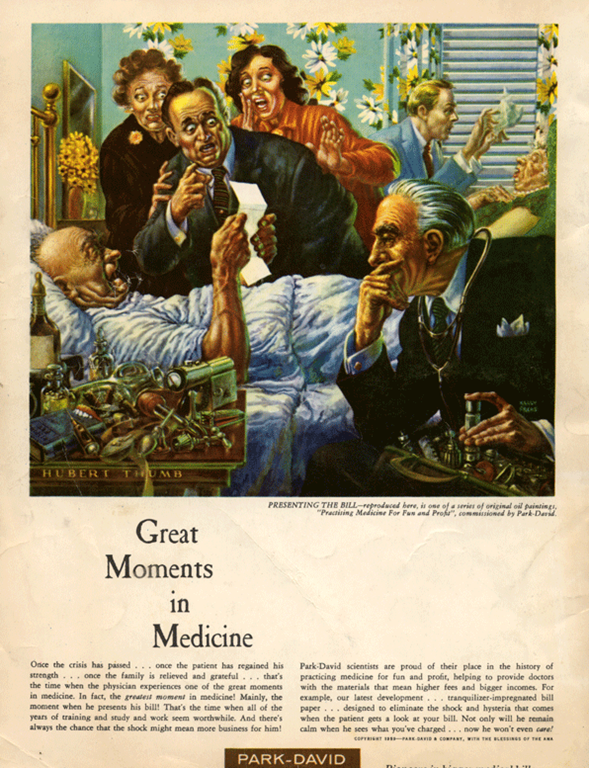
Mad Magazine famously pointed out the inflation in medical costs in the late 60’s with a parody on ads by Parke Davis (By Ken Freas). 

image

Parody sadly has become reality:  Outpatient shocked by $45 billion bill.

Health Care Spending Slows (McKinsey)—It’s Economic Rationing?

McKinsey group believes the slowdown in the growth of health care spending is complicated but at least in part driven  by “value” seeking consumers .  They note that consumers are paying a larger proportion of their health care expenses and that makes them more conscious of cost.

Remember we are talking about  a decrease in the rate of increase, not an actual decrease in the amount spent. In fact, our spending per-capita still far exceeds what one would expect even given our wealth when compared with other countries around the world.  This is evidence of an inefficient non-competitive approach. 

The historic slowdown in spending growth was caused by the convergence of a number of factors, including changes in benefit design, structural shifts within specific segments of the health economy, and a recession from which the U.S. economy has been slow to recover. Changes in coverage patterns and the decline in the share of the population with private insurance during the recession have also played an important role. Between 2007 and 2009, the number of people with employer-sponsored or private individual insurance fell by nearly 10 million. In 2009, the share of Americans with private insurance slipped to 64.5 percent – the lowest in 20 years of census records – while the share receiving public assistance and the percent uninsured both reached record highs. 

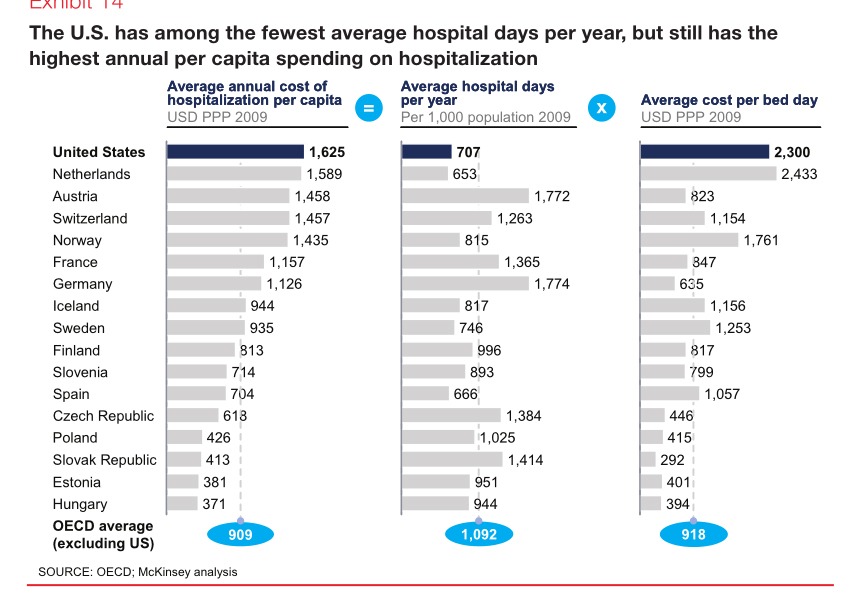
Despite the “slowdown”  our costs/capita for health care remain by far the highest in world.  For example hospital costs, even with the decreased “utilization:”

costhospitalization

 Medicynical Note:  Mckinsey may view this decreased rate of increase as a search for value in health care, which is laudable. 

However, searching for value when it’s driven by lack of insurance, substandard coverage and poverty  easily morphs into inadequate access, delays, and substandard health care (economic rationing).

PIP Implants: Regulating Safety, the role of FDA

We’ve commented previously on the need for regulation.  In health care this is particularly the case because of the consequences.

The recent and ongoing breast implant problems from Poly Implant Prosthese (PIP) devices could well have been a major issue in the U.S. but for the FDA taking seriously it’s mandate to assess the safety of medical devices.

The now-defunct PIP was recently found to have sold implants made with industrial-grade silicone to some 300,000 women worldwide, sparking a global health scare. France’s government instructed 30,000 French women to have their implants replaced due to a high rupture rate, and the country’s health minister has called for Mas to answer for the actions of a “shady business.”

In the United States, where the FDA had banned all silicone implants from 1992-2006, PIP sold a line of saline-filled implants starting in 1996. The business accounted for up to 40 percent of its revenue, according to company securities filings. McGhan’s MediCor signed on to distribute the products in 1999, but a year later the Food and Drug Administration (FDA) conducted a new review of the devices and decided there wasn’t enough data to show they were safe.

The agency then sent an inspector to PIP’s plant in France, who found multiple violations of accepted manufacturing practices and determined the products to be “adulterated,” Reuters has reported.

Medicynical Note:  Read the entire article to get a sense of the aggressive marketing of these devices.  When money is involved people do funny things. 

Health Care Cost’s Moderating? Good News?

The U.S. leads the world in health care spending per-capita.  We spend over 2.5 trillion dollars a year (over 8,000/person) on medical expenses but still have 50 million people lacking health insurance and assured access to care—I don’t count “free” ER access as assured care.  This is one and a half to two times the expenditures of other industrialized countries.

We’ve an approach to health care that’s become unaffordable to most people.  Our country leads the world in bankruptcy due to medical expenses.  To tell the truth such a category is unheard of in other industrialized countries. 

One can cautiously take the recent news that health expenses are “only” increasing at the rate of inflation as progress in gaining control over these expenditures:

Still, the increases for 2010 and 2009 were the lowest measured in 51 years. And health care as a share of the economy leveled off at 17.9 percent, the first time in a decade there’s been no growth.

But:

The main reason for the slowdown was that Americans were more frugal in their use of health care, from postponing elective surgery to using generic drugs and thinking twice about that late-night visit to the emergency room.

Medicynical Note:  After increasing at multiples of inflation for years, health care spending seems to have finally become unaffordable, thanks to increasing  deductibles, co-pays, inadequate coverage  and lack of coverage for over 50 million citizens. 

In these hard economic times we’ve proven that rationing by ability to pay works.  It’s however a blunt instrument.  People lacking resources cut back on care, whether it’s really needed or not.  We may lose a few but then we’re saving money.

Progress?  No.  Rational?  No.

Medical Expense Related Bankruptcy—We Lead the World

Our non-system of health care causes many distortions.   Health care costs in the U.S. are the highest in the world, almost double that of other industrialized nations.

Because of escalating costs, lack of job provided coverage, and pre-existing illness over 50 million of our citizens have no health insurance.   Limits in insurance coverage, high deductibles and co-pays make health care increasingly unaffordable.

These costs have driven individuals and families to bankruptcy in increasing numbers as noted in this article which documented that 62% of those going bankrupt in 2007  were driven to it by health bills.

The author’s abstract notes:

Using a conservative definition, 62.1% of all bankruptcies in 2007 were medical; 92% of these medical debtors had medical debts over $5000, or 10% of pretax family income. The rest met criteria for medical bankruptcy because they had lost significant income due to illness or mortgaged a home to pay medical bills. Most medical debtors were well educated, owned homes, and had middle-class occupations. Three quarters had health insurance. Using identical definitions in 2001 and 2007, the share of bankruptcies attributable to medical problems rose by 49.6%. In logistic regression analysis controlling for demographic factors, the odds that a bankruptcy had a medical cause was 2.38-fold higher in 2007 than in 2001.

In 1981 only 8% of bankruptcies were related to medical expenses.   With the current lack of wage growth, the decreasing proportion of people with insurance and the exploding health care costs over the past 10 years (well over 100%) the findings in the article are not surprising. 

For 92% of the medically bankrupt, high medical bills directly contributed to their bankruptcy. Many families with continuous coverage found themselves under-insured, responsible for thousands of dollars in out-of-pocket costs. Others had private coverage but lost it when they became too sick to work.  Nationally, a quarter of firms cancel coverage immediately when an employee suffers a disabling illness; another quarter do so within a year.  Income loss due to illness also was common, but nearly always coupled with high medical bills.

And the U.S. is exceptional:

Medical impoverishment, although common in poor nations,  is almost unheard of in wealthy countries other than the US.  Most provide a stronger safety net of disability income support. All have some form of national health insurance.

Medicynical Note: It’s bad enough that we have adopted an approach that does not have universal coverage and  that our health care costs are rising at an unsustainable rate and that our health insurance provides inadequate coverage. 

It is absolutely obscene however, that when a person gets sick and can’t work, his insurance can be cancelled or made unaffordable by raising the rate.  This is further aggravated by allowing insurers to then deny new coverage because of pre-existing illness.

American health care is set up to provide security and protection to everyone involved except the patient.  Quite an accomplishment if you ask me.

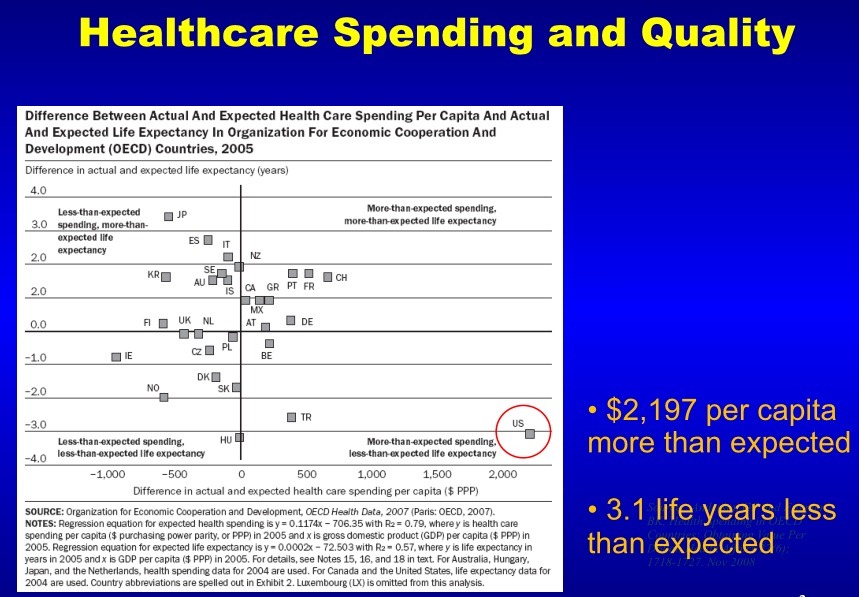
The U.S. is the Least effective, Most Expensive Health-Care Non-System (Industrialized Nations)

Healthcarespending USvswld

Doubleclick to enlarge

From:  Schmid, Tufts University Evidence Based Medicine Lecture: http://andrewgelman.com/wp-content/uploads/2011/12/SchmidJSM2011.pdf

Medicynical Note:  Something’s wrong here.