
Category Archives: General Cynicism

The Medical Industrial Complex: It’s the Money Stupid!

In health care, we’ve developed a system of money making that’s unprecedented.  What once was a profession that at least gave lip service to patients and health care–remember the “sacred patient doctor relationship?” or the “ethical” pharmaceutical industry?–has evolved into a money grubbing borderline ethical business.

Gaming the billing system has become the norm.  When our local “non-profit” hospital (run by a Catholic hospital conglomerate) bought out medical practices in our area, costs dramatically increased.  Coding for visits moved to more expensive levels.  The hospital  billed an additional facility fee even while the practices remained in the same location as before.   Procedures previously done out of the hospital were moved into their facility.  Instead of finding ways to provide efficient economical care, providers (and suppliers) even so-called non-profits seek to maximize revenue.  This is happening at every level of our health care mess and is one of the major causes of our  ridiculous cost inflation over the past 20 years.

More on gaming our non-system here:

Between 2001 and 2010, doctors increasingly moved to higher-paying codes for billing Medicare for office visits while cutting back on lower-paying ones, according to a year-long examination of about 362 million claims. In 2001, the two highest codes were listed on about 25 percent of the doctor-visit claims; in 2010, they were on 40 percent.


Big Pharma in Full Spin

The headline reads “Alzheimer’s Drug Misses Goal, but Offers Hint of Potential”.  It’s clear the drug didn’t work, but Lilly is spinning the results like mad—it’s stock actually rose.

An Alzheimer’s drug being tested by Eli Lilly failed in its main goal of halting progress of the disease, the company said Friday, but there were some signs it could slow cognitive decline in patients with mild cases.

The study found:

The two clinical trials involved a total of more than 2,000 patients with mild or moderate Alzheimer’s disease who received either solanezumab or a placebo for 18 months. In both trials, those treated with the drug were not better off at the end of the trial than those who received the placebo, either in terms of cognition or daily functioning.

Sounds conclusive to me, but through manipulation of data Lilly found that

there was a statistically significant slowing of the decline in cognition. When the data was further broken down, it was found that this beneficial effect was found in the patients with mild disease but not those with moderate disease.

Medicynical Note:  It would be nice if we could suspend reality and say that this drug had benefit but it’s hard to ignore the first part of the findings.  The discussion notes that “It is also not clear whether a slowing of cognitive decline, without an improvement of the ability of a patient to perform daily activities, would be sufficient for approval.”

Kind of pathetic.   It seems clear that the drug didn’t work and that Lilly is grasping at the straw of a subgroup without revealing the extent of the “benefit,” or the number of patients out of 2000 who “benefitted.”  

The press report and presumably Lilly’s press release reeks of a (Medi)cynical statistical manipulation designed to boost Lilly’s stock, not to improve the care and outcomes of these patients

The Ryan/Romney Health Plan: A Faustian Bargain!

To fully understand what’s happening in the health debate you  need to keep in mind that the repubs opposed Medicare (as well as Medicaid and Social Security) from it’s inception and have done everything in their power to cripple it (them).  They’ve prevented Medicare from assessing efficacy of treatments and interventions, prevented Medicare from negotiating prices with the drug companies, and have worked to “privatize” it.

Now they try to sell privatization as an improved program when it would appear to be a rather cynical effort to undermine affordable coverage to both the elderly and younger populations.  How else to interpret this:

He wanted to reassure the seniors in the crowd about the Republican presidential ticket’s plans for Medicare, the government health insurance program serving 39 million seniors.

“Our solution to preserve, protect and save Medicare does not affect your benefits,” Ryan, Romney’s vice presidential pick, said during an Aug. 18, 2012, stop at The Villages.  “Let me repeat that — our plan does not affect the benefits for people who are in or near retirement

Medicynical Note:  Guess who gets to pay for the continued benefits of the elderly under Romney/Ryan?  Our children and grandchildren! Guess who will get lower benefits and higher costs now and when they retire?  Our children and grandchildren!  This is a greed is good deal. 

In plainer terms “Romney/Ryan is a Faustian bargain with the payoff being the wealth, health and well-being of our children and grandchildren.    The Romney promises are empty as he has a track record of flip-flopping on health care and many other issues, depending solely on his political ambition. 

Romney has no apparent heart felt core issues, except to protect the interests of the wealthy.   Accepting his assurances  on health care provides no certainty that he actually will maintain the policy.  Adding to the uncertainty are the beliefs of his radical conservative tea party backers who want to completely gut Medicare, Medicaid as well as Social Security. 

Supporting Romney/Ryan is Faustian, there will come a time when we/you will be called upon to pay!

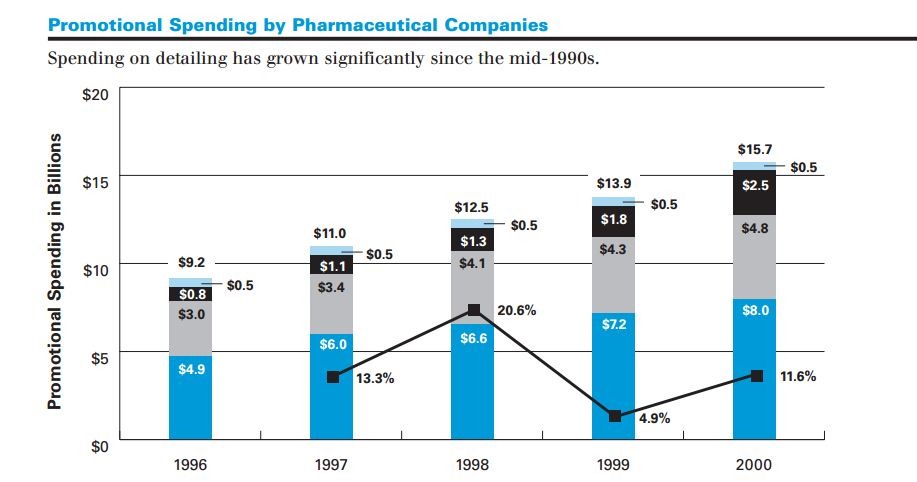
Why Drugs are Expensive: Marketing Costs

Drug companies spend as much or more on marketing than they do on research.  In the first quarter of 2012 direct to consumer advertising approached 1 billion dollars.

The costs of marketing to doctors,  and this is admittedly old data, is reflected in this graph.

  Capture

Today one would expect at least a 100% increment paralleling the increase in health care costs over the same period of time. 

Aggressive marketing has been shown to effect doctor’s decisions and increase patient expenditures, and overall costs.  Guess who pays?

Medicynical Note:  Read the links for more details.

It’s all about the money: Dermatologic Drug Price Inflation

Health care at one time was a altruistic endeavour.  Yes you earned a living and companies made profits but most providers were individuals and most institutions, non-profits.   The pharmaceutical industry at the time had the moniker, “ethical.”

Since the mid eighties there has been a unceasing inflation in costs.  Individual providers are anachronisms today and non-profits for the most part have converted into to for-profit entities.  As a matter of fact, because of a lack of concern about costs, even the non-profits that survive charge the same or more.

The report today in the Times on the rapid increase in generic dermatologic drugs re-emphasizes the point the prices in health care have nothing to do with costs of “development” or production.  It’s simply whatever drug companies choose to charge.  Since the number of suppliers and producers are few they are not inclined to compete on price.  So prices sky-rocket:

They are the staples of most dermatology practices: generic creams and ointments that treat everything from skin rashes to athlete’s foot to scabies. Many doctors prescribe the drugs without a second thought. But increasingly, some dermatologists say, patients are complaining about a recent, mysterious and rapid rise in price.

Take betamethasone dipropionate, a cream used to relieve itchy skin. In 2008, a tube cost $18.17. The medicine now costs $71.28, according to Red Book, which tracks wholesale drug prices. Permethrin cream, which kills scabies mites, cost $29.25 in 2008 but has jumped to $71.08 today.

Medicynical Note:  There’s no rational reason for this except that companies charge what insurers will pay.  Since Medicare is forbidden from negotiating prices and private insurers simply pass through the higher prices by adding to co-pays and deductibles, there is no strong countervailing force to control the gouging, particularly for these relatively inexpensive agents. 

In other countries the governments  negotiate prices and control price increases.  In our country our congress, under republican control at the time, forbade Medicare to negotiate. 

Is it any wonder that we pay more, double in some cases, for health care than anywhere else in the world….and I’d hazard a guess that we pay more for these drugs as well. 

American Health Care and Pizza (Papa Johns)

In addition to having the most expensive and by inference the most inefficient health care on earth, ours is the most heartless.  As noted in the experiences of this young woman, when you are desperately ill you are forced to spend an inordinate amount of time figuring our your coverage, worrying about life time maximums, finances, and copays and deductibles.

If you have a chronic illness in America, there’s a good chance you also hold a degree in Health Insurance 101, whether you want to or not. The first thing I learned was how lucky I was to have health insurance at all. (An estimated 49 million Americans, and nearly one-third of Americans 18 to 24 years old, are uninsured.) I was on my parents’ insurance, a plan provided through my father’s employer. It’s a comprehensive plan that will cover me until age 26 — two years from now.

I’ve been fortunate to be treated by excellent doctors at world-class hospitals. In the last year alone, my insurance has covered over a million dollars in medical expenses, including a bone marrow transplant and 10 hospitalizations amounting to a combined five months of inpatient care. It all sounds straightforward when I explain it like that. But even if you have insurance, the cost of health care — in dollars as well as in time and stress — is incredibly high.

Read the rest of the article for more.

Medicynical Note:  If Mitt gets his way insurers will be free to discriminate against this young woman and others with serious and debilitating illness and not offer them insurance or price it out of their range.  She is a poster person for health reform in that her coverage through her parents was not allowed prior to the  passage of that act.

Regarding the millionaire owner of Papa John’s Pizza moaning about increasing the cost of an order .15-.20 cents, he should be thankful to be able to offer such coverage to his employees.  Who, but for their good luck, could be facing similar catastrophic illnesses. Would he have preferred no coverage for his valued workers and the government paying directly through Medicaid for their care or having them become financially bankrupt or even worse not having access to care because of lack of insurance or funds.  Apparently Mr. Schatter is a Romney supporter, so who knows what he thinks.

The U.S.is the only industrialized country in the world without a national health plan assuring coverage to all citizens.   How exceptional is that?!

Rationing by Cost, The American Way!

Incidental Economist has a sobering graphic from the OECD evaluation of inequalities in health care access.  The U.S. again is an outlier. 

People like to believe that we don’t ration care in the US. We do. More than just about any other country, we ration by cost.

Medicynical Note:  The conservative right in our country would have you believe that we have the best health care in the world.  The questions I would pose is for whom?  and what alternative reality world are you talking about?

Our care is the most expensive; our insurance coverage the least available (50 million uninsured); and we lead the world in bankruptcy caused by medical expenses—a category of bankruptcy unknown in other industrialized countries. 

What we can say is that the U.S. leads the world in  dysfuntionality when it comes to health care—and self delusion. 

Conflicts of Interest in Genetic Counseling?

Being on the payroll of a company that pays commissions (kickbacks—medicynical observation)  for more business sounds at least unethical in a medical practice.  If the service provided is more than a person needs and if the relationship with the company is not fully revealed,  it could be criminal.  Something out of a HBO crime  family show?  No it’s simply the way genetic testing is encouraged in the U.S.

Now, as the number of tests and the money to be made from them are exploding, another question is being asked by professionals in the field themselves. Is it ethical for genetic counselors, who advise patients on whether to undergo testing, to be paid by the companies that perform the tests?

While it might not always be immediately obvious to patients, some counselors offering them advice in hospitals and doctors’ offices work for the commercial genetic testing companies, not for the hospitals or doctors themselves.

The testing companies appear to have business arrangements with hospitals and practices that recommend the use of the company’s counselors and product.  They and/or the counselor often  pay for office space in the facilities, to facilitate access to patients.   The counselors get paid more for an increased volume of testing.  When the full details of the arrangement is known the conflict of interest is quite likely to be worse.

For example, are the counselors full employees with benefits from the testing company or are they contractors?  If they are contractors than the extra payments for increased volume have more the flavor of a kickback than a “bonus” to an employee for good service.  In either case, the arrangement borders, in my view, on being unethical particularly if the relationship between the counselor, testing company, doctor and hospital is unclear.

Medicynical Note:  A cleaner way of doing this would be to have a completely separate office/facility for the genetic counselor with the relationship between the facilities clearly and understandably spelled out. 

The Problem with Free Markets: They are Rigged

Simon Johnson observes regarding the LIBOR scandal:

In the aftermath of the Barclays rate-fixing scandal, the most surprising reaction has been from people in the financial sector who fully understand the awfulness of what has happened. Rather than seeing this as an issue of law and order, some well-informed people have been drawn toward arguments that excuse or justify the behavior of the Barclays employees.

The justifications offered include that this kind of cheating has long been done; that everyone does it; that “no one” get’s hurt; that the regulator’s should have caught them; and that it was only a very few basis points—a very small percent of a huge amount of money.

Medicynical Note:  This sounds vaguely similar to some of the arguments put forth for continuing and “freeing from regulation”  our non-system of health care.  It is posited that “free markets” without government regulation will magically contain costs and result in better outcomes.  Something that has not occurred anywhere in the world. 

It should be noted that we’ve seen how well deregulation worked in the 80’s with Reagan’s S&L disaster; in the 90’s with Enron’s manipulation of energy markets; in this past decade with the Bush/Greenspan collapse of the financial system and now with the LIBOR scandal. 

From these experiences, the long term effect of deregulation on complex markets would appear to be collusion and corruption.  The goal of which is to maximize short term profit (and incomes) of those involved.  Perhaps, that’s why the U.S.’s quasi free market of health care costs 1.5-2 times that of any other place in the world. 

Improved health is not the driving force of this system.   But rather the motivation is more revenue and profits  for suppliers, whether they are insurers, providers, pharmaceutical companies or developers of technology.  As with the LIBOR scandal, integrity and honesty (and improved quality, affordability, and access) is not their concern.

And as Simon Johnson noted:

Power corrupts, and financial market power has completely corrupted financial markets. Barclays and the other global mega-banks involved in fixing Libor have brought their own industry very low – completely destroying the legitimacy on which sensible financial intermediation needs to be based.

Gaming Incentives for better Care

Interesting article in JAMA (Journal of the American Medical Association) reviewing the effects of incentives (mostly financial) in medical decision making.  They affect both patient and physician decision making and may be useful in getting additional value out of our non-system of health care.

There is ample evidence that physicians, who typically fulfill the criteria for being economically rational, are exquisitely sensitive to the incentives they face. Physicians tend to recommend tests and treatments that will provide them with financial benefit. For example, oncologists who are reimbursed based on the chemotherapy drugs they provide administer more of these drugs and concurrently, the more expensive drugs.1 On average, compared to physicians paid on a capitated basis, physicians paid for specific procedures tend to recommend more of those procedures. 

And

Patients tend to face idiosyncratic health issues, get relatively little useful feedback about the quality of medical decisions, and often make decisions when sick and, as a result, in a heightened emotional state. Perhaps not surprisingly, therefore, the behavior of patients can be less than perfectly rational.

Medicynical Note:  There is an opportunity here but I’m doubtful that there is enough support for the  social engineering necessary to improve.  For example, doctors are all for change until it affects their bottom line.  Patients want limitless access to everything regardless of efficacy or cost.  Both approaches lead to excessive costly medical interventions without quality improvement.

I guess we’ll see!?