
Category Archives: Ethics

Why Our Non-sytstem of Health Care is Bankrupting Us (Provenge, Makena) — While Congress Fiddles, Rome Burns

Two interesting events this week illuminate why health care costs are increasing (by double digit percentages) each year and why they are bankrupting individuals, insurance companies, Medicare, Medicaid, states and indeed the U.S. government.  And while this is happening congress is taking resolute steps to cut NPR’s funding, question individual’s rights to abortion (even in cases of rape, incest and mother’s life risk).  Their budget cuts amount to about 2% of the current budget deficit.  This budget balancing urgency comes after granting a 400 billion dollar a year tax cut.  Remarkable ineptitude.

How health care is  bankrupting us:

1.  Consider the recent rebranding of a long time generic drug hydroxyprogesterone caproate into  Makena.  Without getting into the question of efficacy, consider that hydroxyprogesterone caproate was available for many years at $10-15/ dose from compounding pharmacies.  The branded version of this same exact drug will sell, according to it’s manufacturer, for $1500/dose and the manufacturer expects individuals and insurers to pay.

Now a national pharmaceutical company has gotten FDA approval to make hydroxyprogesterone caproate and will be charging about $1,500 per shot.
KV Pharmaceutical, headquartered in Bridgeton, Mo., received approval Feb. 4 to make and market the drug for the prevention of pre-term labor that for years had been mixed by compounding pharmacies. (at $15, Medicynical clarification)

Medicynical Note:  It’s better than alchemy to be able to make a $15 drug into a $1500 one.  But that’s American ingenuity and creativeness.

2.  Selling a marginally effective drug (Provenge) for $93,000/course of treatment:

Medicare officials said Wednesday that the program will pay the $93,000 cost of prostate cancer drug Provenge, an innovative therapy that typically gives men suffering from an incurable stage of the disease an extra four months to live.

The Centers for Medicare and Medicaid said the biotech drug made by Dendreon Corp. is a “reasonable and necessary” medicine. The decision ensures that millions of men would be able to afford the drug through the government-backed health care coverage. With government reimbursement, analysts estimate Provenge could rack up $1 billion in sales next year. The decision, which will be finalized by June 30, is important for Dendreon because most prostate cancer patients are 65 or older.

Also:

“It’s impossible to put a dollar figure on a human life, especially when you’re talking about a drug that has such mild side effects,” said Jim Kiefert, a prostate cancer patient and advocate who was part of the Provenge study. “Of all the treatments I’ve had — with surgery, radiation and hormone treatment — Provenge had fewer side effects than any of them.”

But bioethicists who study health care decisions say Medicare’s ruling on Provenge mirrors the bias of the overall U.S. health system, which emphasizes expensive treatments over basic medical care. Health care costs account for nearly one fifth of the U.S. economy, more than any other country.

Medicynical Note:  It’s obvious to any thoughtful person that unless the cost of care comes down, we can’t afford our non-system.  We pay twice as much as other similar countries and still have 50 million and climbing uninsured.

Resolving the conundrum of health care costs is a major question that instantly strikes our politicians deaf, dumb and blind.  Even the most innocuous suggestion, for example, comparing the efficacy of new drugs against older less expensive ones, in studies not sponsored by drug companies, is considered controversial.

I’m sad for my grandchildren.

Addendum:  4/1/2011 Drug company slashes price of drug from $1500 to $690. A bargain?  Still only 50 times the price of the generic.  Amazing!

The price of an expensive (? Medicynical question mark) drug to prevent premature births has been cut by more than half, following bitter controversy over its high cost.KV Pharmaceutical Co. said Friday that it is dropping the price from $1,500 per dose to $690.

The company got government approval in February to exclusively make the drug named Makena (mah-KEE’-nah), and it hit the market last month. For years, specialty pharmacies had been making a version of the weekly injection for $10 to $20 a dose, so the price of Makena was a shock to doctors who prescribe the drug and private and public insurance programs that pay for it.

It’s hard to tell what’s real on April fools day.
Moral Hazard? Bad Luck? Or Totally Dysfunctional Health Care

At the annual stroke conference (every disease has it’s conference) it was reported that some patients are not getting optimal care because they are uninsured and/or can’t afford the necessary medications.

The issue of the coverage of health care costs is intensified by the large vocal organized minority (I think) who believe sickness is just another moral hazard for which to hold people accountable.  Their  view  is that the individual bears responsiblity for their illnesses and therefore it’s all right that they should suffer the indignation of having no insurance.  These health care untouchables in their view deserve  relegation to  limited access to care–“they can go to ER’s.”  This tough luck attitude is held whether the  problem is lack of job, access to insurance, high cost of insurance, “pre-existing” illness clauses, accidents, hereditary disease, bad luck……whatever.

This report on strokes is the tip of the 50 million uninsured iceberg that affects health care quality and outcomes in the self proclaimed wealthiest country in the world.

Some stroke survivors skip prescribed medications because the cost is too high — a situation that may be worsening, particularly among young and uninsured patients, researchers found. According to a national survey of stroke survivors conducted from 2006 to 2009, 30% of those ages 45 to 54 and 60% of those who were uninsured reported that they were nonadherent because they could not afford to buy the medication

The current situation, not surpisingly, is worse than reported previously:

Both figures were greater than those reported in a similar survey conducted from 1998 to 2002, when cost-related nonadherence was 18% among those 45 to 54 and 39% among the uninsured,

Medicynical note:  Sad but true.   It is also a fact that the problem is getting worse with many states in the process of cutting subsidized health insurance programs, access to medicaid and working to undermine health care reform.  Only in America, literally.

Individual Mandate: Be careful what you wish for

Be careful what you wish for.  This cuts both ways.

The incidental economist notes: (Austin Frakt)

If one wants to address the problems in health insurance markets and/or to get providers to accept payment reforms, the mandate–or something like it–is the political price. Yes, it’s about money. What else?

Put it this way, if one wants to retain a private market-based health insurance system (which ours largely is), it takes a mandate. Reject the mandate without replacement with a similar mechanism and the whole thing unravels, not just as a matter of health economics (adverse selection) but as a matter of politics.

Medicynical Note:  We’ve created the most dysfuntional, expensive healthcare non-system in the world.  Yes we’re number one.

Employer sponsored health care is a mess.  Employers don’t have to provide their employees health care–in many instances they can’t afford to provide it; “contractors” are not employees and don’t qualify for employer provided benefits;  if you get sick and can’t work, you lose your insurance.  Remarkable.

Our health care costs are twice that of many other industrialized countries and thousands more per capita/year.  We have 50 million uninsured and have a “system” that encourages “free” use of the most inefficient, most expensive health care provider in the country–emergency rooms.

We all pay.

25% Overuse of Implantable Cardioverter (ICD)

As noted in JAMA, implantable cardioverters are being overused. 25% of patients in the study cited did not have the accepted indications for this expensive procedure. Furthermore:

Patients who received a non–evidence-based ICD compared with those who received an evidence-based ICD had a significantly higher risk of in-hospital death (0.57% [95% confidence interval {CI}, 0.48%-0.66%] vs 0.18% [95% CI, 0.15%-0.20%]; P <.001) and any postprocedure complication (3.23% [95% CI, 3.01%-3.45%] vs 2.41% [95% CI, 2.31%-2.51%]; P <.001).

Medicynical Note: We think of the art of medicine as making treatment decisions using science as well as instincts based on the provider’s unique knowledge of the patient, local standards and what is medically indicated.

In the JAMA study 25% of patients received ICD’s did not have the established indications for the procedure and as a group these patients had worse outcomes. Presumably their doctors felt the use of the ICD indicated (applying the “art of medicine”). As costs have increased (an ICD procedure is $50,000 or more) and better tracking of outcomes reveal that overuse leads to more complications and worse outcomes, I’m not sure we can afford this type artistry.


The Game of Health Care — Another Great Moment in Medicine

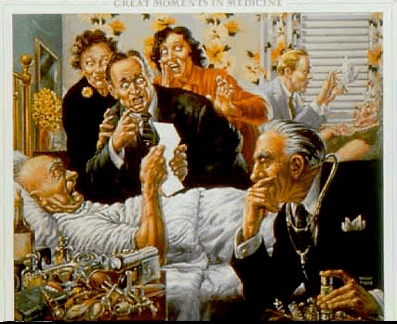
I can recall a MAD Magazine illustration series (drawn by Kelly Freas) called “Great Moments in Medicine.” It was a parody of one of the “ethical” pharmaceutical company’s ad campaigns. Except in the MAD magazine case the great moment was presenting the bill.


In today’s Times there is another great moment.   Drug companies distributing coupons to decrease co-pays on their expensive drugs so as  to increase their  use rather than equally effective less expensive generics. With the coupon the patient’s out of pocket expense was the same. but for  insurers the cost was many times more. Guess who pays for this with increased insurance premiums?

Drug companies say the plans help some patients afford medicines that they otherwise could not.

But health insurers and some consumer groups say that in many cases, the coupons are just marketing gimmicks that are leading to an overall increase in health care costs. That is because they circumvent the system of higher co-pays on costlier drugs that insurers use to encourage consumers to use less expensive products.

One example was a one a day patented formulation of the generic drug minocycline:

A month’s supply of Solodyn sells for more than $700 on drugstore.com, compared with about $40 a month for capsules of generic minocycline, which are generally taken twice a day.

Almost 20 times the cost.

Medicynical Note: Is it any wonder that our non-system of health care is bankrupting us?

Suppliers (and insurers at times) game the system to maximize profits. Patient care? Cost efficiency? Not our department.


Spinal Fusion Surgery — Big benefit to doctors, limited benefit to patients

Bloomberg has an interesting article on the limited medical benefit of spinal fusion to patients–but big financial benefits to doctors, medical practices and suppliers (Medtronic). The article documents at least the appearance of, if not actual, conflicts of interest; high costs $135,000 for the surgery (yes on one patient); $800,000/year incomes for the orthopedists–three times that of pediatricians.

The possibility that many of these and other surgeries are needless has gotten little attention in the debate over U.S. health care costs, which rose 6 percent last year to $2.47 trillion. Unnecessary surgeries cost at least $150 billion a year, according to John Birkmeyer, director of the Center for Healthcare Outcomes & Policy at the University of Michigan.

“It’s amazing how much evidence there is that fusions don’t work, yet surgeons do them anyway,” said Sohail Mirza, a spine surgeon who chairs the Department of Orthopaedics at Dartmouth Medical School in Hanover, New Hampshire. “The only one who isn’t benefitting from the equation is the patient.”

There’s lots to this article including evidence that fusion is no better than physical therapy for disc related pain in several studies–only a 47% success rate for surgery in one U.S. study;  high complication rates for surgery;  direct payments from the medical supplier (Medtronic) in the form of royalties and consulting fees to doctors (as high as $440,000/year to an individual doctor and 1.75 million to a practice in Minneapolis).

Medicynical note: Not a pretty picture of American medicine. Costly, open conflicts of interest, use of aggressive expensive unproven procedures over more conservative approaches–with the same or worse outcomes.  Is it any wonder that our costs are one and half to two times that of other industrialized countries.

The “free market” encourages entrepreneurs to find ways to take advantage of markets, sometimes that leads to better outcomes and more efficiency but in medicine it seems to encourage waste, high cost and over-utilization.

Hospital Saves Mother, Loses Catholic Hospital Status

When churches do religion they apparently do it well. When they choose to practice medicine they bungle, despite their “infallibility.”

In this situation the hospital, after doing an appropriate ethical review, saved the life of a woman having life threatening complications from a pregnancy– hypertension, probably eclampsia.

The church’s reaction to this life saving act:

The Roman Catholic Diocese of Phoenix stripped a major hospital of its affiliation with the church Tuesday because of a surgery that ended a woman’s pregnancy to save her life.  

The woman is in her 20s had a history of abnormally high blood pressure when she learned of her pregnancy. After she was admitted to the hospital with worsening symptoms, doctors determined her risk of death was nearly 100 percent.

Medicynical note: If a loved one were pregnant, I would not advise using a hospital blindly adhering to the catholic church’s wishes. Medieval notions in the modern era unfortunately lead to remarkable distortions which in this case threatened life.

Urologist Owned Radiation Facility (IMRT) = Expensive Conflict of Interest

WSJ notes the overuse of IMRT (intensity modulated ratiation therapy) at great cost to patients, medicare, other insurers and our health care non-system.

In recent years a number of urology groups have puchased and own radiation centers. The result is costly self referrals and obvious conflicts of interest. Here’s how it works.

urologists buy radiation equipment and hire radiation oncologists to administer it. They then refer their patients to their in-house staff for treatment. The bulk of Medicare’s reimbursements goes to the urologists as owners of the equipment.

The problem is not patient outcomes or fewer complications but rather overuse of an effective form of treatment to the financial benefit of the providers.

Asked during the interview what proportion of its prostate-cancer patients Integrated Medical treats with IMRT, Dr. Kapoor said he didn’t track such data closely, but said he would be “comfortable” with an estimate of “one out of six,” or 17%.

An analysis of Integrated Medical’s Medicare claims later performed for the Journal suggested a much higher rate. Between its launch in mid-2006 and the end of 2008, Integrated Medical administered IMRT to 601, or 53%, of 1,132 Medicare patients recently diagnosed with prostate cancer, the Journal analysis found.

Integrated Medical received $26.7 million from Medicare for the care of those 601 patients, according to the Journal’s calculations. If Integrated Medical’s urologists hadn’t owned radiation equipment and had referred these patients for radiation treatment outside of their practice, Medicare would have paid them only $2.6 million. Medicynical note: The data on treatment of patients over 80 discussed in the WSJ article is particularly damning.

The sales pitch to urologists considering buying such a radiation facility predicts an income of $425,000/doctor from incorporating such a unit in his/her practice.

Medicynical Note: This behavior falls into a loop hole of the Stark provisions against self referral. Read the article for a more complete explanation. The doctor’s position that their treatment decisions are based solely on patient benefit would be more defensible if they did not participate in the entire revenue stream and if the radiation modality did not appear to be overused.

What’s depressing is that there seems no incentive to provide care at a more reasonable price (value).   Rather than take a cut in the  generous $425,000/year doctor profit  (this in addition to his/her other fees) these providers stick it  to our failing health care non-system.

With everyone at every level  concerned with  maximizing profit, is it any wonder that we spend 17% of GDP on health?  That our health care insurance system is failing? and that we can no longer afford it!

This is going on during a disastrous financial downturn.  But then again considering the behavior of our financial sector, maybe it’s a natural consequence of a medical establishment whose primary goal seems to be monetary rather than medical.


Our Health Care System: Inefficiency, is that a problem?

The Washington Times presents a tortured argument against promoting more efficient care in the most expensive health care non-system in the world.

Think of it, a centralized, federal database tracking your every visit to a health care provider – where you went, who you saw, what was diagnosed and what care was provided. Chilling.  Medicynical note: as if private insurers oversight that  controls and limits treatment given is less intrusive, or as if the data will have patient identifiers.

The Times takes issue with the notion of efficiency in health care.  To them, apparently,   spending 50% more per capita on health care than any other nation in the world and 17% of GDP, and increasing yearly, is acceptable:

There is no telling what metrics will be used to define the efficiencies, but it is clear who will bear the brunt of these decisions. Those suffering the infirmities of age, surely, and also the physically and mentally disabled, whose health costs are great and whose ability to work productively in the future are low. And how will premature babies fare under the utilitarian gaze of Washington’s health efficiency experts? Will our severely wounded warriors be forced to forgo treatments and therapies based on their inability to be as productive as they once might have been? And will the love between a parent and child have a column on the health bureaucrats’ spreadsheets?

The Times then goes on to compare cost efficacy measures with the nazis.

Medicynical note: Nothing surprising here. Until we show some will to control  costs our non-system caring for an aging increasingly health care needy population will continue to spend our nation’s wealth.

Our republican friends have been amazingly quiet about their solutions. Their “free market” rhetoric leads one to assume they would put an increasingly large burden of expense on individuals–their form of individual mandate. They would then let the costs of health care assure economic rationing. For those who can’t afford care, I suppose their solution for patients is that of 18th century France and will let them eat cake.

Starbucks — More spent on health care than coffee

It’s remarkable how shortsighted American businesses are. Their Chamber of Commerce is on record as opposing health reform.  Given the cost of providing employees health insurance one would think they would be supportive of  reform efforts, particularly if they removed health insurance as an employee benefit, as is the case in most industrialized countries.

Consider the bankruptcies of GM and Chrysler due in part to health insurance costs; consider also Starbucks which provides health care for employees, “a line item that tallies $300 million. That’s more than the company spends on coffee.”

Medicynical note: In other countries businesses don’t have to factor the health coverage burden into their planning, or costs. It’s another of those incomprehensible inefficiencies that is uniquely American.