NIMBY in Financials and Health Care

Last week the President met with financial leaders and proposed reform and regulation of their market. You would think after the hundreds of billions spent to keep them afloat after their meltdown that they would be receptive to anything that would decrease the risk of a recurrence. But no, in typical american fashion, they seem to bridle under the accusation that their problem was self inflicted, that it would happen again and that some type of restraint (regulation) was necessary.

In health care we see similar NIMBY traits. No one wants to give an inch. Insurers want to continue their profligate policies that guarantee profits but not access or quality. Providers fear the unknown and are the most vulnerable so they are wary of change. Patent holders (technology or pharmaceuticals) oppose change because it might infringe on their profits. Parenthetically all are afraid that their cost plus gravy train is jeopardized.

You would think with the hundreds of billions wasted yearly on health care the players would be receptive to proposals that would decrease costs and improve efficiency. But no, in typical american fashion, they seem to bridle under the accusation that their problem is self inflicted, that it will continue and/worsen in and oppose the notion that some type of reform (regulation) is essential for improvement.

In reality there is no “free market” in health care, nor, for that matter, is one possible. For example, our patent system offers long protection to new drug developers and guarantees their monopoly. Some free market, particularly when they charge thousands of dollars/month for a drug alone–which accrues over 12 months to more than the yearly average income! This is particularly aggravated by the fact that in health care there is no assured access to full information; optional approaches are not fully explained, understandable to the average person nor universally available; the buyer is under duress; and the providers charge whatever they wish without relation to true cost.

As a result we ration access (50 million uninsured) and care by cost. That’s our non-system.

It’s distressing to see what’s happening in our congress. Their timidity and responsiveness to the health care lobby quite depressing.


Through the Looking Glass–Back from Vacation, the cruel joke of the health care debate

We traveled the past 5 weeks by auto and trailer to Alaska, not paying much attention to the health care debate. In a number of places however, we talked with people from overseas about health care and their perceptions of our non-system and the on-going debate.

Unanimously the Canadians and Europeans were bemused and appalled by the tenor of the republican and so called conservative attitudes. They don’t understand the the lying, half truths and the exaggeration that is tolerated in our discourse. Lastly they can’t comprehend the lack of efficiency in health care; our excessive costs; and the pervasive fear in our society of being able to pay for a doctor’s visit, much less the services one might need. This, in what once was the leader of the “free” world and the most dynamic efficient successful economy in the world.

Meanwhile, these overseas visitors are delighted with their own organized, government supported, health care systems. They are not complaining about access or costs.

It’s a fact that elsewhere:

Costs are half to two thirds those in the U.S.

Outcomes in their systems are as good, or better. Preventive health measures seems to have resulted in longer life expectancy and better maternal and child mobidity and mortality in many places

Drugs costs are much less

All are eligible for care, NO ONE is bankrupted by health care and none have a fear of the cost of becoming sick

Jobs are not held hostage to health care coverage

Medicynical note: Our conservative types don’t like inheritance taxes, calling them a “death tax.” But all of us ultimately will face a fatal illness. Paying for it will strip our “estates”, if we have them, of financial worth. Is this not another death tax, one that applies to all regarding of income; one in which the notion the inevitibility of death and going bust to pay for it are near certainties for most of us.

Shouldn’t we do better?

Powered by Zoundry Raven

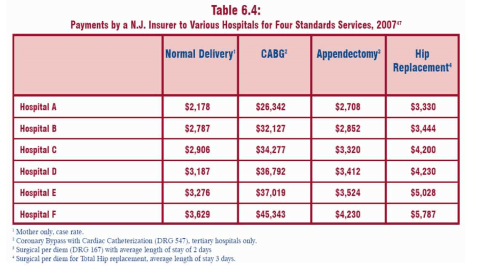
Variation in costs: Standard Operating Procedure in the U.S.A. Is this any way to run a health care non-system?

Interesting juxtaposed articles by Ewe Reinhardt and Paul Ginsberg at the Health Affairs site regarding the huge variation in payments by insurers to different hospitals for the same procedure. Imagine what an individual pays!

Here’s an example from Reinhardt’s article:

Medicynical note: These insurers are negotating with providers in a free market to provide the least payment possible for the service provided–so as to maximize the insurer’s profit. The insurers are unable to reach a consistent payment for the same services. The insurers presumably are knowledgeable and have the advantage of reams of information about payments to other providers for the same service and still cannot arrive at a consistent price.

This is the “free and open” market that our conservative friends talk about. They would argue that the consumer would have incentive to shop for the cheapest price and go to that facility, disregarding urgency, locale, quality, ability to understand alternatives, and convernience. This is not reality.

Powered by Zoundry Raven

Best Health Care in the The World–Our Myth

Our conservative friends have chosen the mantra that we have the best healthcare in the world as their basis for opposing reform. Facts, however, don’t support their claim.

This from the Congressional Research Service on quality:

“However, research comparing the quality of care has not found the United States to be superior overall. Nor does the U.S. population have substantially better access to health care resources, even putting aside the issue of the uninsured. Although the United States does not have long wait times for non-emergency surgeries, unlike some OECD countries, Americans found it more difficult to make same-day doctor’sappointments when sick and had the most difficulty getting care on nights and weekends. They were also most likely to delay or forgo treatment because of cost.”

We are number one (compared with other industrialized nations) in:

Bankruptcy caused by health care expenses

Excessive utilization of services and by inference inefficiency

Doctor’s salaries

Hospitalization costs

Drug costs

Insurance costs

The number of citizens who are uninsured.

The costs of emergency room services

NOT preventing preventable disease also here

Inequities of it’s health care system. It “ranks dead last on almost all measures of equity,” with the “greatest disparity in the quality of care given to richer and poorer citizens”

Perhaps because of the failures of our non-system, the World Health Organization ranked the U.S. health care system’s quality 37th in the world in 2000, if anything the situation is worse now.

Infant mortality–In 1960, the United States ranked 12th lowest in the world, by 2004, the ranking had dropped to 29th lowest.

The U.S. has been slipping for decades in international rankings of life expectancies as other countries are improving health care, nutrition and lifestyles, according to the AP/Daily Star. Countries that rank above the U.S. include Japan, most of Europe, Jordan and the Cayman Islands. A U.S. resident born in 2004 has a life expectancy of 77.9 years, placing the U.S. in 42nd place, down from 11th place two decades ago.”

“The U.S. ranks “near the bottom in healthy life expectancy at age 60” and 15th among 19 nations in deaths that would not have resulted “if treated with timely and effective care”

Outcome studies on a variety of diseases, such as coronary artery disease, and renal failure show the United States to rank not significantly better and in some cases worse than Canada and a wide variety of industrialized nations.

On the positive side however, the U.S. ranks “first in providing the ‘right care’ for a given condition” and high for preventive care but performs “poorly in coordinating the care of chronically ill patients, in protecting the safety of patients and in meeting their needs and preferences”;

Medicynical note: Our conservative friends say they want a more market oriented approach without bothering to correct the rotten “core” of our non-system. But market “competition” in health care doesn’t work. Our patent system provides a government sponsored protection to profits for drug companies and other new product developers for a generation. Such a scheme by definition is not free and open. Certainly there are benefits from patents but if the patent holders are irresponsible and abuse the privilege, the system fails, as our is in the process of doing. Drugs that cost over $10,000/month are simply not affordable by the system or individuals.

The “free market” approach to health care falls apart because the asymmetry in knowledge; the duress consumers face when utilizing the system (pay or die in some cases); and the lack of a reason for efficiency. Providers, institutions, insurers and manufacturers have operated on a cost plus basis for the past thirty years, piling on excessive costs without concern for value or for affordability.

The “free” availability of emergency room care is touted by our conservative friends as the solution to the lack of access for the uninsured. It’s at best ironic, and at worst cynical, that conservatives count on a government mandated safety-net program as an answer for our uninsured population. ER care is inefficient and expensive. As such it doesn’t answer our cost problems or the continuing care problems for 50 million of our citizens. How pathetic we are that this is a “serious” argument in the health care debate.

In summary: We have evolved into a healthcare non-system that is quite good for making money. Because of profit pressures our free wheeling approach encourages overutilization and inefficiency. Our costs are 1.5 -2 times that of other industrialized countries in the world, and approaching 16% of GDP. It’s simply not the best, but is the most expensive.

Powered by Zoundry Raven

Moyers Interview with CIGNA executive: Insurers sadly meet our expectations

This was in Bill Moyer’s Journal week of July 9. Wendall Potter, an executive at CIGNA, reveals the other worldly quality of health insurers decision makers; their insular goals–and they are not improving health care; and explains his motivation in giving the interview. Worth seeing.

Medicynic: It really is about the money–insurers, high salaries and profits. Amazingly our legislators seem reluctant to reform our non-system. The industry seems to have them in their pocket–I mean pocketbook. We’ll need to drag them kicking and screaming into change.

Powered by Zoundry Raven

Our Health Insurance System isn’t working–We MUST do something!!

This from today’s Seattle Times:

“In what is becoming an annual ordeal for policyholders, Regence BlueShield is raising premiums for 135,000 individual health-plan members in Washington by an average 17 percent on Aug. 1.”

“And it comes after two other insurers, Group Health Cooperative and LifeWise Health Plan of Washington, recently imposed similarly steep premium increases.”

In yet another strong argument for health reform it was noted:

“Hensley said,Regence is losing money on its individual plans and subsidizes them with earnings from its group plans.”

One patient noted that her premium is now $1400/month and is going to rise to $1700.

In a letter to the editor of the same Seattle Times, a patient made these comparisons between what goes on here and in the health care system of Canada. Yes, I know it’s just an anecdote, but what do think the other side cites when damning health care reform.

“Canadian health care would be a welcome change”

“Opponents of a public-health-insurance option caution that such a plan would result in “Canadian-style” health care. In support of this, here is a true story.”

“A cautious, self-employed Seattleite, I pay for the best private health insurance available. Good thing, because at 43 years old, after being diagnosed with an aggressive breast cancer, I received treatment at two top regional facilities: surgery at University of Washington Medical Center and chemotherapy at Seattle Cancer Care Alliance.”

“Weeks after my diagnosis, a lifelong friend in Vancouver, B.C., was diagnosed with a virtually identical cancer — same tumor size and characteristics, same lymph node status, etc.”

“After tumor discovery, I received diagnostic tests after more than 30 days.

Her tests took three. I waited five weeks for surgery; she was scheduled in two. Post-surgery, I waited five weeks to begin chemotherapy. Her chemo started in three.”

“In the end, my out-of-pocket expenses exceeded $30,000. Her bills were in the hundreds of dollars.”

“The UW just hired my reconstructive surgeon from the University of Toronto for his education in pioneering techniques. My friend’s surgeon was Canadian, too.”

“So will a public plan result in Canadian-style health care? I truly hope so.”

Medicynical note: What we have costs more and does no better, maybe worse in some areas. We’re bankrupting individuals and the “system” (I use the term system very loosely here).

Powered by Zoundry Raven

Targeted therapy in Lung Cancer: Which offers more value, Avastin, Erbitux or NEITHER!

Annotated abstract from the recent ASCO meetings.

This is a study comparing the cost of two very expensive, marginally effective treatments for lung cancer. The abstract purports to show that one of these drugs is less expensive and offers more “value” than the other. In fact neither is a “value” choice.

Title: A cost analysis (1) of treatment with bevacizumab plus cisplatin and gemcitabine (BCG) versus cetuximab plus vinorelbine and cisplatin (CVC) in patients with advanced or recurrent non-small cell lung cancer (NSCLC) in Germany

Authors: D. F. Heigener, C. Wiesner and R. Aultman

Affiliations: Krankenhaus Grosshansdorf, Grosshansdorf, Germany; Roche Pharma AG, Grenzach-Wyhlen, Germany; F. Hoffmann-La Roche, Basel, Switzerland

#: e17553

Background: Although new treatment options for advanced NSCLC can offer improved survival over standard treatment with chemotherapy (CT) they should also offer value for money.(2) Bevacizumab (BEV), a humanized monoclonal antibody (MAb) directed against vascular endothelial growth factor when combined with CT increases overall survival (median 13.6 months in the AVAiL study) and progression-free survival (PFS) in patients with advanced NSCLC when compared with CT alone.(3) Cetuximab (CTX), an IgG1 MAb which targets the epidermal growth factor receptor achieved a median survival time of 11.3 months when combined with CT in the FLEX study (4) and marketing authorization is anticipated in 2009. The aim of this study was to compare the costs of treating NSCLC with BCG or CVC in Germany. Methods: A Markov model was used to compare drug and administration costs associated with treating advanced or recurrent NSCLC with either BCG or CVC. The model assumes patients move from non-progressive to progressed disease prior to death, according to transition probabilities derived from an indirect comparison of the efficacy of BCG and CVC in terms of PFS using data from the respective pivotal trials and appropriate indirect comparison methodology. Cost data were derived from local sources. Drug cost assumed CT was given for up to 6 cycles, that CTX was administered at an initial dose of 400 mg/m2 followed by 250 mg/m2 weekly until progression and that BEV was administered at 7.5 mg/kg until progression. The model estimated average drug and administration costs per patient treated with either BCG or CVC. Results: The mean total costs of BCG treatment was Euro 4713 less per patient when compared with CVC (Euro 28342 vs. Euro 33055). The addition of BEV to CT was less costly than the addition of CTX to CT ( Euro 18796 vs. Euro 29502) and the administration costs were also lower (Euro 391 vs. Euro 1179). Conclusions: Targeted therapy using BEV is less costly than CTX in Germany and thus, from a budget perspective, offers the best value for money strategy for improving outcomes in patients with advanced NSCLC. Furthermore, costs savings with BCG in Germany are likely to be increased when gemcitabine comes off-patent in 2009.

Medicynical Annotations:

1. Cost Analysis: This abstract hardly describes a cost analysis. It is an attempt to encourage the use of bevacimimab (Avastin) instead of cetuximab (Erbitux). The study was sponsored by a drug company and the authors were company employees or recipients of financial support.

2. Value for money. It’s ironic to hear pharmaceutical company’s spokespeople tout value. In this case we are talking about two medications that are priced in the $10,000/month range. That’s more on an annual basis than the median and average incomes in the U.S. Yet these medication appear to have minimal positive effect in the setting described. That sure doesn’t sound like value!

3. Survival Benefit: The AVAIL trial found :

“At 12.5 months of follow-up, progression- free survival was significantly improved with bevacizumab, from 6.2 months in the placebo arm to 6.8 months with the 7.5 mg/kg dose (P = .0003) and to 6.6 months with the 15 mg/kg dose (P = .0456), Dr. Manegold reported.”

It also noted:

“No differences were observed in overall survival.”

Medicynical Note: The abstract doesn’t comment on the lack of a survival benefit. This omission is similar to the drug company’s press releases (google AVAIL study–press release here , and here .) But the various press releases do imply such a benefit when they claim: “Only first-line treatment to demonstrate extended survival in over a decade.” A claim that is marginal at best.

Dr. Manegold also furthers the fiction that there might be a survival benefit by stating that the 13 months survival was the “longest” for advanced NSCLC. However, he didn’t note that the survival in the group not receiving targeted therapy in his study was just as long

The only proven benefit from this expensive drug in the AVAIL study was a .6 month delay in disease progress.

(4) Compared with FLEX study: The other study referred to in the abstract is an ECOG (Easter Cooperative Oncology) group trial ( ECOG 4599 N Engl J Med 355:2542-2550, 2006). They compared carboplatin and taxotere with and without cetuximab (Erbitux). They found overall survival was 11.3 months in the cetuximab group and 10.1 months in the controls , an improvement of just 1.2 months. One-year survival was 47% in the cetuximab group and 42% in the control group.

Medicynical note: The AVAIL trial resulted in a .6 month delay in progression and no improvement in overall survival. The cetuximab trial shows slight benefit. These are hardly revolutionary improvements in patient care from drugs priced in the range of $100,000/year.

For what it’s worth the FLEX trials patients’ overall survival with cetuximab and chemotherapy was less than the control group (the group only receiving conventional chemotherapy) in the AVAIL trial.

The small delay in progression and improvement in survival (only found in the FLEX study) in these studies may be explained by patient selection, first study bias or simply be an indication of the limited efficacy of these agents in advanced lung cancer. Something that you would not know from the abstract or the PR releases.

Comparing the costs of very expensive agents with small benefits obfuscates whether they should actually be used in the first place.

It is a truism that drug companies market for profit rather than patient benefit.

Powered by Zoundry Raven

Rationing in Healthcare? It’s the American way

Nice summary of healthcare rationing in Economix.

Reinhardt notes:

“In short, free markets are not an alternative to rationing. They are just one particular form of rationing. Ever since the Fall from Grace, human beings have had to ration everything not available in unlimited quantities, and market forces do most of the rationing.”

“Let me remind rationing-phobes what they would find in the huge body of research literature and media reports on our health system, should they ever trouble themselves to read it:”

  • “Many Americans without health insurance or very high deductibles routinely forgo prescribed medicine or follow-up visits with a doctor because they cannot afford it, risking more serious illness later on.”
  • “A 2008 peer-reviewed study by researchers at the Urban Institute found that health spending for uninsured nonelderly Americans is only about 43 percent of health spending for similar, privately insured Americans. Unless one argues that the extra 57 percent received by insured Americans is all waste, these data imply rationing by price and ability to pay.”
  • “A few years ago, The Wall Street Journal featured a series of articles reporting how often uninsured middle-class Americans are charged the highest prices at pharmacies and in hospitals, and how sometimes they are hounded over medical bills to the point of being jailed for failed court appearances.”
  • “Studies have shown that solid middle-class American families – even ostensibly insured families -can lose all of their savings and sometimes their homes over mounting medical bills in the case of severe illness.”
  • “In its report Hidden Cost, Value Lost: The Uninsured in America, the prestigious Institute of Medicine a few years ago estimated that some 18,000 Americans yearly die prematurely for want of the timely health care that health insurance makes possible and that can prevent catastrophic illness.”
  • “A recent study by an M.I.T. professor found that uninsured victims of severe traffic accidents receive 20 percent less health care than equivalent, insured victims and are 37 percent more likely to die from their injuries.”

Powered by Zoundry Raven

Caution urged with selenium

In 1996 a study looking at the effects of selenium supplements in prevention of skin cancer reported no effect on skin cancer but a decrease in the incidence of prostate cancer in the selenium group–parenthetically this same study showed less lymphoma in those who did not receive selenium. (Clark et al, JAMA 276:1957-1963, 1996)

For some reason, this very preliminary incidental finding was taken as gospel and since that time innumerable food and vitamin supplements purporting to support “prostate health”, whatever that is, have contained selenium.

In the June 15th Journal of Clinical Oncology comes an article and editorial with disturbing findings and a suggestion that perhaps less selenium supplementation would be better until more is know on all the potential effects.

“Selenium supplementation does not decrease risk except possibly in selenium-deficient populations. Supplementation possibly increases risk of prostate cancer, especially aggressive disease, in selenium-replete men or men with a particular genotype for antioxidant enzymes. These hypotheses and the questions posed above suggest the need for personalized risk prediction. At present, we do not know enough to determine how much selenium any man or woman should receive from the diet or a supplement.”

“This lack of knowledge supports the common public health recommendation of moderation with respect to supplements for men and women. Furthermore, we should encourage men and women to eat a wide array of foods, maintain normal weight, be physically active, not smoke, and drink in moderation if at all to prevent chronic diseases in general. Unlike the prospect of personalized chemo-prevention,”

Medicynical note: Sometimes less is better. It’s enough to make a medicynic smile!

Powered by Zoundry Raven

Ethics in Health Insurance–Only with Regulation, and/or a public option

Another article on inadequate health insurance coverage, this from the NY Times.

As noted in previous posts, the U.S. health care non-system is unique in the industrialized world. First, it’s does not provide for universal coverage. Furthermore, it allows, no it encourages, private for profit insurance companies to eliminate people who need coverage (the sick) from their roles.

I say encourages because the first responsibility of a private corporation is to make money. Having these people provide “health” insurance is an unstated sanction for them to cull their rolls of, or otherwise scam beneficiaries, particularly those who are sick and use health care. A paradox? No, it’s simply how insurers make money!

From the Times:

“Last week, a former Cigna executive warned at a Senate hearing on health insurance that lawmakers should be careful about the role they gave private insurers in any new system, saying the companies were too prone to “confuse their customers and dump the sick.””

“The number of uninsured people has increased as more have fallen victim to deceptive marketing practices and bought what essentially is fake insurance,” Wendell Potter, the former Cigna executive, testified.”

Also:

“He and the hospital say they were surprised to eventually learn that the $150,000 hospital coverage in the Aetna policy was mainly for room and board. Coverage was capped at $10,000 for “other hospital services,” which turned out to include nearly all routine hospital care – the expenses incurred in the operating room, for example, and the cost of any medication he received.”

Medicynical Note: The mythical free market in health care has never existed. And given the complexity of health care, the myriad conflicts of interest among the participants (patients, docs, institutions, patent holders, insurers), a so-called “free market”would never work to decrease costs. The proponents of such schemes inexplicably omit addressing the issues of the poor, the working poor, the sick and the asymmetry of information available (costs, options, outcomes) that would tend to distort such a “new” “free market” system.

So, if we are to reform health care coverage, we are left with what must be a highly regulated insurance scheme. Insurers would offering some standard government mandated clearly defined package of coverage using community rates (as opposed to individual ratings) with extra options at extra costs. They would compete with each other on price and service. To keep these people honest a competing public insurance program would provide an objective benchmark from which to rate the value of the private company’s offerings.

Powered by Zoundry Raven