Rationing: We have it NOW!

Financial rationing of health care has been with us for years and has worsened as our costs have skyrocketed.

This is the latest atrocity:

Miami’s public hospital system stopped paying for kidney dialysis for the indigent this week, officials said, leaving some patients to rely on emergency rooms for their life-sustaining treatments.

Emergency room dialysis!?

At Jackson, officials said patients could come to the emergency room for treatment, and eight have this week. “That’s the best we can do right now,” said Dr. Eneida O. Roldan, Jackson’s chief executive.

Federal law requires that emergency rooms treat patients in serious medical jeopardy, regardless of their ability to pay. For patients with end-stage kidney disease, going without dialysis can prove fatal in as little as two weeks.

To be treated in an emergency room, however, dialysis patients often must show up in severe distress. In an interview, Dr. Roldan said patients could be treated in Jackson’s emergency room as often as three times a week, the national standard for continuing dialysis.

Medicynical note: This is somewhat embarrassing news for the country with the “best” health care in the world.


Uncompensated care–How Much? Who Pays?

wahospitalpricing.org provides a list of the charges for various procedures at hospitals in Washington State.

The high costs are a commentary on our cost-plus, most expensive non system in the world. For example, major abdominal surgery, no complications is in the $60,000/procedure range. This does not include physician (surgeon, anesthesiologist, etc) fees and post surgical care. This procedure has an average stay of 14 days at a cost of $5,500/day.

Also of interest was the magnitude of unreimbursed care–that is charges that the hospital didn’t receive payment for because the patient qualified for free or reduced-charge care or because the patient failed to pay what was owed. This includes the “free” emergency room services offered anyone who appears for care.

For our local hospital (St. Joseph Hospital Bellingham), a facility with about $430,000,000 in total fees the unreimbursed numbers were:

Charity Care: $12,921,335
Bad Debt $7,981,155
Total Uncompensated Care $20,902,490

I then looked further at Swedish Hospital in Seattle, one of the mega institutions in our area with over $700,000,000 in total charges of which $273 million dollars is paid.

There, the numbers were:

Charity Care $12,499,950
Bad Debt $11,515,756
Total uncompensated Care $24,015,706

Would you care to guess who ultimately funds these unpaid expenses? This goes away with health reform.

Medicynical Note: At one time the largest expenditure in a person’s life was housing. Second was automobiles. Not any more! Health care with it’s $100,000/year drugs, $60,000 surgeries, and a continuing yearly cost for insurance, is our most expensive item. Without health care reform and serious cost containment it’s going to get worse.


The Best Health Care System in the World Isn’t

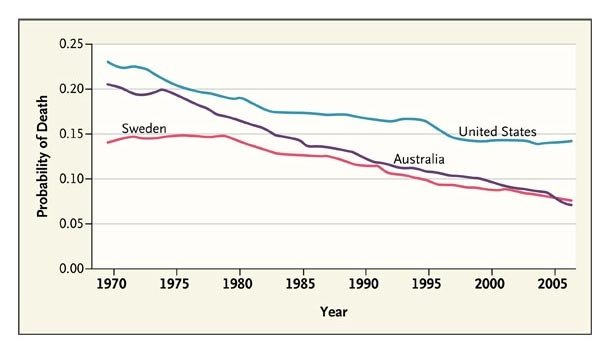
We keep hearing from those opposing health care reform that our health care is the “best.” But it isn’t. This from the NEJM Jan 6, 2010.

Despite the claim by many in the U.S. health policy community that international comparison is not useful because of the uniqueness of the United States, the rankings have figured prominently in many arenas. It is hard to ignore that in 2006, the United States was number 1 in terms of health care spending per capita but ranked 39th for infant mortality, 43rd for adult female mortality, 42nd for adult male mortality, and 36th for life expectancy.

Comparisons also reveal that the United States is falling farther behind each year (see graph). In 1974, mortality among boys and men 15 to 60 years of age was nearly the same in Australia and the United States and was one-third lower in Sweden. Every year since 1974, the rate of death decreased more in Australia than it did in the United States, and in 2006, Australia’s rate dipped lower than Sweden’s and was 40% lower than the U.S. rate.

The article goes on to describe the many opportunities, with the advent of health reform, to improve our non-system. These may be exciting times.


Spin in Medical Results

This ABC piece by John Paulos points out how the public is misled about the magnitude and significance of medical results.

That being said, imagine that a headline announces that screening for cancer X reduces deaths from it by 25 percent. Imagine as well that another headline announces that screening cuts deaths from cancer X by about 1 in 1,000, reducing the rate from 4 in 1,000 to 3 in 1,000.

25% is much more impressive than a drop of 4 in 1,000 to 3 in 1,000

See this in a British newspaper touting the results of the Jupiter study. This article reads like a PR release from AstraZeneca the makers of Crestor.

The Jupiter study showed heart attacks were cut by 54 per cent, strokes by 48 per cent and the need for angioplasty or bypass was cut by 46 per cent compared with a placebo. Levels of ‘bad’ cholesterol were halved.

Experts say the results would not necessarily be found with other statins because some work differently.

But in another interpretations of the Jupiter study published in the New England Journal:

The relative risk reductions achieved with the use of statin therapy in JUPITER were clearly significant. However, absolute differences in risk are more clinically important than relative reductions in risk in deciding whether to recommend drug therapy, since the absolute benefits of treatment must be large enough to justify the associated risks and costs. The proportion of participants with hard cardiac events in JUPITER was reduced from 1.8% (157 of 8901 subjects) in the placebo group to 0.9% (83 of the 8901 subjects) in the rosuvastatin group; thus, 120 participants were treated for 1.9 years to prevent one event. (Medicynical emphasis)

Not nearly as impressive as the 54% reported in the news article.

This type “interpretation” of results is common. PhARMA companies maximize the “benefit” by using relative rather than absolute values. In addition to overemphasizing the medical benefit their interpretation also doesn’t factor in toxicity and cost. Somewhere, somehow in our “reformed” health care system we need to look at this.


Alternative Medicine–it’s not medicine

Nice review of five of inexplicably popular alternative modalities with references here.

As you’d expect reiki, reflexology, zone therapy, homeopathy, magnetic therapy, and kava don’t work. Also inexplicably some insurers cover such nonsense.


Happiness improves Outcomes–Silly idea that lasted 20 years

In 1989, a study from Stanford posited that support groups helped patients with cancer live longer. The study was flawed by small numbers (86 patients), the fact that the many patients who died early on were weighted less in the results than the few that had long survivals.

Immediately counseling groups developed cancer support programs, costing a fortune. Everyone wanted to feel “better” about their disease and reap the benefit of a longer life. It was amazing that this bad study’s impact was so great.

For the patient caught up in the maelstrom of bad science, in a subtle way, it became their fault that the disease progressed–because they didn’t have a positive enough outlook.

This all was proven to be nonsense as one would expect. In 2007 the same author, David Spiegel, in a small study (125) patients tried to “replicate” the previous flawed study. He found this time, as others have documented, no effect on survival from participation in these support groups.

In the interim Spiegel became a guru for support groups to improve survival of cancer patients and literally made a career speaking and appearing on TV flogging his bogus hypothesis. He’s still talking as noted in this NY Times article which takes an appropriately skeptical view of benefits of happiness.

Medicynical note: Having experienced cancer in a loved one I’m aware of the difference between being delusional and realistic; Between trying everything and trying everything that makes sense. One of the drivers of cost of health care in our culture is the notion that there must be “something” that will work and that we are all entitled to try everything. I’m not sure how we approach this.


Health Reform Not So Bad–Pass now, Amend Later

The republican strategy to oppose and campaign against health reform is the best news the country could have as it will be disastrous for republican election hopes.

Consider the millions who benefit from the bill; the cost savings accruing from health reform; the disappearance of medical expense caused bankruptcy; the fact that we are the last industrialized nation to have some form of national health scheme.

If the bill had passed during the Clinton administration is likely the GM and Chrysler bankruptcies would have been avoided.

This in support of health reform from the December 2, NEJM article by Jonathan Gruber, Ph.D.

One common refrain of opponents of reform is that it represents a government takeover of health care. But reformers made the key decision at the start of this process to eschew a government-driven redesign of our health care system in favor of building on the private insurance system that works for most Americans. The primary role of the government in this reform is as a financier of the tax credits that individuals will use to purchase health insurance from private companies through state-organized exchanges. In Massachusetts, which passed a similar reform in 2006, private health insurance has expanded dramatically. The public insurance alternative that is included in the Senate bill simply adds another competitor — on a level playing field — to the insurance market, and the Congressional Budget Office (CBO) projects that it will enroll only a tiny minority of Americans.

And

A second criticism is that the bills are budget busters. This is simply incorrect. Both bills are completely paid for — indeed, both would reduce the deficit by more than $100 billion over the coming decade. And the CBO estimates that both would reduce the deficit even more in the long run, particularly the Senate bill with its strong cost-containment measures.

Regarding Medicare

In any case, there is substantial evidence that reducing these overpayments will not harm the health of Medicare patients — just the pocketbooks of those who profit from them. This reform would simply use market bidding to set the reimbursement rate for Medicare Advantage plans, rather than setting administrative prices, which have traditionally been much too high; and it would reduce payments to hospitals by a small percentage, while tying them to outcome measures.

and so on.

Medicynical Note: Perfect, NO. A good start, yes!


Another alternative medicine that isn’t medicine–Ginkgo

It’s been claimed that Ginkgo improves cognition and may delay or prevent dementia. It doesn’t. It’s in the JAMA here.


Sending the Wrong Signal to Big Pharma–Drug reform and generics

It’s too bad that health care reform has been gutted by special interests. In addition to the Nelson and Landrieu obscenities drug companies have taken advantage.

This is not new behavior for these guys. The patented drug pharmaceutical industry has always been in the forefront of dubious practices aimed at making money, not improving care.

I can recall as a senior medical student being taking for a weekend to New York, all paid for by a drug company. On graduation these so called “ethical” pharmaceutical companies gifted students with doctor bags, books, and instruments all for the purpose of maintaining brand consciousness.

It’s therefore a little disconcerting to watch these same interests work to undermine parts of health “reform” to maintain their grip on products and pricing. Included in the bill are:

extensive protections against generic versions of pricey biotech medicines, an incentive for Medicare recipients to use more brand-name drugs,

more, not less, patent protection for drugs costing more than most U.S. citizens make in a year.

Like the House bill, the Senate bill gives the Food and Drug Administration power to allow biogenerics onto the U.S. market. Such protein-based medicines treat cancer and other conditions but can cost tens of thousands of dollars a year per patient.
Generic makers welcomed the pathway to approval, but the bills provide for a 12-year period of exclusivity for brand-name drugs before a biogeneric can be approved. The Obama administration had sought just five to seven years of protection. (Medicynical emphasis)

Drug companies claim they need the protection to recoup research costs. But if they have to charge $10,000/month and more for new biotech drugs then they are either exceptionally inefficient (FYI they spend tens of billions on marketing which they have to also recoup), or the drug is simply too expensive for our system to afford. Sadly to this point most of these new agents offer only slight, if any (that is no proven survival benefit) over other therapies. Paying a premium for such agents is a little nuts.

The Senate seems to have outdone itself in protecting drug companies, how about something for U.S. taxpayers who will be paying the bills for these new but, so far, marginally effective drugs.


Cost Containment in Health Reform–Not this reform

Alain Enthoven has a review of the problems of cost containment.

Ultimately the reason we need health reform is because our costs exceed our ability to pay. The current bill doesn’t approach this issue. It is more a bill designed to protect the income and profits of the current players than to reform it.

Enthoven’s solution:

What should be done? I explained it in my “Consumer Choice Health Plan” articles in the 1978New England Journal of Medicine. The idea is also in a recent report by the Committee for Economic Development (CED). The general idea is for government to pay everyone’s way into the purchase of an efficient or low-cost health plan, meeting standards in their state or region but no more; if people want something that costs more, they must pay the difference with their own net after-tax dollars. Additionally, the creation of exchanges that broker multiple choices of health plans would drive the delivery system to produce better value through consumer choice and competition.