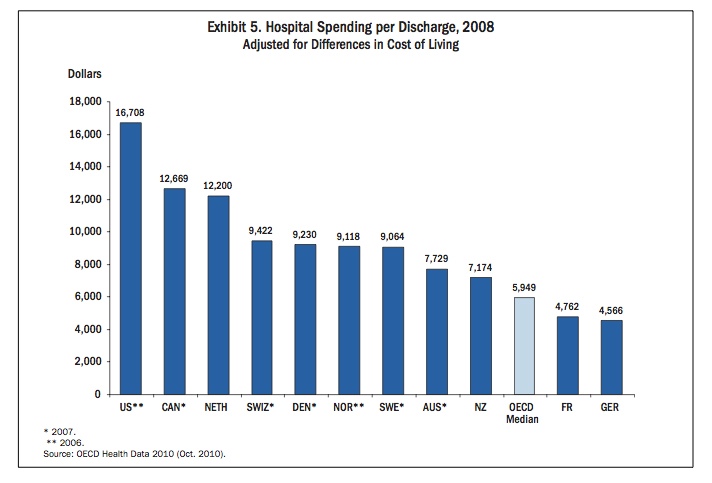
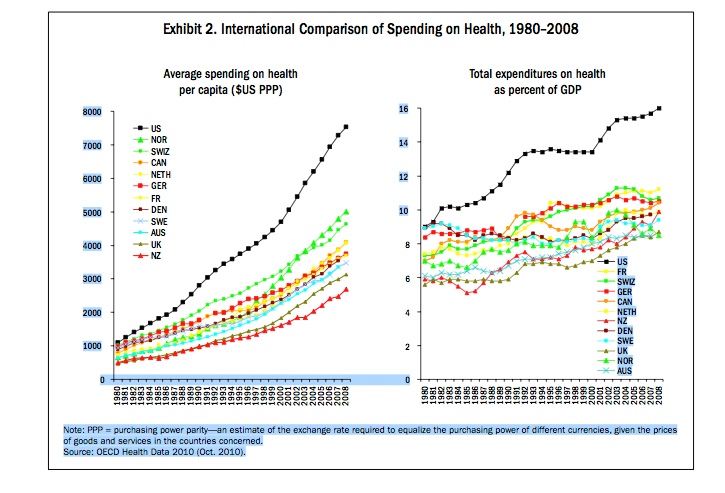
Costs: American Exceptionalism

If you don’t believe we spend too much on health care check this out.


PSA Tests and Mammograms; Are They (Cost) Effective?

From the NEJM Oct 26, 2011 a review of the idiosyncracies of PSA testing. Most importantly:

Using data from the European screening trial, researchers have estimated that $5.2 million would have to be spent on screening (and the interventions that follow it) to prevent one death from prostate cancer. (Medicynical emphasis) That estimate does not appear to include the costs of excessive serial PSA testing and repeated office-based encounters devoted to discussions about screening or interpretation of fluctuating PSA results. The extraordinary time, effort, and costs associated with the PSA-screening enterprise must be evaluated against other claims on health care spending and physicians’ time and energy. We believe that the current PSA-based screening paradigm does not compare favorably with competing health care priorities.

Adding to the critical view of screening was the recent NY Times magazine review Can Cancer Ever Be Ignored? The article notes:

Patients and their doctors are now faced with radically polarized views about the logic of routine testing. On one side are physicians like Mohler, who argue that the test can reduce a man’s chances of dying of prostate cancer, plain and simple. This side of the debate is passionate, backed by the persuasive conviction of men who have survived prostate cancer and well financed by the multibillion-dollar industry that has grown up around the testing and treatment of the disease.

The other camp makes a less emotionally satisfying argument: on balance, scientific studies do not support the claim that screening healthy men saves lives. Screening, Brawley and others argue, can lead healthy men into a cascade of further testing and treatments that end up injuring or even killing them. As Richard Ablin, who discovered a prostate-specific antigen, put it in an Op-Ed in The New York Times, using the P.S.A. test to screen for cancer has been “a public health disaster.”

What appears to be proven by two large studies of PSA published in 2009 is that there is no difference in deaths in groups of patients receiving PSA and those not receiving it. It appears that while there is reduced mortality from prostate cancer, there is increased mortality from other causes possible from the complications of the diagnostic procedures.

An analysis of six studies of screening involving nearly 400,000 men, published last year in the British medical journal BMJ, found no significant difference in overall mortality when screened men were compared with controls. Philipp Dahm, a professor of urology at the University of Florida College of Medicine and lead investigator for the analysis, says the study shows that P.S.A. screening “does not have a clinically important impact” on overall mortality.

There have been similar concerns raised about breast cancer screening:

A new analysis of mammography concluded that while mammograms find cancer in 138,000 women each year, as many as 120,000 to 134,000 of those women either have cancers that are already lethal or have cancers that grow so slowly they do not need to be treated.

And:

The problem is that the benefit is tiny and expensive. A recent cost–benefit analysis showed that adherence to the current guidelines from the American Cancer Society costs more than $680,000 per quality-adjusted life-year (QALY) gained, as compared with a proposed alternative costing only $35,000 per QALY. Statistician Donald Berry has calculated that for a woman in her 40s, a decade’s worth of mammograms would increase her lifespan by an average of 5 days — and this survival advantage would be lost if she rode a bicycle for 15 hours without a helmet (or 50 hours with a helmet).5 The key issue here, however, is that these figures represent population averages. For the small number of women whose lives are saved, the difference is literally as large as that between life and death.

It should be also noted that much of widely publicized improved outcomes of cancer treatment today can be attributed to earlier diagnosis of the disease (lead time bias); and from finding lesions that would not grow and spread not treatment.

In the end more judicious use of screening and finding ways to cut the cost of same would improve the value of such testing without adversely affecting outcomes.

For example: one solution is to cut the price of the test from its current $70 to $$400 (including phlebotomy costs) to a more reasonable amount ($10-20). Economies of scale and efficiency would increase the value (in a cost-effectiveness sense) for this test. Charging anywhere from $25 to $150 for phlebotomy, as is the current practice, seems excessive as well.

In breast cancer screening one approach would be to delay routine screening from 40 to 50 years of age. Which as noted by Susan Love:

“I really don’t think we should be routinely screening women under 50. There’s no data showing it works.”

Medicynical Note: We live in a country that is on the road to bankruptcy caused in great part by profligate health care costs. Controlling these costs is not optional but also is not widely discussed in our bizarre political atmosphere. In the stunted political debate conservatives roar that patients should be able to choose what they want (NO RATIONING, NO DEATH PANELS) but cogently leaves vague who pays when patients choose. Reading between the lines they oppose public funding of medical care, including Medicare and Medicaid. Their solution however, is tantamount to medical rationing by economic status.

On the other side is the notion that all U.S. citizens should have access to a defined level of care. And those who want more can buy additional services (testing and procedures) as they wish.


Exceptional Americanism?

This graphic says it all.


Medicynical Note: What’s most striking are the poverty rates: 14% overall, 17% for children, 22% for the elderly and income inequality. Our comparative expenditures on pre-primary education and finally the health rating of our population are also not very encouraging. Exceptional yes, but in the wrong way.


Regulate Medical Devices? Demand Safety and Utility? The Best Congress Money Can Buy

It’s difficult to believe anyone would want to deregulate control of drugs or for that matter medical devices. Without a neutral third party review of efficacy and safety, it’s anyone’s guess what would be foisted onto an unsuspecting public.

Consider that over the years defects have been very commonly found in such implantable devices. In fact thousands of recall notices/year are the norm.

Meanwhile, the number of items implanted in people’s bodies is soaring, as is the number of recalls. Nearly 2,500 medical devices were recalled for potential safety problems in fiscal 2008, according to the Food and Drug Administration. That was nearly double the number reported the previous year and a 164 percent increase since 2000.

With all this, we now have legislators who have accepted campaign contributions from venture capitalists working to undermine the oversight process:

Over the following month, Mr. Paulsen’s campaign committee took in $74,000 from people with a stake in device regulation, much of it from executives affiliated with venture capital funds and their spouses. Now Mr. Paulsen, a two-term Republican, is a sponsor of a bill that would make it easier to bring new medical products to market.

“They have this unwritten assumption that every new device is innovative,” Dr. Rita Redberg, who is the editor of the Archives of Internal Medicine, said, referring to the venture capital funds. But some devices, she said, “are killing people or causing significant harm.”

Further complicating the medical device business is the established fact that the gate keepers, medical providers, often take payment from device manufacturers to encourage use of their “innovations.” Without some brake in the system we have a recipe for development of faulty devices and their overuse and/or misuse.

Furthermore, these same forces want tort reform so as to protect these same manufacturers from being sued for bad outcomes from faults in the device and the selfsame overuse and misuse.

Note: Bringing devices to market without careful continuing oversight, when there is a money driven motivation, is a recipe for disaster.


Durg Companies Payments to Doctors– A Huge Conflict of Interest

This, from CBS, says it all:

A dozen pharmaceutical companies have given doctors and other healthcare providers more than $760 million over the past two years – and those companies’ sales comprise 40 percent of the U.S. market.

With bucks that big flying around, is the quality of care offered by providers accepting them compromised? “Absolutely,” said Dr. John Santa, head of the Consumer Reports Health Ratings Center.

Medicynical Note: Guess who pays for this largesse? Is it any wonder that drugs in the U.S. cost 30% more than elsewhere in the world. Drug companies are uninterested in efficiency and value. It’s about the money. Sad but true.


Rating of U.S. health Care: Commonwealth Fund

The Commonwatlth Fund’s review of U.S. health care provides assessments of our non-system’s efficiency, equity, access and quality.

Some good news can be found in an exception to the overall pattern of U.S. performance: rapid progress on quality metrics that have been the focus of national initiatives and public reporting efforts. Hospitals, nursing homes, and home health care agencies are showing marked improvement in patient treatment and outcomes for which data are collected and reported nationally on federal Web sites and as part of improvement campaigns. There has also been significant improvement in the control of high blood pressure, a measure that is publicly reported by health plans; increasingly, physician groups are being rewarded for improving their treatment of this and other chronic conditions. Better management of chronic diseases also has likely contributed to reductions in rates of avoidable hospitalizations for certain conditions, though rates continue to vary substantially across the country.

Of great concern, access to health care significantly eroded since 2006. As of 2010, more than 81 million working-age adults—44 percent of those ages 19 to 64—were uninsured during the year or underinsured, up from 61 million (35%) in 2003. Further, the U.S. failed to keep pace with gains in health outcomes achieved by the leading countries. The U.S. ranks last out of 16 industrialized countries on a measure of mortality amenable to medical care (deaths that might have been prevented with timely and effective care), with premature death rates that are 68 percent higher than in the best-performing countries. As many as 91,000 fewer people would die prematurely if the U.S. could achieve the leading country rate.

The summary also notes the cost burden and the lack of improvement in many health system indicators:

such as preventive care, adults and children with strong primary care connections, and hospital readmissions—likely stems from the nation’s weak primary care foundation and from inadequate care coordination and teamwork both across sites of care and between providers. These gaps highlight the need for a whole-system approach, in which performance is measured and providers are held accountable for performance across the continuum of care.

A nice chart shows some of the savings that would accrue if we actually had a system:


Medicynical Note: We spend more and have worse health care. Only in the U.S.


Our inefficient Non-System of Health Care: We’re Number 1

Administrative costs in health care are a silent epidemic. Our inefficiency is costly to patients, providers, insurers, and government.

Ewe Reinhardt observes:

In many ways, our health care system mirrors our tax code — especially in its financing and health insurance facets. These can be made so complex and have been made so complex in the health care system in the United States that many decision makers in health care — patients, physicians, hospitals, employers and so on — need in-house or external consultants to find their way through the maze.

and:

Consulting firms help physicians bill private and public insurers or help patients submit claims to insurers after an illness. Legions of insurance brokers help prospective clients through the maze of the nongroup or small-group health insurance market. Large employee-benefit consulting firms, helping large companies, establish what amount, in effect, to analogues of the health-insurance exchanges in the Affordable Care Act, and many more consultants of many stripes are involved.

Medicynical Note: Yes the U.S. has the number 1 health care system in the world–it’s the most inefficient by far.


Drug Prices for Indigent Medicare Patients: The Same As Medicaid or Cost plus?

The New England Journal of Medicine (NEJM) (Oct. 12, 2011) looks at the proposal to require drug companies to offer low income Medicare beneficiaries the same prices given Medicaid recipients:

Seems like a reasonable money saving idea but:

Reducing Part D payments for low-income beneficiaries, it is argued, could undermine incentives for the pharmaceutical industry to invest in research and development, as well as create illusory savings by shifting drug costs to other parties. In considering the wisdom of such deficit-reduction proposals, it’s important to consider how well the market is working for Part D and whether there are important inefficiencies that can be eliminated, resulting in budget savings.

It is pointed out however that the market doesn’t seem to work well with the indigent elderly who most often of the medicare group have multiple chronic conditions (30% of the group) and spends more on drugs than others in the medicare group.

It concluded that:

The approach obtains savings without undermining incentives for developing important new medical treatments. The anticipated side effects would be outweighed by the size of the estimated budget gains. This is as close to a win–win solution as we can get.

Medicynical Note: Put pressure on drug companies to offer more affordable drugs, why that may be Un-American. Consider that drug companies spend more on marketing than research; pay nothing to the government for drugs developed from government funded research; all have increased their prices and revenue by incredible amounts during a recession/depression.

Big PHarma will oppose this initiative preferring that we continue to pay more for drugs than any other industrialized country in the world. That’s really Un-American.


Cancer Treatment Costs a Lot

The Washington Post notes the “hefty cost” of cancer treatment even for those with insurance.

Recent research spells out what patients are facing. A study by the Agency for Healthcare Research and Quality estimated that between 2001 and 2008, 13.4 percent of adults younger than 65 who had cancer spent more than 20 percent of their income on health care, including premiums. That compared with 9.7 percent of people with other chronic conditions and just 4.4 percent of those with no chronic conditions.

The article goes on to note the the increased bankruptcy rate among patients –over 6 times the baseline rate over 5 years.

ASCO the American Society of Clinical Oncology in the same article is noted to recommend :

The American Society of Clinical Oncology encourages oncologists to discuss treatment costs with patients. But that’s easier said than done, say some oncologists. More than half of the income of many oncology practices comes from administering the drugs they prescribe, says Ramsey, so oncologists are not entirely disinterested parties. In addition, the timing is often tough. Patients are “already scared and they have cancer,” he says.

Medicynical Note: It appears from their pricing of medications that drug companies have a sliding scale. The more life threatening the illness, the more the drug costs–whether or not it has a significant effect on the disease’s course

Another factor in the cost of cancer treatment, or any drug treatment purchased in the U.S., is that we pay more by 30%, for the exact same drug than other countries’ citizens. It’s a fact.

What’s amazing is that we tolerate the discriminatory behaviour of drug companies and pay the increased price.


Vitamin E and Selenium May Increase the Risk of Prostate Cancer

The October 12 Journal of the American Medical Association reports a slight increase in the risk of prostate cancer from vitamin E and selenium. The increase from selenium is not considered statistically significant. Vitamin E’s increase just met the criteria and is considered more likely to be real. This increase in risk, for both agents, is important in that they were being evaluated as preventatives. They obviously don’t work.

This report includes 54 464 additional person-years of follow-up and 521 additional cases of prostate cancer since the primary report. Compared with the placebo (referent group) in which 529 men developed prostate cancer, 620 men in the vitamin E group developed prostate cancer (hazard ratio [HR], 1.17; 99% CI, 1.004-1.36, P = .008); as did 575 in the selenium group (HR, 1.09; 99% CI, 0.93-1.27; P = .18), and 555 in the selenium plus vitamin E group (HR, 1.05; 99% CI, 0.89-1.22, P = .46). Compared with placebo, the absolute increase in risk of prostate cancer per 1000 person-years was 1.6 for vitamin E, 0.8 for selenium, and 0.4 for the combination.

Medicynical Note: This is not stunning news as vitamin and mineral supplements have little efficacy–unless there is dietary deficiency. Perhaps our pill popping culture will take note.