
Category Archives: Health Economics

The Medical Industrial Complex: It’s the Money Stupid!

In health care, we’ve developed a system of money making that’s unprecedented.  What once was a profession that at least gave lip service to patients and health care–remember the “sacred patient doctor relationship?” or the “ethical” pharmaceutical industry?–has evolved into a money grubbing borderline ethical business.

Gaming the billing system has become the norm.  When our local “non-profit” hospital (run by a Catholic hospital conglomerate) bought out medical practices in our area, costs dramatically increased.  Coding for visits moved to more expensive levels.  The hospital  billed an additional facility fee even while the practices remained in the same location as before.   Procedures previously done out of the hospital were moved into their facility.  Instead of finding ways to provide efficient economical care, providers (and suppliers) even so-called non-profits seek to maximize revenue.  This is happening at every level of our health care mess and is one of the major causes of our  ridiculous cost inflation over the past 20 years.

More on gaming our non-system here:

Between 2001 and 2010, doctors increasingly moved to higher-paying codes for billing Medicare for office visits while cutting back on lower-paying ones, according to a year-long examination of about 362 million claims. In 2001, the two highest codes were listed on about 25 percent of the doctor-visit claims; in 2010, they were on 40 percent.


Why Drugs are Expensive: Marketing Costs

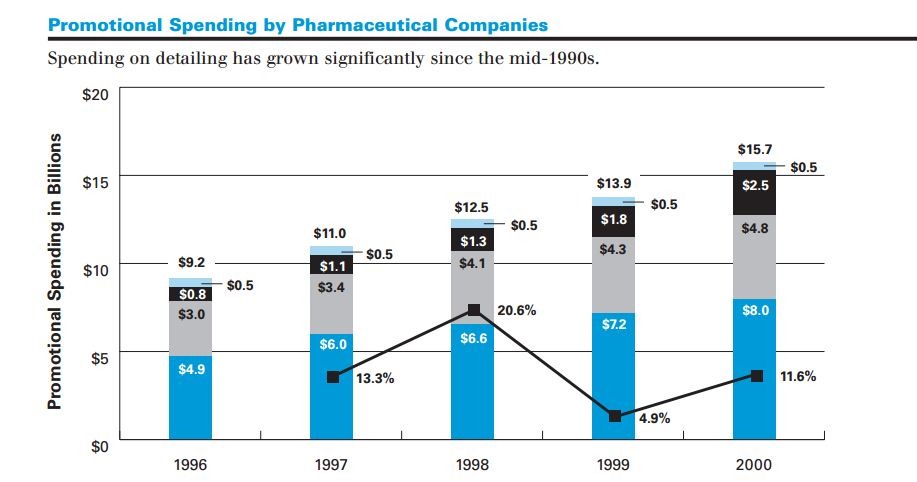
Drug companies spend as much or more on marketing than they do on research.  In the first quarter of 2012 direct to consumer advertising approached 1 billion dollars.

The costs of marketing to doctors,  and this is admittedly old data, is reflected in this graph.

  Capture

Today one would expect at least a 100% increment paralleling the increase in health care costs over the same period of time. 

Aggressive marketing has been shown to effect doctor’s decisions and increase patient expenditures, and overall costs.  Guess who pays?

Medicynical Note:  Read the links for more details.

It’s all about the money: Dermatologic Drug Price Inflation

Health care at one time was a altruistic endeavour.  Yes you earned a living and companies made profits but most providers were individuals and most institutions, non-profits.   The pharmaceutical industry at the time had the moniker, “ethical.”

Since the mid eighties there has been a unceasing inflation in costs.  Individual providers are anachronisms today and non-profits for the most part have converted into to for-profit entities.  As a matter of fact, because of a lack of concern about costs, even the non-profits that survive charge the same or more.

The report today in the Times on the rapid increase in generic dermatologic drugs re-emphasizes the point the prices in health care have nothing to do with costs of “development” or production.  It’s simply whatever drug companies choose to charge.  Since the number of suppliers and producers are few they are not inclined to compete on price.  So prices sky-rocket:

They are the staples of most dermatology practices: generic creams and ointments that treat everything from skin rashes to athlete’s foot to scabies. Many doctors prescribe the drugs without a second thought. But increasingly, some dermatologists say, patients are complaining about a recent, mysterious and rapid rise in price.

Take betamethasone dipropionate, a cream used to relieve itchy skin. In 2008, a tube cost $18.17. The medicine now costs $71.28, according to Red Book, which tracks wholesale drug prices. Permethrin cream, which kills scabies mites, cost $29.25 in 2008 but has jumped to $71.08 today.

Medicynical Note:  There’s no rational reason for this except that companies charge what insurers will pay.  Since Medicare is forbidden from negotiating prices and private insurers simply pass through the higher prices by adding to co-pays and deductibles, there is no strong countervailing force to control the gouging, particularly for these relatively inexpensive agents. 

In other countries the governments  negotiate prices and control price increases.  In our country our congress, under republican control at the time, forbade Medicare to negotiate. 

Is it any wonder that we pay more, double in some cases, for health care than anywhere else in the world….and I’d hazard a guess that we pay more for these drugs as well. 

American Health Care and Pizza (Papa Johns)

In addition to having the most expensive and by inference the most inefficient health care on earth, ours is the most heartless.  As noted in the experiences of this young woman, when you are desperately ill you are forced to spend an inordinate amount of time figuring our your coverage, worrying about life time maximums, finances, and copays and deductibles.

If you have a chronic illness in America, there’s a good chance you also hold a degree in Health Insurance 101, whether you want to or not. The first thing I learned was how lucky I was to have health insurance at all. (An estimated 49 million Americans, and nearly one-third of Americans 18 to 24 years old, are uninsured.) I was on my parents’ insurance, a plan provided through my father’s employer. It’s a comprehensive plan that will cover me until age 26 — two years from now.

I’ve been fortunate to be treated by excellent doctors at world-class hospitals. In the last year alone, my insurance has covered over a million dollars in medical expenses, including a bone marrow transplant and 10 hospitalizations amounting to a combined five months of inpatient care. It all sounds straightforward when I explain it like that. But even if you have insurance, the cost of health care — in dollars as well as in time and stress — is incredibly high.

Read the rest of the article for more.

Medicynical Note:  If Mitt gets his way insurers will be free to discriminate against this young woman and others with serious and debilitating illness and not offer them insurance or price it out of their range.  She is a poster person for health reform in that her coverage through her parents was not allowed prior to the  passage of that act.

Regarding the millionaire owner of Papa John’s Pizza moaning about increasing the cost of an order .15-.20 cents, he should be thankful to be able to offer such coverage to his employees.  Who, but for their good luck, could be facing similar catastrophic illnesses. Would he have preferred no coverage for his valued workers and the government paying directly through Medicaid for their care or having them become financially bankrupt or even worse not having access to care because of lack of insurance or funds.  Apparently Mr. Schatter is a Romney supporter, so who knows what he thinks.

The U.S.is the only industrialized country in the world without a national health plan assuring coverage to all citizens.   How exceptional is that?!

Rationing by Cost, The American Way!

Incidental Economist has a sobering graphic from the OECD evaluation of inequalities in health care access.  The U.S. again is an outlier. 

People like to believe that we don’t ration care in the US. We do. More than just about any other country, we ration by cost.

Medicynical Note:  The conservative right in our country would have you believe that we have the best health care in the world.  The questions I would pose is for whom?  and what alternative reality world are you talking about?

Our care is the most expensive; our insurance coverage the least available (50 million uninsured); and we lead the world in bankruptcy caused by medical expenses—a category of bankruptcy unknown in other industrialized countries. 

What we can say is that the U.S. leads the world in  dysfuntionality when it comes to health care—and self delusion. 

Drug Companies: Its About the Money (GlaxoSmithKline)

Pharmaceutical companies used to modestly call themselves the “ethical pharmaceutical industry.”  Their behavior in recent years is anything but………ethical. 

GSK, one of the world’s largest healthcare and pharmaceuticals companies, admitted to promoting antidepressants Paxil and Wellbutrin for unapproved uses, including treatment of children and adolescents.

And:

The company also conceded charges that it held back data and made unsupported safety claims over its diabetes drug Avandia.

It agreed to resolve civil liability for promoting asthma drug Advair and two lesser-known drugs for unapproved uses.

In addition, GSK has been found guilty of paying kickbacks to doctors.

Medicynical note:  The industry has made an oxymoron of their conceit– the “ethical pharmaceutical industry.”  They are part of our medical industrial complex which is money driven rather than patient care driven.  Ethics?  Appropriate use?  Not our department.

How drugs are developed and marketed are part of what needs to change.  I would never have imagined single medication priced at more than the average and median income in the U.S.  By inspection it’s unaffordable and unsustainable.  But that’s what our non-system regularly produces.  It needs reform.

American Health Care Number One!!! In Cost

Once again U.S. health care leads the world in cost:  From the International Herald Tribune and the OECD:

It confirmed that the U.S. spends more per capita on publicly funded health care than almost every other country in the developed world. And that includes countries that provide free health care to all their citizens.

Figures published on Thursday by the Organization for Economic Co-operation and Development, a 34-nation grouping of advanced economies, showed that less than half of health spending in the U.S. was publicly financed compared with an O.E.C.D. average of 72.2 percent.

“However, the overall level of health spending in the United States is so high that public (i.e. government) spending on health per capita is still greater than in all other O.E.C.D. countries, except Norway and the Netherlands,” according to the Paris-based organization’s Health Data 2012 report.

Combined public and private spending on health care in the U.S. came to $8,233 per person in 2010, more than twice as much as relatively rich European countries such as France, Sweden and Britain that provide universal health care.

There’s more in the article.  We have fewer doctors but they cost us more.  We spend more but have slightly lower than average life spans.  And our Canadian friends spend much less on health care but have better rankings when one looks at the “common measures of health.”

In Europe and elsewhere, access to care is considered part of being a citizen.  Here we have around 50 million uninsured.

Medicynic:  The current non-system obviously needs reform.  Yes, the current plan is imperfect but it is a start.  Without it, the system will fail even more dramatically than at present.

Affordable Care Act: Marcia Angell’s view

Interesting view here…..

The Supreme Court’s decision to uphold the Affordable Care Act, aka Obamacare, puts me in mind of the old proverb: Be careful what you wish for. Democrats on a victory lap should watch their step, because John Roberts may have given Mitt Romney a gift. The impact on the health system will be much smaller than the political fallout, because with or without Obamacare, the American health system will continue to unravel — quickly if Romney is elected, slowly if Obama is re-elected.

Medicynical Note:  The outcome will depend on the will of the public to either provide and pay for universal care one way or the other or not.  Whatever the case, I agree with Dr. Angell, the current over bloated, inefficient, ridiculously expensive non-system is finished.

Shop for care? See if you can get a price, and understand it

Only in America would there be an article about the incomprehensible cost of health care but that’s the way our non-system works.  Bill for everything you can, then if a person or insurer questions the bill, negotiate.  We even have a new category of worker, a “medical billing advocate.”

Ask Jean Poole, a medical billing advocate, about her work helping people navigate the bewildering world of medical bills and insurance claims, and the stories pour out. There’s the client who was billed almost $11,000 for an 11-minute hand surgery.  The cancer patient who was charged $9,550.40 for a round of chemotherapy he never received.

Read the article for details.

Medicynical Note:  Our non-system of care is designed to be opaque when it comes to cost and  maximize revenue rather than care.  That’s why we spend more and get less….45-50 million uninsured at any given time.  That’s why we encounter the sad fund raisers for families, often young, who encounter catastrophic illness but have no or inadequate insurance and no savings to speak of. 

Health Care in U.S. Unaffordable: $20,000 average for family of four

Clarifying commentary on the recent Millman index report at AcademyHealth Blog by Aaron Carroll. 

For the first time the average cost of health care for the typical American family of four has surpassed $20,000.

What accounts for this? Well, it turns out that care in America is extremely expensive. The average inpatient admission to the hospital cost $14,662 in 2010. If you were admitted to the hospital for a surgery, the average cost was $27,100. The average newborn delivery – if things went well – cost $7,371. Instruments like cost sharing and high deductible health plans that are designed to empower consumers lose much of their appeal when confronted with numbers like these. If you have a baby, or need to go to the hospital just once in a year, you’ve likely already spent as much as allowed out-of-pocket, meaning that any cost-sharing incentives to reduce spending are gone.

Moreover, it appears that prices, not utilization are the cause of increases in spending:

Read the post for details.

Medicynical Note:  Utilization is decreasing but costs increasing.  Our republican friends will say this is the marketplace—people becoming more cost conscious.  

Yes, indeed, increased costs decrease utilization, but it also decreases access—over 50 million and rising uninsured in the U.S.  In the short and long run quality of care and patient’s lives suffer.  We lead the world in uninsured citizens and costs.  That’s the American “system.”