
Category Archives: Health Economics

Avastin (bevacizumab), Provenge (sipuleucel-T) Two More Reasons Why Health Care is Bankrupting Us

The drugs Avastin (bevacizumab) and Provenge (sipuleucel-T) are two of the most expensive drugs in the world. Bevacizumab costs in the range of $100,000/year for treatment and simuleucel $93,000 for a course of treatment.

Neither cures patients. In studies in breast cancer bevacizumab has been found minimally effective, if at all. When compared to outcomes of patients not using the drug, It appears to delay progression by a few months and survival by even less then that (between no survival advantage to a few months). Sipuleucel-t gives about the same degree of response in prostate cancer. Despite this apparent lack of efficacy, and the advice of an FDA advisory board, Medicare has decided to continue to pay for the use of these agents.

The problems with these drugs are two-fold. One, they do very little to improve survival. And second, they are outrageously priced.

Regarding pricing, we’ve allowed drug companies to price drug grotesquely by:

  • Providing them government sponsored monopoly (a patent) for a generation. (so much for free markets)
  • Allowing drug companies to take drugs developed in part with government research funding private without offsetting the government’s investment by requiring licensing or reasonable pricing of the drug
  • Prohibiting Medicare from negotiating price with drug companies. This was part of the Medicare D law and has resulted in the inexorable upward spiraling of drug prices. We pay more for drugs in the U.S. than anywhere else in the world. WE ARE NUMBER 1!
  • Cost effectiveness is not in our health care system’s vocabulary. We regularly use drugs with limited to no effectiveness.

Medicynical Note: For many years as an oncologist I used drugs with limited efficacy just on the chance that my patient might benefit. Desperate people accepted remarkable levels of toxicity in the hope that they will be the lucky ones and have a long survival benefit. During treatment, they all thought the drug was working, until it became clear that the disease was progressing. In retrospect very little of the “response” (and I’m thinking of patients with colon cancer treated with 5FU during the 70’s and 80’s) was tumor regression due to the drug. We almost never saw tumor’s decrease in size. Rather each cancer has a biology that affects how rapidly it will grow and recur. There are other poorly understood factors such as the patient’s immune system’s affect on tumor growth that also may come into play. But what was clear from comparison studies of 5 FU and no treatment was that very few patients benefitted. It should be noted that at the time 5FU in 500 mg vials cost $5.00.

Medicare has now announced that despite the proven limited efficacy of these drugs (bevacizumab and sipuleucel-T they will continue to pay for them–at the price demanded by the manufacturer.

If we are unable to rationally use these grotesquely expensive agents we will undoubtedly be rationing through increased co-pays, increased cost of insurance, and lo ball insurance that does’t cover such agents.
Drug Costs and Prostate Cancer: Charging a Premium for Minimal Efficacy

The Times has an article highlighting the costs of new drugs for prostate cancer. Mind you, these are drugs that have a very limited ability to extend life in patients with advanced disease.

In the last 15 months, three new drugs that extended the lives of prostate cancer patients in clinical trials have been approved by the Food and Drug Administration and several other promising medicines are in clinical trials.

And:

Men with that late-stage cancer had a median survival of about a year and a half using docetaxel. The new drugs each added two to five months to median survival when tested in clinical trials. Doctors say that men taking more than one of the drugs in succession would be expected to live more than two years. (Medicynical note: The last sentence is completely unproven and highly doubtful if it means to live 2 years beyond the original 18 months achieved by docetaxel alone. One wonders which doctors are saying this?)

And:

Provenge costs $93,000 for a course of treatment, while Zytiga costs about $5,000 a month. Another of the new drugs, Sanofi’s Jevtana, costs about $8,000 every three weeks.

With other pricey drugs on the way, said Joel Sendek, an analyst at Lazard, “We could be talking easily $500,000 per patient or more over the course of therapy, which I don’t think the system can afford, especially since 80 percent of the patients are on Medicare.”

Medicynical Note: New drugs are protected by a government sponsored monopoly (patents), allowing a generation of exclusive use to the developer of the advance.

Health care of course is different from computers or other consumer products. There is limited choice about both the timing, source and type of treatments available, particularly in diseases that have fatal consequences.

As such it’s a wonderful set-up for manufacturers. They have exclusive rights to a product that their customers feel they must have. The customer is buffered from the true cost by his/her insurance coverage. The insurer is under huge pressure from the patient to cover everything that they need and simply passes the costs on to policy holders.

Cost efficacy is not a consideration. Patients believe that they will be the one who will benefit and have excellent results. This is the situation even where 1/2 the patients treated get little or no benefit and the treatment at best provides minimal life extension–as in these drugs. It should be re-emphasized that the judgement that these drugs could provide years of survival is completely untested and likely false.


Bevacizumab (Avastin) for Breast Cancer, Expensive and Mediocre

Todays NY Times reports that Genentech will try to pressure the FDA to continue the bevacizumab (Avastin) indication for treatment of breast cancer.

It should be stated up front that the drug can be used for breast cancer without FDA approval. The question is whether medicare and other insurers should should be forced (by virtue of the FDA approving the indication) to cover a wildly expensive ineffective treatment.

The data on this drug’s lack of efficacy is clear. It was originally approved in a study which showed a delay in progression of disease. At the time of approval, little was known whether patients so treated would actually live longer. Genentech wanted accelerated approval and agreed that followup studies would be done to confirm its efficacy, not only in delaying progression but also in improving survival.

The F.D.A. approved the drug for advanced breast cancer in February 2008, after one clinical trial showed that combining Avastin with another drug, paclitaxel, delayed the median time before tumors worsened by 5.5 months, compared with using paclitaxel alone. But the women who got Avastin did not live significantly longer than those who got only paclitaxel, which is also known by the brand name Taxol.

and:

Subsequent trials, in which Avastin was combined with different chemotherapy drugs, showed a much smaller delay in tumor progression, ranging from less than 1 month to 2.9 months. And again there was no improvement in survival for those receiving Avastin.

Yet another trial showing this drug’s huge costs and limited efficacy was reported on at ASCO 2011, we commented on this trial here. The study reported .49 years delay of progression free survival and just .135 years (about 1.5 months) of life extension–a cost of $745,000 for a QALY (quality adjust life year). Hardly evidence of a cost-effective intervention, or for that matter a drug that works.

This controversy is in part due to the erosion of standards in clinical trials. At one time patients were deemed to show a response if the tumor decreased in size by 50%. The gold standard for an effective treatment was an improvement in survival, not a mere delay in progression.

It turns out unfortunately that a delay in progression often means little in regard to survival and in the case of bevacizumab (Avastin) even that delay is open to question as repeated studies show a more limited delayed progression as well the lack of a significant survival benefit.

Medicynical Note: With drugs as expensive and ineffective as this one is in breast cancer, it’s easy to understand why health care costs are out of control.


ASCO 2011: Cost effectiveness Zoledronic Acid (Zometa) vs Denosumab (Prolia, Xgeva)

There were very few cost efficacy studies at the recent ASCO meetings.

One set of three studies sponsored by the drug company (Novartis) compared zoledronic acid with denosumab made by Amgen. The abstracts looked at the cost of a QALY (quality adjusted life year) in patients with metastatic prostate cancer (abstract 1), and breast cancer (abstract 2). The third was an economic evaluation (abstract 3) comparing the costs of preventing a skeletal related event in prostate cancer. Not surprisingly, since they were sponsored by Novartis, these studies “confirmed” that zoledronic acid was more “cost effective.”

The studies found that while zoledronic acid is slightly less effective than denosumab in preventing skeletal related events, denosumab is more expensive.

From abstract 1:

Compared to ZOL (Table), Dmab resulted in fewer SREs, more QALYs, and lower SRE-related costs, but higher drug-related and total costs ($5,313). Overall, Dmab resulted in an incremental cost of $1,250,000 per QALY gained.

From abstract 2:

Dmab resulted in fewer SREs, more QALYs, and lower SRE-related costs, but higher drug-related and total costs vs. ZOL, resulting in an incremental cost of $6,884/pt (Table). The cost per QALY gained was $644,000 when excluding SAEs ($613,000/QALY when including SAEs).

It is telling, and perhaps reflects a “strategic” omission, that neither abstract 1 or 2 reveals zoledronic acid’s cost of a QALY gained.

However, abstract 3 gives a better indication of the relative costs and efficacy of the approaches.

The total costs incurred over one year were estimated at $37,854 for denosumab and $30,499 for ZA, with an incrementally higher cost of $7,355 for denosumab. The estimated number of SREs during the one-year period was 0.56 for denosumab and 0.67 for ZA, where the denosumab patients had 0.11 fewer SREs.

QALY= quality adjusted life year
SRE= Skeletal related event

Medicynical Note: What is unstated in these cost comparison studies is that none of the current generation of treatments to prevent bone events including zoledronic acid and the newer monoclonal, denosumab, meet the guideline for cost effectiveness. (a QALY at a cost of less than $50,000-$100,000.

A study in the Journal Urology in 2004 compared the outcomes of patients getting zoledronic acid with patients receiving placebo and noted:

The nominal cost per skeletal complication avoided was US dollars 112300 (95% CI US dollars 6900 to US dollars 48700) and the cost per additional patient free of skeletal complications was US dollars 51400 (95% CI US dollars 26900 to US dollars 243700). Nominal within-trial cost per quality adjusted life-year was US dollars 159200, which varied widely in sensitivity analyses.

To put it in perspective, in 2004 when drug costs were much lower than now, the health care non-system in the U.S. spent over $50,000 to save one additional skeletal complication. That approximates the yearly median income in our country.


Bevacizumab (Avastin) in Breast Cancer — Neither Effective nor Cost-Effective

It’s been well documented that bevacizumab is not very effective in breast cancer.

However, Roche/Genentech continues to lobby it’s use for this indication. At the ASCO 2011 meeting there was yet another study documenting the lack of efficacy and value of the drug in breast cancer. Needless to say there were no company hyped headlines touting the results.

The study from Singapore found:

Bevacizumab added 0.49 years of PFS and 0.135 QALY with an incremental cost of $100,300 and therefore a cost of $204,000 per year of PFS gained and an ICER of $745,000 per QALY.

PFS= progression free survival
QALY= quality adjusted life year
ICER= the additional cost per one life year gained of one treatment over another

Medicynical note: Three reasons why bevacizumab should not be used in breast cancer. High costs, lack of benefits and additional toxicity.

The numbers are embarrassing. $745,000 for an additional life year (ICER). A statistical gain of just .135 life years (QALY).

If Genentech/Roche were to price the drug at 1/10 the current price it would be marginally cost effective, while remaining ineffective in extending life. It’s amazing that there is still a discussion about this indication.


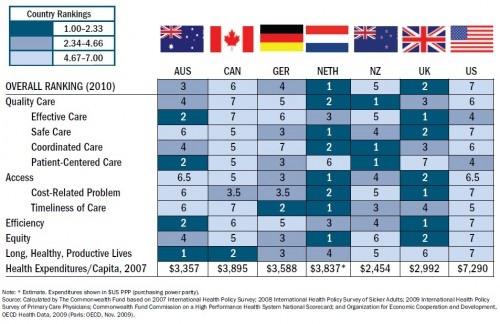
Health Care: We’re Number 7 OVERALL, Number 1 in COSTS


Medicynical Note: At least we’re number 1 in something.


Socioeconomic Status, Quality of Care, Outcomes in Lung, Pancreas and Esophageal Cancer

At ASCO 2011 there were very few studies on cost efficacy, it doesn’t seem to be an issue to researchers funded mainly by pharmaceutical manufacturers. There was however an interesting abstract (6004) which looks at the care provided and outcomes of patients in different socioeconomic groups.

The study was of patients with cancers of the lung, esophagus and pancreas which “account for over 35% of all cancer deaths in the US and a sizable share of cancer costs.”

The researchers from the University of Michigan used the SEER-Medicare data base and examined the effect of socio-economic status on treatment and 2 year survival rates. The authors found:

The lowest SES (socio-economic status) patients were more likely to require urgent or emergent admissions and to be treated at very low volume hospitals and non-teaching hospitals. For all three cancer types, low SES patients were more likely to receive no cancer-directed treatment (e.g., 60% of the lowest SES patients received no treatment for pancreas cancer). Receipt of cancer-directed surgery, chemotherapy, and/or radiation therapy was consistently higher for the highest SES patients, with most patients receiving at one type of treatment and many receiving a combination of treatments.

And concluded:

There is pronounced variation in types of cancer treatment received by different SES groups. Despite receiving more aggressive treatments, higher SES patients do not have improved survival rates.* Reducing variation in treatment strategies may improve healthcare efficiency without changing patient outcomes.

*emphasis by medicynic

Medicynical Note: I’m not sure what more there is to say. We have a primeval, possibly money driven urge, to do all modalities of treatment to patients with bad disease, especially to those with money, insurance or other resources. But we have no impact on the ultimate course of the disease.

This mania is costly. We are using drugs and procedures costing our health care non-system many thousands of dollars a month, uselessly. More careful shepherding of resources and more considered use of treatments would save money (lots) and not impact outcomes adversely.


Defying Gravity: Cancer Care Costs, Hepatoma, sorafenib

The American Society of Clinical Oncology meeting finishes and I’m left with a continued disbelief in treatments with limited efficacy costing in the range of $60,000-120,000/year. Patients are not cured; many studies report no survival benefit found as of yet (reports of delays of progression abound); and yet there appears little or no concern whether the advances are affordable by the various insurance schemes or individuals.

Consider the improvement provided by sorafenib compared with sunitinib in Hepatoma ( abstract 4000 at the meeting).

The report noted:

Median OS (overall survival) was 8.1/10.0 mo (HR 1.31 [95% CI: 1.13–1.52], P=0.0019); PFS was 3.6/2.9 mo (HR 1.12 [95% CI: 0.98–1.29], P=0.1386) and TTP (Time to Progression) was 4.1/4.0 mo (HR 1.13 [95% CI: 0.97–1.31], P=0.1785). OS for pts with hepatitis B (Hep B; Su 290/So 288; post hoc analysis) was 7.8/7.9 mo (HR 1.09 [95%CI: 0.9–1.32], P=0.236). In 526/541 pts evaluable for safety, all-causality, grade 3/4 adverse events (AEs) occurred in 82/73% of pts; the most common were thrombocytopenia (19%) and neutropenia (16%) for Su, and skin disorders (21%) for So. Discontinuations due to AEs occurred in 26/23% of pts. Serious AEs were noted in 44/36% of pts, with grade 5 AEs in 18/16%.

Neither drug seems particularly effective but the fact that there was any effect in this difficult cancer is considered an event.

Medicynical Note: Sofafinib costs in the range of $6000/month. It has a benefit of a few months over no treatment and perhaps 2 months over sunitinib, apparently in patients with associated Hep C. Cases of cancer associated with Hep B cases were equally “improved” OS 7.8 and 7.9 months.

It should be noted that when compared with placebo in an earlier study the results were similar, a 2-3 month improvement of overall survival.

Median overall survival was 10.7 months in the sorafenib group and 7.9 months in the placebo group (hazard ratio in the sorafenib group, 0.69; 95% confidence interval, 0.55 to 0.87; P < 0.001).


Tax Burden, Health Care: Europe vs the U.S.

Nice article in the NY Times by Bruce Bartlett on the policy choices, taxation and health care, comparing the U.S. and other OECD countries. He notes:

1. The U.S. has very low taxes by international standards:


2. The difference in taxation is to a great degree the payment of health care costs in most industrialized countries by taxation and cash payments (family allowances) made to families in most Euopean countries.

He notes the impact of such payment on taxes:

The impact on the tax burden can be dramatic if one views family allowances as negative taxes. For example, in Luxembourg, an average married worker with two children pays a nominal income tax rate of 16.5 percent (including state and local income taxes), while an American in the same situation would pay 5.2 percent. But once family allowances are subtracted from the Luxembourg worker’s income-tax payment, the effective tax rate falls to just nine-tenths of 1 percent. (Medicynical note: lower than the U.S. )

3. Regarding health care in the U.S. national health insurance covers 72% of expenditures in other OECD countries and just 46.5 % in the U.S.

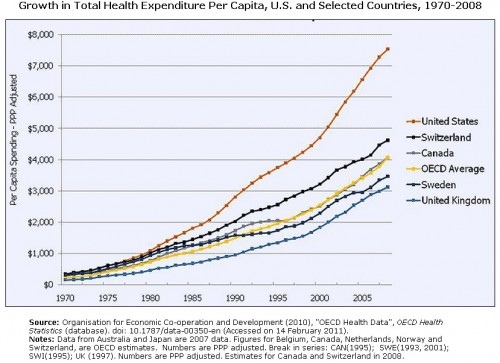
4. The U.S. pays more for health care than residents in any other major country. And the government share of current health spending that in the U.S. covers a just minority of citizens…

is about the same as total health care costs in many other countries, including (as a percentage of G.D.P.) Luxembourg (6.8 percent), Israel (7.8 percent), Japan (8.1 percent), Britain (8.4 percent) and Norway (8.5 percent).

That is, the proportion of GDP we spend now for just those on medicare, and medicaid in the U.S. non-system covers the total health costs in other countries. We are one of the least efficient, lowest value health care “systems” in the world. Exceptional!

Read the article, it’s short and clear.

Medicynical Note: The solution being offered by Ryan, provides less coverage for those in medicare and medicaid; does nothing about the 50 million uninsured. It will likely cut costs but also cut care provided and result in the deaths of our citizens. Amazingly modest proposal.


Drug Patents: Part of the Problem

Dean Baker in the Guardian, notes the obscenity of drug pricing and Senator Sanders’ solution.

We can do better – and Senator Bernie Sanders has proposed a way. He has introduced a bill to create a prize fund that would buy up patents, so that drugs could then be sold at a free market price. Sanders’s bill would appropriate 0.55% of GDP (about $80bn a year, with the economy’s current size) for buying up patents, which would then be placed in the public domain so that any manufacturer could use them at no cost.

Medicynical Note: Unlikely to happen but might put pressure on manufacturers to more reasonably price drugs.