
Category Archives: Health Economics

CT Screening for Lung Cancer — The Best Use of Resources?

The NEJM has an article an editorial on CT screening for lung cancer. The article notes:

The rate of adherence to screening was more than 90%. The rate of positive screening tests was 24.2% with low-dose CT and 6.9% with radiography over all three rounds. A total of 96.4% of the positive screening results in the low-dose CT group and 94.5% in the radiography group were false positive results. The incidence of lung cancer was 645 cases per 100,000 person-years (1060 cancers) in the low-dose CT group, as compared with 572 cases per 100,000 person-years (941 cancers) in the radiography group

The rate of death was reduced by 6.7%.

The editorial noted:

The NLST results show that three annual rounds of low-dose CT screening reduce mortality from lung cancer, and that the rate of death associated with diagnostic procedures is low.

And:

According to the authors, 7 million U.S. adults meet the entry criteria for the NLST,1 and an estimated 94 million U.S. adults are current or former smokers. With either target population, a national screening program of annual low-dose CT would be very expensive, which is why I agree with the authors that policy makers should wait for more information before endorsing lung-cancer screening programs.

Medicynical Note: This screening is quite costly even without considering the costs of sorting out the false positives. There is a question whether any system of care, much less one that is bankrupting a nation, can afford such a screening program. Would, for example, some of the funds be better employed in education about the hazards of smoking and smoking cessation.
Controlling Healthcare Spending, Without Killing People or the Program

Suggestions to the new congressional debt committee from the Incidental Economist:

1. Competitive bidding, also known as competitive pricing. This idea really puts the market to work to buy Medicare benefits for the lowest possible price on a market-by-market basis. Participants can be public and private entities. It piggybacks on the exiting, hybrid structure of Medicare (FFS Medicare + Medicare Advantage) and makes all participating plans compete directly in a way they never have. Scholars have estimated the savings to be 8% of Medicare spending. I’ve written a lot about this elsewhere. Perhaps this post is the best place to start.
2. Competitive bidding can be put to work for durable medical equipment too. See the work of Peter Crampton.
3. Part D formulary design and drug pricing. Did you know the VA buys drugs for 40% less than Medicare? True! That alone suggests Medicare could spend a lot less on drugs. There are many possible Part D reforms that would lower program spending. Kevin Outterson wrote about some. For more about what it would take and mean to make Medicare’s drug benefit more like the VA’s see my post, which links to my paper with Steve Pizer and Roger Feldman.
4. Reference pricing. This idea came to me via David Leonhardt and Peter Orszag (smart guys, by the way; you should talk to them). The basic idea is that Medicare should only spend an amount on therapy for a condition equal to the lowest cost, effective one (that’s the “reference price”). If individuals want more costly therapies that are no more effective, they should pay the difference out of pocket. There’s more to this. See this prior post and related links therein.
5. There are lots of things Medicare shouldn’t even be paying for at all because they don’t work. See Rita Redberg’s NY Times op-edon this.
6. Support comparative effectiveness research so we can learn more about which therapies are most effective. There is too much we don’t know and it is costing us. Let ACOs be tested. We don’t know if they’ll work, but they’re worth a try.
7. Support the IPAB. Isn’t it obvious by now that Congress itself can’t control Medicare costs? 7. 8. Consider all-payer rate setting. More on that here. Perhaps this post is a good starting point

Medicynical Note: These are excellent suggestions, many of which approach the issue of value and efficiency.. The new super congress however, is unlikely to look deeply into programs and solutions but rather will opt for across the board type fixes. On one hand republicans would view such fixes as an opportunity to hamstring Medicare which their conservative base views as evil. On the other hand, the democrats have shown little insight or particular interest in constructive alteration of Medicare.

Underlying both parties is the desire to hang the responsiblity for Medicare cuts on the other. Not a particularly constructive atmosphere for controlling costs and maintaining quality.


The False (and expensive) Promise of Avastin

Over the years the criteria for a response to treatment has eroded changed. We once considered a decrease in size of a tumor of 50% with prolongation of survival a partial response. Then we considered any response as long as the patient lived longer as evidence of a treatment’s efficacy. Now, in the new world of money driven medicine, the benchmark has eroded even further and seems to be anything the manufacturer decides is a response, whether or not the patient lives longer. Medicyically I’d add anything that boosts a profit.

The NEJM (July 14,2011) discusses the recent removal of breast cancer by the Food and Drug Administration (FDA) from the indications for use of Avastin. The article focuses on whether a slowing of progression is adequate for recommending use of a drug. It should also be understood that this drug has been shown to improve survival in breast cancer patients by just 1 or 2 months; and that as new studies accrue the length of the delay in progression (and survival benefit) appears to be less and less; and that this drug costs between $80,000 and $100,000/year, for the drug alone.

Genentech argues that progression-free survival is an acceptable measure of direct clinical benefit in metastatic breast cancer and that confirmatory trials demonstrate that bevacizumab prolongs progression-free survival. Yet the progression-free–survival benefit in confirmatory trials, while statistically significant, was considerably smaller than that seen in E2100. In addition, safety concerns — both new and previously described — have arisen from the recent clinical trials. Genentech further claims that the FDA has switched approval standards for bevacizumab. The agency, however, has consistently maintained that progression-free survival is “not statistically validated as surrogate for survival in all settings” and is “not precisely measured.” Therefore, the FDA has full authority to respond to adverse safety and efficacy data by changing medication labeling.

Medicynical Note: This company obviously doesn’t give a damn whether this drug offers value, or whether the drug has significant benefit for the amount charged for it. Under the guise of offering desperate patients a choice, albeit and expensive ineffective one with significant side-effects, the company’s management is keeping true to its fiduciary responsibility to simply make money for stockholders.

It’s hard to conceive of a worse basis for health

care.


The False (and expensive) Promise of Avastin

Over the years the criteria for a response to treatment has eroded changed. We once considered a decrease in size of a tumor of 50% with prolongation of survival a partial response. Then we considered any response as long as the patient lived longer as evidence of a treatment’s efficacy. Now, in the new world of money driven medicine, the benchmark has eroded even further and seems to be anything the manufacturer decides is a response, whether or not the patient lives longer. Medicyically I’d add anything that boosts a profit.

The NEJM (July 14,2011) discusses the recent removal of breast cancer by the Food and Drug Administration (FDA) from the indications for use of Avastin. The article focuses on whether a slowing of progression is adequate for recommending use of a drug. It should also be understood that this drug has been shown to improve survival in breast cancer patients by just 1 or 2 months; and that as new studies accrue the length of the delay in progression (and survival benefit) appears to be less and less; and that this drug costs between $80,000 and $100,000/year, for the drug alone.

Genentech argues that progression-free survival is an acceptable measure of direct clinical benefit in metastatic breast cancer and that confirmatory trials demonstrate that bevacizumab prolongs progression-free survival. Yet the progression-free–survival benefit in confirmatory trials, while statistically significant, was considerably smaller than that seen in E2100. In addition, safety concerns — both new and previously described — have arisen from the recent clinical trials. Genentech further claims that the FDA has switched approval standards for bevacizumab. The agency, however, has consistently maintained that progression-free survival is “not statistically validated as surrogate for survival in all settings” and is “not precisely measured.” Therefore, the FDA has full authority to respond to adverse safety and efficacy data by changing medication labeling.

Medicynical Note: This company obviously doesn’t give a damn whether this drug offers value, or whether the drug has significant benefit for the amount charged for it. Under the guise of offering desperate patients a choice, albeit and expensive ineffective one with significant side-effects, the company’s management is keeping true to its fiduciary responsibility to simply make money for stockholders.

It’s hard to conceive of a worse basis for health care.


Avastin for Breast Cancer: NCCN Cost/Efficacy Not Our Department

Value in medicine appear to be an oxymoron. Despite having little evidence of efficacy but strong evidence of great cost, the National Comprehensive Cancer Network (NCCN) an ad hoc outfit that provides guidelines for cancer treatment has decided that Avastin should be available to treat cancer patients.

Apparently $80,000-$90,000 for treatment, for the drug alone, does not make them pause even a second on their recommendation.

Of course a significant number of the panel members who decided this, including the chairman are on Genentech/Roche’s payroll. (FYI Genentech/Roche makes Avastin)

The organization’s “quote” conflict of interest rules state:

Per NCCN policy (also on the website), disclosure of a relationship with an external party does not automatically disqualify an individual from committee membership.

The policy also states that committee members who have a “significant and direct or indirect interest with an external entity which constitutes a conflicting interest shall not participant in the NCCN Guidelines Panel’s discussion when the NCCN Guidelines Panel’s action or topic under discussion may advantage or disadvantage an external entity.”

However, the NCCN disclosure policy gives committee chairs discretion to allow panelists with potential conflicts to “participate for the purpose of providing or presenting information to the NCCN Guidelines Panel.”

Medicynical Note: Cost-efficacy doesn’t appear to be anyone’s responsibility. No wonder our non-system of health care is the most expensive by far in the world.

And no wonder our dysfunctional pathetic political non-system which oversees health care (as well as our national budget and debt “ceiling”) is the laughing stock of the world.


Medical Info Tainted by Drug Companies Bias — So What Else is New?

Not surprisingly drug companies do everything they can to get doctors to prescribe their products. It matters not that their medications are no better than generics, that their medications cost more than the annual average income in the U.S., that there are other better drugs available. They pay for the ads and for the prominence of the drug recommendations. Take the “wonderful” free app Epocrates: Please.

But like so much else on the Web, “free” comes with a price: doctors must wade through marketing messages on Epocrates that try to sway their choices of which drugs to prescribe.

and:

However, the marketing through Epocrates is more insidious, according to Dr. Adriane Fugh-Berman, an associate professor of medicine at Georgetown University and founder of PharmedOut, a nonprofit group critical of drug companies’ marketing practices.

“With targeted ads in Google, you may buy something that’s an unwise purchase,” she said. “But when a physician is influenced in Epocrates, it’s the patient (Medicynical addendum: and insurer) who’s bearing the financial and health risk.”

Dr. Fugh-Berman and other critics of drug marketing say the apps promote more expensive and sometimes less effective drugs. The companies say they are helping doctors find the best medicines.

Medicynical Note: This type advertising costs us all money, whether we pay directly for the medication or our insurer covers the cost. Doctors have lived too long in the world where cost is not a consideration in their treatment options. We need to encourage value, as well as efficacy, in health care. The U.S. has the most expensive, most inefficient and perhaps only non system of health care operational in the industrialized world. We can do better……..maybe.


People Will Die (I don’t know How Else to Put it)

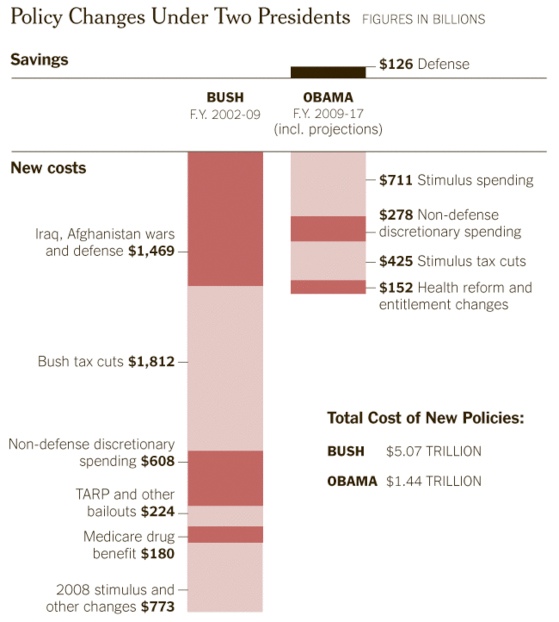
This chart tells it all. Republicans had no problem with Bush but are determined to continue our recession/depression and health care by by cutting programs that benefit the poor, lower middle class, the sick and infirm the most. It’s letting them eat cake.


The Boehner bill to be voted on today will cut 1.6 trillion from “entitlements” which will include cuts in Medicare, Medicaid and Social Security. Meanwhile his party has vowed there will be no increase in taxes on anyone, including the weathiest individuals and corporations. Just to refresh your memory in the US the distribution of wealth is highly skewed to the wealthiest and has gotton more out of balance the last ten years:

Top 1% own 38.1%
Top 96-99% own 21.3%
Top 90-95% own 11.5%
And it gets much uglier as you proceed downward. Bottom 40% of population has 0.2% of all wealth.

Medicynical note: The cuts proposed by Boehner, the tea party, and the republicans in Medicare and Medicaid will result in much pain, suffering and deaths in the lowest income groups who cannot afford healthcare and rely on publically funded programs. Yes people will die.

We can and should do better by implementing health reform; providing rational coverage to the uninsured; controlling costs by evaluating treatment options and using the most cost effective; negotiating with suppliers on price; cutting the cost of administration.


Multiple Sclerosis Medications — Overpriced? Effective?

Drug companies take advantage of chronically ill patients and their families by aggressively marketing modestly effective drugs at inflated prices, especially in the U.S. This is commonplace for cancer patients who are coerced into paying $50,000-$100,000/year for drugs offering very limited benefit.

The same appears to be true in multiple sclerosis:

The drugs include beta interferons (brand-names like Avonex, Rebif and Betaseron), glatiramer (Copaxone) and natalizumab (Tysabri). They are given by injection or infusion and can help prevent MS symptom flare-ups and delay long-term disability from the disease. But the price tag is large, with each drug now costing upwards of $3,000 a month in the U.S.

And a study in the journal Neurology estimates:

They would gain an extra two months or less of good health over 10 years, the researchers say, compared with using only therapies that help ease MS symptoms — like medications for pain, fatigue and muscle spasms. Overall, the study estimated, DMDs cost close to $1 million for each year of relatively healthy life a person with MS could expect to gain with 10 years of use.

And if the drug is started earlier in the course of the disease:

The researchers estimate that starting the drugs before any noticeable disability makes the medications more cost-effective — though they still hover above $700,000 for each good-quality year of life gained.

It should be noted that while there is no hard and fast rule regarding cost-effectiveness in the U.S., costs exceeding $150,000 for a year of good quality life are consider excessive. Consider also that the average and median incomes in the U.S. are in the $50,000-$60,000 range.

And in the U.S. we get to pay more for the drugs!

Both Noyes and Smyth said the findings highlight a wider issue: the high price Americans pay for prescription drugs.

Avonex, for example, cost Americans with MS about $34,000 for the year in 2010. The price in the UK was equivalent to about $12,000 — because that’s all the National Health Service will pay for the drug.

Medicynical Note: Is it any wonder the PHarma doesn’t want to negotiate prices with Medicare and pays our congressmen and women handsomely in the form of campaign support to maintain the pricing structure in the U.S. It may be “speech” of some sort, but it certainly isn’t free.


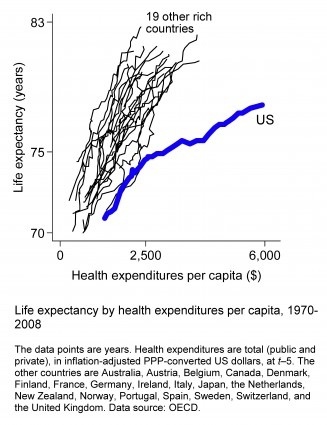
Less for More–A System to Assure PHarma’s Profits Not Our Health

A a graph says it best:

20110715-123720.jpg

Medicaid: An Ongoing Public Health Disaster

The NEJM reviews the limitations of Medicaid, which is about to get worse whether or not there is agreement on debt extension:

Since Medicaid was enacted in 1965, its coverage guarantee for millions of the poorest Americans has faced a substantial vacuum in actual access to health care. Multiple factors contribute to this problem: severe shortages of physicians and hospitals in many low-income inner-city and rural communities; low rates of participation in Medicaid among available providers, owing to low payment rates; state administrative practices that drive providers away; and the economic, clinical, educational, and cultural characteristics of Medicaid beneficiaries. Where they are operating, federal programs such as community health centers, federally funded family planning agencies, the National Health Service Corps, local public health agencies, and public and children’s hospitals help to mitigate the situation. But thousands of U.S. communities lack such programs, and even where they do exist, they don’t address the specialized long-term care needs of beneficiaries with severe disabilities.

Medicynical note: This in the “best” and most expensive non-system of healthcare in the world.