Category Archives: General Cynicism

Why our economy has been non-competetive for years

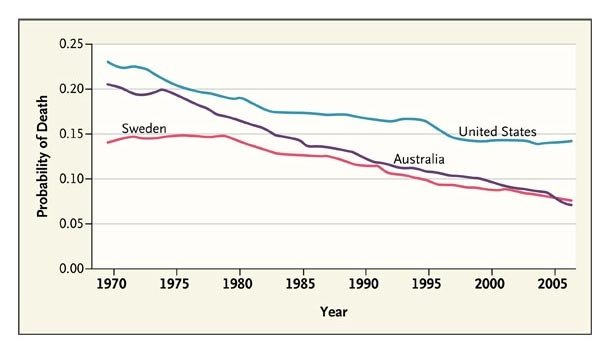
Back from Vacation. This from OECD: factbook 2009

Medicynical Note: The opposition’s side show is quite amazing given these numbers. We certainly can’t continue like this. The party of NO has no ideas, no questions and no answers. Their views open the door to an empty room.

Passage of this bill is just a first step. Now comes the hard work and more decisions. We must now bring our costs in line with our competitors in the world. That will mean a careful look at expenditures; modifying our practice incentives; controlling the cost of innovation (patent reform) and controlling expectations–of patients, of providers and suppliers.


Is this Socialism?

For Dairy and other farmers who oppose health reform, is this socialism?

Dairy policy in the United states has been and is comprised of the following major components: (i) border measures that create import barriers for most dairy products and export subsidies for a few manufactured dairy products; (ii) government purchases of manufactured dairy products to support the farm price of milk.

Or this?

The U.S. Agricultural Department is required by law (various U.S. farm bills which are passed every few years) to subsidize over two dozen commodities. Between 1996 and 2002, an average of $16 billion/year was paid by programs authorized by various U.S. farm billsdating back to the Agricultural Adjustment Act of 1933, the Agricultural Act of 1949, and theCommodity Credit Corporation (created in 1933), among others.


Medicynical Note: Medical care is bankrupting the country and individuals. We spend twice as much as other countries for care that is no better. As in agriculture, in medical care we need organization and regulation to assure affordable access. That’s not socialism it’s good government.


Segregation, not good in race relations, not good in health care

Health Insurance giant Anthem Blue Cross said it was raising rates on thousands of individual policyholders in California because the cost of their medical care exceeded the premiums they paid last year.

At the same time, other parts of Anthem reaped a profit. A Times analysis of the company’s regulatory filings shows that $525 million in Anthem’s earnings in 2009 was shipped to its corporate parent WellPoint Inc. The analysis was not disputed by Anthem.

Anthem Blue Cross has been so profitable that, since WellPoint acquired it in 2004, it has contributed more than $4.5 billion to the parent company’s bottom line.

Medicynical note: These hikes reveal the insurer’s strategy of segregating patients into risk groups. It allows Anthem to selectively raise rates on those who cost them more. So if you have a small group with a few patients with illnesses your rates will go up. If you are an individual buying health insurance you rates go up if you have illness, frequently to the point that you can’t afford the coverage. The rate hikes are designed to do just that.

Quite a system. Insurer’s can systematically extinguish their risk. Patients who need the coverage most are priced out of the market. They are forced to bankruptcy, government programs, and “free” ER use–the republican health plan.


Hard to believe–Humans, Dinosaurs, evolution

This is true:

Nearly a third of Texans believe humans and dinosaurs roamed the earth at the same time, and more than half disagree with the theory that humans developed from earlier species of animals\

Did humans live at the same time as the dinosaurs? Three in ten Texas voters agree with that statement; 41 percent disagree, and 30 percent don’t know.

And it’s a bipartisan problem, in Texas:

Republicans are less likely to believe that humans developed from earlier species of animals; 26 percent agree, while 60 percent disagree. Among Democrats in the survey, 46 percent agree that humans evolved from earlier species; 42 percent disagree. Perry’s voters were most hostile to this premise — 67 percent disagree.

Medicynical Note: If you think established scientific fact is difficult to get across, try to explain the nuances and risks of global warming or the reasons why we have a mess in health care or the need for increased taxes


Epogen, Aranesp and Procrit–Tumors grow faster

Epogen and Procrit have been used for about 20 years. They have been shamelessly marketed as an adjuvant to treat fatigue, rather than therapy for cancers. They were promoted as safe and effective.

Now after all these years we learn:

Studies have shown that the drugs, which sell under the trade names Epogen, Aranesp and Procrit, can cause tumors to grow faster and shorten the lives of some cancer patients.

They also:

increase risk of heart failure, blood clots and stroke.

Medicynical note: This is a more profound product liability problem than Toyota’s. Where’s the outrage? Congressional interest?

These drugs accounted for tens of billions of dollars in health care expenses since the early 90’s. The companies aggressively, and I mean aggressively, marketed to consumers as well as physicians. Creating organizations to flog the concept that we needed to address the fatigue in cancer problem. There was a feeling all along that these blood cell stimulators might have an effect on tumor cells as well. Were the studies done early on? No! Who knew what and when?

This is a strong argument for a routine impartial review of drug efficacy rather than leaving it to the undermanned FDA and biased drug companies.


Why new drugs are so expensive–AstroZeneca fostamatinib

AstraZeneca has purchased the rights to a new arthritis drug (fostamatinib). If you are wondering why drugs are so costly consider this.

AstraZeneca on Tuesday said it’s reached a pact to pay Rigel Pharmaceuticals up to $1.25 billion before royalties (medicynical emphasis) to license a drug used to treat rheumatoid arthritis.

AstraZeneca, in buying the drug, is paying for the previous research and future profits. Consumers will get to pay for both these companies revenue.

This is not a unique practice in the drug manufacturing industry.

“We believe that the terms Rigel secured compare very favorably to the other two compounds that are now in the hands of U.S. large pharma companies, with higher economics in terms of both up-front and future milestones,” he said in a note to clients.

Is it any wonder that drugs are so costly. Is this the market providing impetus for efficiency and competition or is it monopolistic practices manipulating the market to assure high prices and profits?

Medicynical Note: (added 2/18) My objection to this type maneuvering is the doubling of the profit requirements. Astrazeneca pays, the developing company, for the right to own and market the drug and also for future profits. Meanwhile AstraZeneca has its own profit needs that have to be fulfilled. In a single stroke the company is obligated to earn double profits on an already expensive drug–guess who pays.


Health Insurance Companies Making Money!! Not a surprise.

Health Insurance Companies Making Money!! That’s their business. Health care is a product line, patient care an annoyance and expense. Outcomes, are for someone else to worry about. Costs? why worry when we simply pass them through.

While businesses and individuals struggled to cope with ever-rising health insurance costs, health insurance companies lined their pockets with profits of $12.2 billion in 2009 – an increase of 56 percent from 2008.

Medicynical Note: The US is the only industrialized nation without a national health insurance program. We spend twice as much, have 50,000,000 uninsured and are number one not in health care but in health care bankruptcies.

We have a money making system for insurers, pharmaceutical companies and such and a non-system of health care.


No Recession for Health Insurance/Pharmaceutical Companies

It’s not hard to understand why insurers and pharmaceutical companies oppose health reform:

Insurers:

As the nation struggled last year with rising health-care costs and a recession, the five largest health-insurance companies racked up combined profits of $12.2 billion, up 56 percent over 2008, according to a new report.

Based on company financial reports for 2009 filed with the Securities and Exchange Commission, the report said insurers WellPoint, UnitedHealth Group, Cigna, Aetna and Humana covered 2.7 million fewer people than they did the previous year.

The report also said three of the five insurers cut the proportion of premiums they spent on customers’ medical care, committing relatively more to salaries, administrative expenses and profits.

Even so, insurance companies have also offloaded their most expensive patients by cancelling their policies and raising premiums drastically, Kirsch asserted in a Thursday press call.
Among the report’s findings on specific insurance companies:

  • Wellpoint increased profits 91 percent from 2008 while it chopped 3.9 percent of its total enrollment.
  • United Health’s profit increased 28 percent from 2008, while enrollment dropped by 3.4 percent.
  • Cigna’s profit increased 346 percent and enrollment dropped 5.5 percent.
  • Humana’s profit increased by 61 percent while enrollment decreased by 1.7 percent.
  • Aetna was the only company with a drop in profit and a gain in enrollment. The company’s profit declined by 8 percent from 2008, and enrollment grew by 7 percent.

More here:

Two things stand out in the exchange between Sebelius and spokesmen for the health plans. First, to hear industry flacks tell it, the health insurance plans in question are barely surviving, poor souls, with profits at or below those of rivals. Second, the federal government, for all Sebelius’ handwringing, has little power to rein in the insurance giants.

The insurance industry is one of the lucky few that enjoy exemption from federal antitrust regulation, an enormous and incomprehensible loophole in view of the power the insurance giants exert over American life. They’re regulated — to use that word liberally — by the states, which is the way they like it.

Pharmaceutical Companies:

GlaxoSmithKline Thursday met forecasts with a 32% jump in fourth-quarter net profit–inflated by pandemic flu products and higher contributions from consumer healthcare operations and emerging markets–but said it will reduce investment in some disease areas and cut more infrastructure costs and jobs as the world’s second-largest drugmaker continues to diversify away from its core pharmaceutical business.

Swiss drugs firm Roche has reported an 8% rise in annual sales, helped by sales of swine flu drug Tamiflu and cancer treatments, such as Herceptin.

Bristol announced net earnings attributable to the company were $8 billion for the three months ended Dec. 31, or $4.06 a share, up from $1.2 billion or 63 cents a share, last year.

Medicynical Note: Patient care has become an afterthought.


Your Money of Your Life–Herceptin and Breast Cancer

Very strange article in the Atlantic arguing all sides of health/cost debate. Virginia Postrel apparently believes that Heceptin, a costly ($60,000 for a course of treatment) biological drug that is used for breast cancer, saved her life. This despite the fact that at one year after diagnosis it is much too early to declare victory.

She indeed has a bad form of breast cancer, 6 lymph nodes positive. She was told there was a 50% chance of surviving.

The statistics she provides are vague and not well documented in the medical literature. For example she states:

“Adding the biological drug Herceptin, approved by the FDA in 2006 for use in early-stage cancers like mine, could increase my survival odds from a coin flip to 95 percent.”

There is no data to support this contention. Herceptin appears to delay recurrence and probably improves survival but how much is still unclear. 95% is a number that greatly exaggerates the benefit.

The New England Journal article cited by the Atlantic piece reported:

“1694 women assignedto one year of trastuzumab, and 1693 women assigned to observation.We report here the results only of treatment with trastuzumab for one year or observation. At the first planned interim analysis(median follow-up of one year), 347 events (recurrence of breastcancer, contralateral breast cancer, second nonbreast malignantdisease, or death) were observed: 127 events in the trastuzumabgroup and 220 in the observation group. The unadjusted hazardratio for an event in the trastuzumab group, as compared withthe observation group, was 0.54 (95 percent confidence interval,0.43 to 0.67; P<0.0001 by the log-rank test, crossing theinterim analysis boundary), representing an absolute benefitin terms of disease-free survival at two years of 8.4 percentagepoints. Overall survival in the two groups was not significantlydifferent (29 deaths with trastuzumab vs. 37 with observation).”

Not nearly as impressive.

The data Ms Postrel herself provides is that chances of recurrence were 1 in six without Herceptin and 1 in 12 with it after two years. Just to be clear, consider that the 1 in 6 recurrence rate means that 16.6% would recur in the non Herceptin treated group. And 1 in 12 (8.3%) would recur in the treated group.

This is a considerable improvement but an exceptionally costly one. It means that out of 100 people treated 8 or so get a benefit. 84 were not going to recur with or without treatment. And around 8 would recur regardless of the treatment used.

At $60,000/patient for Herceptin, 100 patients treated would cost 6 million dollars to treat. Out of the 100 treated, 8 patients would have an improved outcome, a cost of $750,000/patient who benefits.

This is an unimaginable amount for a health care system to spend and it is no wonder that systems think twice before implementing routine use of Herceptin.

The question is whether any health care system can afford this unless they more carefully select patients.

Medicynical note: Our costly pharmaceutic industry prices drugs for cancer patients an order of magnitude higher than drugs developed for less severe illness. Their development costs are a “trade” secret so one can only guess whether the pricing is justifiable. A medicynical guess is that this is a very profitable cost-plus business and that frugality and efficiency are not in these companyies lexicon. They charge based more on the desperateness of the patient’s situation than by the cost of development or even effectiveness of the drug. For example they spend more on drug promotion and advertising than on research.

These drugs are priced high despite the fact that many of them were financed with public funds. Even very effective drugs that required little clinical testing because of their obvious efficacy (admittedly an unusual occurrence) are priced over $50,000/year.

To give this pricing perspective consider that

  • drug costs are increasing at double the rate of inflation
  • incomes dropped several thousand dollars over the past few years
  • the cost of these single drugs alone exceed the median income of U.S. citizens
  • Medical care has superseded home and auto purchases as the most expensive purchases in a lifetime. Amazing

Ms. Postrel notes that we pay more/capita for drugs than New Zealand but what she doesn’t say is that the U.S. non-system spends twice as much as many industrialized nations on all aspects of care; that the U.S. is the only industrialized nation without some form of national health system; and that our outcomes in cancer are only as good as but not significantly better than many other industrialized nations.

As T.R. Reid noted recently:

“Which, in turn, punctures the most persistent myth of all: that America has “the finest health care” in the world. We don’t. In terms of results, almost all advanced countries have better national health statistics than the United States does. In terms of finance, we force 700,000 Americans into bankruptcy each year because of medical bills. In France, the number of medical bankruptcies is zero. Britain: zero. Japan: zero. Germany: zero.”

For people with cancer it’s truly your money or your life, and sadly most of these treatments in advanced disease do not cure and often don’t even improve patients’ outcomes.

Lastly I certainly hope that Ms. Postrel is cured.

Anthem Blue Cross, Its the money stupid

Anthem Blue Cross follows the time honored health insurer practice of flushing high risk people out of the beneficiary pool by increasing rates. 39% increase for thousands of individual policy holders in California. It’s great for business but bad for healthcare.

Wellpoint is the owner of Anthem. It’s stock price is at 61.45. The company earned 4.7 billion dollars last year, yes billion, or $9.88/share. This is in the range of 15% of the stock price. A return of 15%/year is astounding in a bear market.

Medicynical Note: This company’s primary goal is not the care of the sick and infirm but profits. Is this a health care system? Or a money making system? It can’t be both without bankrupting us all.