Category Archives: General Cynicism

More on our Dysfunctional NON-system of Health care

Health Affairs has an article Comparing our private, for large profit, health insurers with those elsewhere. The study compared insurance experiences in Australia, Canada, France, Germany, the Netherlands, New Zealand, Norway, Switzerland, the U.S. and United Kingdom. No surprises:

Overall, the study found significant differences in access, cost burdens, and problems with health insurance that are associated with insurance design. US adults were the most likely to incur high medical expenses, even when insured, and to spend time on insurance paperwork and disputes or to have payments denied. Germans reported spending time on paperwork at rates similar to US rates but were well protected against out-of-pocket spending. Swiss out-of-pocket spending was high, yet few Swiss had access concerns or problems paying bills.

The United States is the only country in which one-fifth of adults reported serious problems paying health care bills. In contrast, at most 9 percent of adults in other countries (8 percent Australia and 9 percent France) reported serious problems paying bills.

Medicynical Note: Yes our approach is unique and dysfunctional and mirrors a culture in which 80% believe in miracles: in which a large proportion, perhaps a majority doubt evolution; in which a near majority deny global warming as an increasing problem; in which large numbers of people don’t want to mandate health insurance coverage but want all possible treatment available at little or no cost when illness occurs.

Welcome to the home of magical thinking.

Health Care is about the money, Care? Not our department

This from Health Care For America.

The six largest investor owned health insurance companies recorded huge profit gains in the third quarter of 2010 by spending a smaller share of premiums on medical care, purging unprofitable members and burdening consumers with higher cost-sharing limits.

The companies, Wellpoint Inc., United Health Group Inc., Aetna inc., Humana inc., Cigna Corp and Coventry Health Care

made combined profits of $3.4 billion in the three months ending Sept. 30.

Medicynical Note: The money came, in part, from reducing the proportion of premiums spent on health care–Coventry is down to 76.8%, Aetna at 80.5%.

In 1993 95% of premium dollars went for health care. By 2007 the average amount spent on care was down to about 80%,

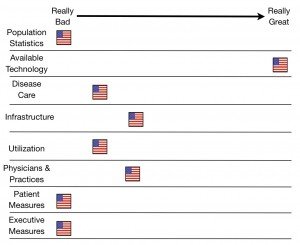
In comparison with other industrialized nations:

Performance on measures of health system efficiency remains especially low, with the U.S. scoring 53 out of 100 on measures gauging inappropriate, wasteful, or fragmented care; avoidable hospitalizations; variation in quality and costs; administrative costs; and use of information technology. Lowering insurance administrative costs alone could save up to $100 billion a year at the lowest country rates.

Only in America would such inefficiency tolerated. Amazing.


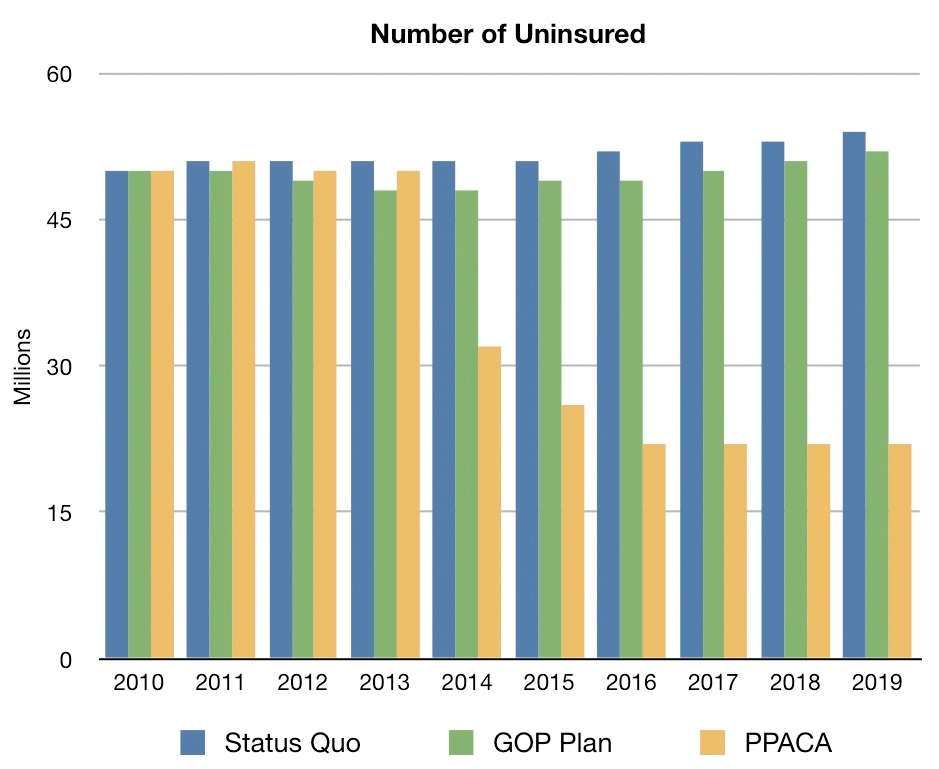
Number of Uninsured — Another reason for Health Reform

This chart is adapted from the CBO studies of health reform and the republican non- plan and was published in the Incidental Economist.

The Patient Protection and Affordable Care Act (PPACA) is Health Reform. The GOP plan is non-existent, with results about the same as doing nothing, which is exactly what it is–a new version of “let them eat cake.” Of course the GOP non-plan and the current non-system relies on “free” cake (care) provided by ER’s which really isn’t free. Guess who ultimately pays and guess why our health care costs twice as much as elsewhere–in part.


US Becoming a Low Wage Country — The Approaching Health Care Bust

BMW has recently increased employment at their Greer South Carolina plant.

Among the applicants: a former manager of a major distribution center for Target, a consultant who oversaw construction projects in four Western states and a supervisor at a plastics-recycling firm. Some held college degrees and résumés in other fields where they made more money.

But they’re all in the factory now making $15 an hour — about half of what the typical German autoworker makes.

it’s a fact that ;

the price of having a more globally competitive work force means more in America could fall well short of the middle-class living standards that manufacturing workers once could expect. Wages adjusted for inflation have declined for these workers since 2003.

Medicynical note: A salary of $15/hour approximates $30,000/year–half the average and median income in the states. Think any of these employees will be able to afford a BMer? Or even a $20,000 Chevy? High deductibles on health care?


Taxing Grandchildren to Pay Off Deficits

The deficit commission’s solution to our debt is to cut taxes, mostly for the wealthy, now and tax the benefits of our children and grandchildren.

Brave? Creative? NO


Starbucks — More spent on health care than coffee

It’s remarkable how shortsighted American businesses are. Their Chamber of Commerce is on record as opposing health reform.  Given the cost of providing employees health insurance one would think they would be supportive of  reform efforts, particularly if they removed health insurance as an employee benefit, as is the case in most industrialized countries.

Consider the bankruptcies of GM and Chrysler due in part to health insurance costs; consider also Starbucks which provides health care for employees, “a line item that tallies $300 million. That’s more than the company spends on coffee.”

Medicynical note: In other countries businesses don’t have to factor the health coverage burden into their planning, or costs. It’s another of those incomprehensible inefficiencies that is uniquely American.

Our Non-System of Health Care is failing

More evidence that our health care institutions are failing, at health care.

Medicynical note: I’m speechless.

Efficacy testing of drugs OK in U.K. –Financial Times

The issue of testing advances for efficacy and value in health care is one of the sticking points for our conservative friends. They oppose such testing and feel that everyone should have infinite choices, no matter the cost or limited efficacy. And Medicare and many other insurers should simply pay and pass through the additional costs. How else to interpret their criticism of comparison testing and evaluation of efficacy in the health reform bill–and the cost savings built into it.

There is however a voice of reason somewhere. (Financial Times November 7, 2010)

But the principle is justified: a centralised body is needed systematically to assess whether a drug offers therapeutic advantages and is cost-effective. Otherwise, in a health system with finite funding, such treatments will squeeze out others offering better outcomes.

In practice, Nice should be involved in establishing value too. Its role could be extended to rule on what constitutes a fair price at the time of launch with periodic amendments as greater clinical use better demonstrates value.

Medicynical note: Of course in the U.S. we don’t have finite funding. We think it’s perfectly all right to spend twice as much as other industrialized countries per capita on health care and eat up almost 20% of GDP. Value in medicine? An archaic concept when the profits of the medical industrial complex are involved.


U.S. Quality of Care– Lacking

A series on health care quality in the United States, here. Read the series and weep!

That Great Sucking Sound

It’s quite remarkable that anyone would oppose reforming our health care system. It’s not the “best in the world” by any measure but is the most expensive.

Atlanta’s large employers watched the per-employee cost of health insurance go up by 140 percent during the past decade, from $3,877 in 2001 to a projected $9,316 for 2011, AJC staffer Carrie Teegardin reports.> Atlanta Journal Constitution

The market analysis firm Standard & Poor’s released new figures on health care costs last month, and the results are disturbing, if unsurprising. The numbers show that from August 2009 to August 2010 the average, per capita cost of health care services rose 7.32 percent. During that same period, overall inflation rose a mere 1.1 percent. Press Enterprise

Meanwhile:

Purchases increased 0.2 percent, the smallest gain in the third quarter, Commerce Department figures showed today in Washington. Incomes fell 0.1 percent, the first drop since July 2009, and the Federal Reserve’s preferred measure of inflation stagnated, capping the smallest 12-month gain in nine years. Bloomberg

Medicynical Note: Its simple arithmetic and it’s been going on for many years. Incomes are not increasing at the rate of increase in health care costs. That sucking sound is health care removing discretionary expenditures from the economy.

We are in a crisis of expectations. The sick expect everything possible to be done, no matter the cost, whether or not they have insurance. Physicians and other providers expect healthy incomes–we’re number one in the world in this.

Hospitals expect continuing income to support their extravagant overhead. They compete for patients by the grandeur of their building and the beauty of their public spaces. Pricing is not competitive and obscured. Outcomes are not understandable or easily accessible.

Insurers are in a cost plus situation and pass through increases, keeping their  excessive  20% margin to fuel profits and executive income.

Pharmaceutical companies and other technology suppliers to the health care industrial complex expect increasing profits each year and generation long patent protection. Pricing of advances does not reflect the benefit of an innovation but rather the desperateness of the patient.

Value?  Quality?  Not our department

Fasten your seatbelts. Regardless of the election outcome the system is about to crash.