Category Archives: General Cynicism

China Better at Capitalism than the U.S. — Controlling Drug Costs

China is making an effort to control drug costs.

A new way to buy essential drugs being tested in Anhui province caused prices to fall by as much as 90 percent. The system, which encourages drugmakers to compete on price and quality for state contracts, may go national and be widened to include other medicines, according to lobbyists representing 38 foreign drugmakers in China.

Foreign companies oppose that because they say it will force them to lower prices to compete with generic-drug makers. That may erode the profit earned from every prescription they sell in the world’s fastest-growing pharmaceutical market, which was worth $41.1 billion last year, according to IMS Health Inc.

Medicynical Note: What a concept, competition. You may recall that when the republican congress passed Medicare Part D, they purposefully refused to consider such type bidding and negotiation. They were, and are, the best congress money can buy.


Multiple Insuers Without Regulation = Higher Practice Overhead

There is extreme waste for practitioners in our non-standardized way of filing for payment from multiple insurers.

Medical practices in the U.S. spend nearly four times as many hours a week dealing with insurers than do practices in Canada, at nearly four times the cost, researchers found.

And:

The researchers estimated that physician practices in Canada spend $22,205 per physician per year interacting with Canada’s single-payer agency. By contrast, U.S. physicians are spending $82,975 per doctor per year.

Medicynical note: The health care reform so reviled by republicans will correct this problem, not by going single payer, but simply by requiring insurers to use a standardized form. 

Controlling Healthcare Spending, Without Killing People or the Program

Suggestions to the new congressional debt committee from the Incidental Economist:

1. Competitive bidding, also known as competitive pricing. This idea really puts the market to work to buy Medicare benefits for the lowest possible price on a market-by-market basis. Participants can be public and private entities. It piggybacks on the exiting, hybrid structure of Medicare (FFS Medicare + Medicare Advantage) and makes all participating plans compete directly in a way they never have. Scholars have estimated the savings to be 8% of Medicare spending. I’ve written a lot about this elsewhere. Perhaps this post is the best place to start.
2. Competitive bidding can be put to work for durable medical equipment too. See the work of Peter Crampton.
3. Part D formulary design and drug pricing. Did you know the VA buys drugs for 40% less than Medicare? True! That alone suggests Medicare could spend a lot less on drugs. There are many possible Part D reforms that would lower program spending. Kevin Outterson wrote about some. For more about what it would take and mean to make Medicare’s drug benefit more like the VA’s see my post, which links to my paper with Steve Pizer and Roger Feldman.
4. Reference pricing. This idea came to me via David Leonhardt and Peter Orszag (smart guys, by the way; you should talk to them). The basic idea is that Medicare should only spend an amount on therapy for a condition equal to the lowest cost, effective one (that’s the “reference price”). If individuals want more costly therapies that are no more effective, they should pay the difference out of pocket. There’s more to this. See this prior post and related links therein.
5. There are lots of things Medicare shouldn’t even be paying for at all because they don’t work. See Rita Redberg’s NY Times op-edon this.
6. Support comparative effectiveness research so we can learn more about which therapies are most effective. There is too much we don’t know and it is costing us. Let ACOs be tested. We don’t know if they’ll work, but they’re worth a try.
7. Support the IPAB. Isn’t it obvious by now that Congress itself can’t control Medicare costs? 7. 8. Consider all-payer rate setting. More on that here. Perhaps this post is a good starting point

Medicynical Note: These are excellent suggestions, many of which approach the issue of value and efficiency.. The new super congress however, is unlikely to look deeply into programs and solutions but rather will opt for across the board type fixes. On one hand republicans would view such fixes as an opportunity to hamstring Medicare which their conservative base views as evil. On the other hand, the democrats have shown little insight or particular interest in constructive alteration of Medicare.

Underlying both parties is the desire to hang the responsiblity for Medicare cuts on the other. Not a particularly constructive atmosphere for controlling costs and maintaining quality.


The False (and expensive) Promise of Avastin

Over the years the criteria for a response to treatment has eroded changed. We once considered a decrease in size of a tumor of 50% with prolongation of survival a partial response. Then we considered any response as long as the patient lived longer as evidence of a treatment’s efficacy. Now, in the new world of money driven medicine, the benchmark has eroded even further and seems to be anything the manufacturer decides is a response, whether or not the patient lives longer. Medicyically I’d add anything that boosts a profit.

The NEJM (July 14,2011) discusses the recent removal of breast cancer by the Food and Drug Administration (FDA) from the indications for use of Avastin. The article focuses on whether a slowing of progression is adequate for recommending use of a drug. It should also be understood that this drug has been shown to improve survival in breast cancer patients by just 1 or 2 months; and that as new studies accrue the length of the delay in progression (and survival benefit) appears to be less and less; and that this drug costs between $80,000 and $100,000/year, for the drug alone.

Genentech argues that progression-free survival is an acceptable measure of direct clinical benefit in metastatic breast cancer and that confirmatory trials demonstrate that bevacizumab prolongs progression-free survival. Yet the progression-free–survival benefit in confirmatory trials, while statistically significant, was considerably smaller than that seen in E2100. In addition, safety concerns — both new and previously described — have arisen from the recent clinical trials. Genentech further claims that the FDA has switched approval standards for bevacizumab. The agency, however, has consistently maintained that progression-free survival is “not statistically validated as surrogate for survival in all settings” and is “not precisely measured.” Therefore, the FDA has full authority to respond to adverse safety and efficacy data by changing medication labeling.

Medicynical Note: This company obviously doesn’t give a damn whether this drug offers value, or whether the drug has significant benefit for the amount charged for it. Under the guise of offering desperate patients a choice, albeit and expensive ineffective one with significant side-effects, the company’s management is keeping true to its fiduciary responsibility to simply make money for stockholders.

It’s hard to conceive of a worse basis for health care.


The False (and expensive) Promise of Avastin

Over the years the criteria for a response to treatment has eroded changed. We once considered a decrease in size of a tumor of 50% with prolongation of survival a partial response. Then we considered any response as long as the patient lived longer as evidence of a treatment’s efficacy. Now, in the new world of money driven medicine, the benchmark has eroded even further and seems to be anything the manufacturer decides is a response, whether or not the patient lives longer. Medicyically I’d add anything that boosts a profit.

The NEJM (July 14,2011) discusses the recent removal of breast cancer by the Food and Drug Administration (FDA) from the indications for use of Avastin. The article focuses on whether a slowing of progression is adequate for recommending use of a drug. It should also be understood that this drug has been shown to improve survival in breast cancer patients by just 1 or 2 months; and that as new studies accrue the length of the delay in progression (and survival benefit) appears to be less and less; and that this drug costs between $80,000 and $100,000/year, for the drug alone.

Genentech argues that progression-free survival is an acceptable measure of direct clinical benefit in metastatic breast cancer and that confirmatory trials demonstrate that bevacizumab prolongs progression-free survival. Yet the progression-free–survival benefit in confirmatory trials, while statistically significant, was considerably smaller than that seen in E2100. In addition, safety concerns — both new and previously described — have arisen from the recent clinical trials. Genentech further claims that the FDA has switched approval standards for bevacizumab. The agency, however, has consistently maintained that progression-free survival is “not statistically validated as surrogate for survival in all settings” and is “not precisely measured.” Therefore, the FDA has full authority to respond to adverse safety and efficacy data by changing medication labeling.

Medicynical Note: This company obviously doesn’t give a damn whether this drug offers value, or whether the drug has significant benefit for the amount charged for it. Under the guise of offering desperate patients a choice, albeit and expensive ineffective one with significant side-effects, the company’s management is keeping true to its fiduciary responsibility to simply make money for stockholders.

It’s hard to conceive of a worse basis for health

care.

Epidemic of Mental Illness — Yes or No?

Fascinating review of three books on psychiatry, conflicts of interest, over medication and ultimately the culture of U.S. money driven medicine in the N.Y. Review of Books by Marcia Angell. This is a two part series. Part 2 is here. Comments here.

Among other issues Angell looks at:

What is going on here? Is the prevalence of mental illness really that high and still climbing? Particularly if these disorders are biologically determined and not a result of environmental influences, is it plausible to suppose that such an increase is real? Or are we learning to recognize and diagnose mental disorders that were always there? On the other hand, are we simply expanding the criteria for mental illness so that nearly everyone has one? And what about the drugs that are now the mainstay of treatment? Do they work? If they do, shouldn’t we expect the prevalence of mental illness to be declining, not rising?

She discusses that there is a misunderstanding of the basis of these diseases; that they are over diagnosed; that neurotransmitter theories are unproven and probably wrong; that the pharmaceutical industry is funding (Medicynical Note: corrupting) psychiatry and psychiatrists more than any other specialty; placebo treatment in depression is virtually as effective as antidepressants; these drugs have serious long term side effects; and so on.

She concludes:

At the very least, we need to stop thinking of psychoactive drugs as the best, and often the only, treatment for mental illness or emotional distress. Both psychotherapy and exercise have been shown to be as effective as drugs for depression, and their effects are longer-lasting, but unfortunately, there is no industry to push these alternatives and Americans have come to believe that pills must be more potent. More research is needed to study alternatives to psychoactive drugs, and the results should be included in medical education.

In particular, we need to rethink the care of troubled children. Here the problem is often troubled families in troubled circumstances. Treatment directed at these environmental conditions—such as one-on-one tutoring to help parents cope or after-school centers for the children—should be studied and compared with drug treatment. In the long run, such alternatives would probably be less expensive. Our reliance on psychoactive drugs, seemingly for all of life’s discontents, tends to close off other options. In view of the risks and questionable long-term effectiveness of drugs, we need to do better. Above all, we should remember the time-honored medical dictum: first, do no harm (primum non nocere).

Read the articles and comments.


Avastin for Breast Cancer: NCCN Cost/Efficacy Not Our Department

Value in medicine appear to be an oxymoron. Despite having little evidence of efficacy but strong evidence of great cost, the National Comprehensive Cancer Network (NCCN) an ad hoc outfit that provides guidelines for cancer treatment has decided that Avastin should be available to treat cancer patients.

Apparently $80,000-$90,000 for treatment, for the drug alone, does not make them pause even a second on their recommendation.

Of course a significant number of the panel members who decided this, including the chairman are on Genentech/Roche’s payroll. (FYI Genentech/Roche makes Avastin)

The organization’s “quote” conflict of interest rules state:

Per NCCN policy (also on the website), disclosure of a relationship with an external party does not automatically disqualify an individual from committee membership.

The policy also states that committee members who have a “significant and direct or indirect interest with an external entity which constitutes a conflicting interest shall not participant in the NCCN Guidelines Panel’s discussion when the NCCN Guidelines Panel’s action or topic under discussion may advantage or disadvantage an external entity.”

However, the NCCN disclosure policy gives committee chairs discretion to allow panelists with potential conflicts to “participate for the purpose of providing or presenting information to the NCCN Guidelines Panel.”

Medicynical Note: Cost-efficacy doesn’t appear to be anyone’s responsibility. No wonder our non-system of health care is the most expensive by far in the world.

And no wonder our dysfunctional pathetic political non-system which oversees health care (as well as our national budget and debt “ceiling”) is the laughing stock of the world.


Medical Info Tainted by Drug Companies Bias — So What Else is New?

Not surprisingly drug companies do everything they can to get doctors to prescribe their products. It matters not that their medications are no better than generics, that their medications cost more than the annual average income in the U.S., that there are other better drugs available. They pay for the ads and for the prominence of the drug recommendations. Take the “wonderful” free app Epocrates: Please.

But like so much else on the Web, “free” comes with a price: doctors must wade through marketing messages on Epocrates that try to sway their choices of which drugs to prescribe.

and:

However, the marketing through Epocrates is more insidious, according to Dr. Adriane Fugh-Berman, an associate professor of medicine at Georgetown University and founder of PharmedOut, a nonprofit group critical of drug companies’ marketing practices.

“With targeted ads in Google, you may buy something that’s an unwise purchase,” she said. “But when a physician is influenced in Epocrates, it’s the patient (Medicynical addendum: and insurer) who’s bearing the financial and health risk.”

Dr. Fugh-Berman and other critics of drug marketing say the apps promote more expensive and sometimes less effective drugs. The companies say they are helping doctors find the best medicines.

Medicynical Note: This type advertising costs us all money, whether we pay directly for the medication or our insurer covers the cost. Doctors have lived too long in the world where cost is not a consideration in their treatment options. We need to encourage value, as well as efficacy, in health care. The U.S. has the most expensive, most inefficient and perhaps only non system of health care operational in the industrialized world. We can do better……..maybe.


People Will Die (I don’t know How Else to Put it)

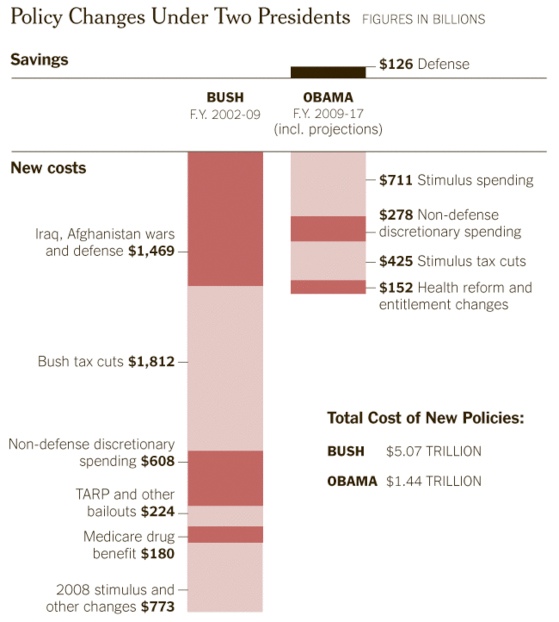
This chart tells it all. Republicans had no problem with Bush but are determined to continue our recession/depression and health care by by cutting programs that benefit the poor, lower middle class, the sick and infirm the most. It’s letting them eat cake.


The Boehner bill to be voted on today will cut 1.6 trillion from “entitlements” which will include cuts in Medicare, Medicaid and Social Security. Meanwhile his party has vowed there will be no increase in taxes on anyone, including the weathiest individuals and corporations. Just to refresh your memory in the US the distribution of wealth is highly skewed to the wealthiest and has gotton more out of balance the last ten years:

Top 1% own 38.1%
Top 96-99% own 21.3%
Top 90-95% own 11.5%
And it gets much uglier as you proceed downward. Bottom 40% of population has 0.2% of all wealth.

Medicynical note: The cuts proposed by Boehner, the tea party, and the republicans in Medicare and Medicaid will result in much pain, suffering and deaths in the lowest income groups who cannot afford healthcare and rely on publically funded programs. Yes people will die.

We can and should do better by implementing health reform; providing rational coverage to the uninsured; controlling costs by evaluating treatment options and using the most cost effective; negotiating with suppliers on price; cutting the cost of administration.


Hospice Care – It’s About The Monry

Health, once a charitable calling has become a “business” opportunity.

As hospice care has evolved from its charitable roots into a $14 billion business run mostly for profit, patients like Covington and their families have paid a steep price, according to lawsuits and federal investigations. Providers have been accused of boosting their revenues with patients who aren’t near death and not eligible for hospice — people healthy enough to live a long time with traditional medical care. In hospices, patients give up their rights to “curative” measures because they are presumed to be futile.

And:

In 2009, a Medicare oversight report found nearly a third of hospice patients were not getting services in care plans that describe the treatment and visits providers promise to give them.

Medicynical Note: Left to themselves without standards or oversight, businesses work to maximize profit. In other areas, competition may work to assure quality.  In hospice care such competition may work as well but that remains to be seen.  What is certain, however, is that in the rush for immediate profit patients suffer needlessly.

In our local area, our “non-profit” hospice recently opened an inpatient facility. It was a financial stretch. To pay for it the hospice, it appears, is emphasizing the need for patients to reside in their facilty rather than remain in their home. This increases their payments from medicare and supports the inpatient facility but undermines the desire of many patients to be in their familiar home setting during the last stage of their illnesses.

And, the remarkably dysfunctional House of Representatives voted thursday to decrease the reach and function of the new consumer protection agency. They find it unimaginable that consumers should be protected.