Category Archives: General Cynicism

New Gene Therapy — Hype for Funding?

Nice articles, here and here, on a new appoach to chronic leukemia. In a phase 1 study (study to evaluate toxicity) the approach seems to have activity.

Two participants in the Phase I trial have been in remission for up to a year. A third had a strong anti-tumor response, and his cancer remains in check. The research group plans to treat four more patients with CLL before moving into a larger Phase II trial.

Just 3 patients have been treated. That there is evidence of efficacy is hopeful but certainly not conclusive.

It should also be noted that:

All of the funding for the University of Pennsylvania’s gene therapy work has come from the academic community, but the work is expensive.

“We are looking for corporate partners as we head into Phase II trials,” Kalos said.

Medicynical Note: The study does give hope for a new approach to refractory leukemias, and it may well be applicable to other tumors.

The funding for this study, the basic research and initial phase 1 trial in all likelihood came from public money, federal grants and such–“from the academic community.” As implied, the researchers are courting corporate sponsors to fund further studies.

In our “system” you and I fund the training and research of basic scientists and their advances and then allow, and, yes, even encourage them to sell their advance to industry for commercialization. If the drug is useful, even marginally so, we get to pay the inflated price demanded by Pharma for a generation (the patent protected time period), with no credit for the funding of the initial advance.

It heads you lose, tails they win.
Our Non-system of Health Care: International Comparisons

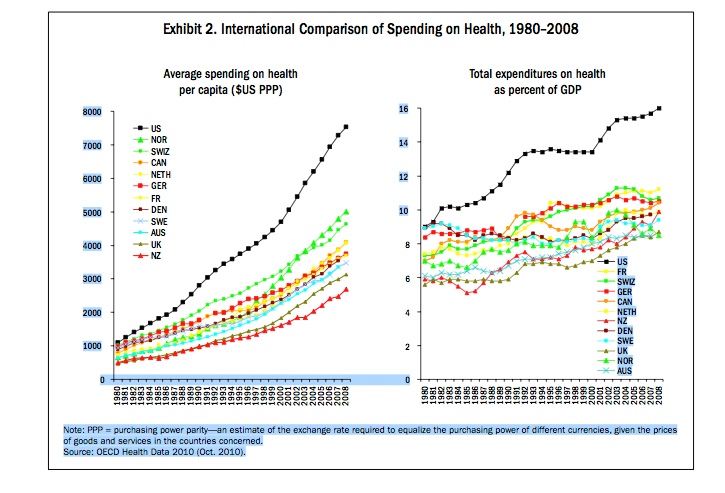
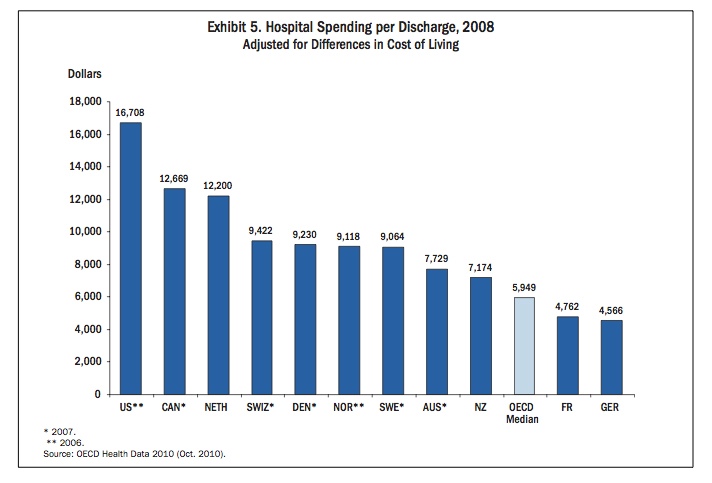
Out health care costs are out of control. We pay more and get limited benefit from our huge expenditure. We lead the world in health care related bankruptcy, hospital expenditures, drug costs, physicians pay, and the proportion of our population without health insurance. We are number 1.

The 2011 analysis of the US health care (non) system suggests that the reasons for our expenditures are “substantially higher prices and more fragmented care delivery that leads to duplication of resources and extensive use of poorly coordinated specialists.”

And concludes that:

Despite much higher spending, U.S. performance in terms of quality is variable relative to other countries. While cancer care in the U.S. seems to be of particularly high quality based on five-year survival rates, the high rates of hospital admissions for chronic diseases suggest opportunities for improvement.

Some graphics from the study:

On Hospital spending:


On comparative costs:


On Cancer survival:


Medicynical Note: It’s wonderful that our cancer survival is somewhat better than elsewhere, but if we accept that as true we also have to accept the shortcomings identified in the study and noted above.

The debate on the conservative side hinges on whether health care in the US should be a right of citizenship. It’s seems somewhat irrational to maintain such reasoning, tantamount to trying to reclaim virginity, when these same conservative friends continually laud U.S. Health Care for providing “free” access to ER’s for all. Is this not a form of defacto health care for all albeit inefficiently and poorly instituted.

Their reasoning, in some ways, is not surprising. After all, what other form of care would the most expensive inefficient health care non-system provide? And it goes without saying that it is not free. Can’t we do better?


Drug Prices

It’s an amazing fact that we pay more, much more than any other country in the world for medications(read the Incidental Economist link). More than double what New Zealand pays:

Medicynical note– Our republican congress during the Bush years wouldn’t agree to negotiating prices with drug companies when Medicare part D passed. After all we wouldn’t want to stress the poor drug company’s profits. Health care? Quality? Value? Not our department.

Creationism Evolving? Intellectual Respectability at Stake?

It’s difficult to believe that in the early part of the 21st century there should be finding the debate amongst evangelicals regarding the existence of Adam and Eve or that it should be of any interest. Perhaps this is a significant moment for American church people that will allow them to reclaim a modicum of intellectual respectability……….or not.

But now some conservative scholars are saying publicly that they can no longer believe the Genesis account. Asked how likely it is that we all descended from Adam and Eve, Dennis Venema, a biologist at Trinity Western University, replies: “That would be against all the genomic evidence that we’ve assembled over the last 20 years, so not likely at all.”

And:

Evolution makes it pretty clear that in nature, and in the moral experience of human beings, there never was any such paradise to be lost,” Schneider says. “So Christians, I think, have a challenge, have a job on their hands to reformulate some of their tradition about human beginnings.”

Medicynical Note: Who knows what’s next? That earth is billions of years old? Acceptance of evolution as the best explanation of man and life on earth? Acceptance of the bible as a book of nice stories?

Or perhaps, more likely, banishment and ostracism of the heretics.

Money, Profits and Hospice — Undermining an Essential Program

A review of Hospice spending shows an alarming change in mission goals from patient care and comfort to profits;

From 2005 through 2009, Medicare spending on hospice care rose 70% to $4.31 billion, according to Medicare records.

A recent report by the inspector general for Health and Human Services, which oversees Medicare, found for-profit hospices were paid 29% more per beneficiary than non-profit hospices. Medicare pays for 84% of all hospice patients.

The article highlighted the investigation of the two largest corporate hospice providers and their alleged fraudulent claims.

Medicynical Note: Trolling nursing homes for “hospice appropriate” patients apparently has become a way to increase revenue. It’s bizarre that Hospices thought it necessary to offer services to patients already in full-time nursing facilities. Two service providers, the nursing home and the hospice, being paid for providing what are, for the most part, the same nursing and support services is a irresistible recipe for waste and in this case fraud.

It should be evident that industry seeks to maximize profit. That’s what capitalism is about. In health care that means leveraging control over products and services by testing the limits of programs–in this case illegally increasing the patient base. It’s an irresistible urge that CEO’s simply can’t resist.

Patient care? Value? Cost Efficiency? Not their department.

Antioxidants — The 23 Billion Dollar Placebo

Interesting take on antioxidants in Slate, noting:

As it turns out, we have no evidence that antioxidants are beneficial in humans. (Though if you’re a Sprague-Dawley rat, there’s hope.) In fact, as Emily Anthes wrote last year in Slate, the best available data demonstrate that antioxidants are bad for you—so long as you count an increased risk of death as “bad.”

Medicynical Note: Before we jump on the bandwagon of antioxidant cynicism, think of the disruption of belief systems, the unemployment (naturopaths, nutritionists, chiropractors, life coaches and gurus, life extension specialists), and the depression from understanding that vitamins have very limited benefit, and perhaps do harm when taken in excess. That we don’t really have the potential to live to 130 years old, that this particular belief system has no basis.

Big PHarma, Conflicts of Interest, Undue Influence, “Freedom of Speech”

The drug industry does everything it can to influence physician’s and patient’s treatment decisions. They spend more on drug promotion than on drug research. They have innumerable physicians, research and practicing, on their payrolls–by offering grants, honorariae, or simply putting them on salary. And it works, it’s well documented that these conflicts of interest influence physician’s choices of treatment.

So it was not surprising to learn that these companies “data mine,” review records of prescriptions at pharmacies, to learn what doctors are prescribing and where to put their emphasis as they propagandize. What is surprising is the recent Supreme Court decision that it is unconstitutional to limit the right of drug companies access to these confidential records.

Concern about detailing has prompted at least 25 states to consider legislation to curtail it by restricting the transfer and use of physician-identifiable prescribing data.13 Laws passed in 3 states — Vermont, New Hampshire, and Maine — were swiftly challenged by PDIs and a trade association of pharmaceutical manufacturers.14-16 One of these challenges reached the nation’s highest court this year, and on June 23, the Supreme Court struck down Vermont’s statute by a vote of 6 to 3,17 holding that in practical effect, the law unconstitutionally restricted the speech of pharmaceutical companies and PDIs on the basis of the viewpoint it expressed. In this article, we review the Court’s reasoning and examine the implications of its holding.

What’s remarkable is that the Court views this a “freedom of speech” issue, once again elevating corporations to the level of citizenship. (As they did with political contributions)

The NEJM concluded:

The Sorrell decision impedes states’ efforts to curb detailing. Clever lawmakers may, however, be able to write their way around the Court’s ruling. The decision might also offer an unexpected dividend to opponents of data mining: the surrounding publicity might alert physicians to their right to opt out of sharing their prescribing information through the PDRP. Although the Supreme Court swept aside data-mining laws with the stroke of a pen, physicians who object to data sharing can escape it with the click of a mouse.

Medicynical Note: Our single minded Supreme Court appears to value the “citizenship” of corporations over individuals. Money appears to be a form of free speech whether in the form of political contributions or the ability to unduly influence prescribers in our non-system of health care. More American Exceptionalism.

The Best Congress Money Can Buy

It’s amazing that this is tolerated:

Now, after losing re-election last year despite hundreds of thousands of dollars in campaign donations from grateful hospital executives, doctors and other industry officials, he has moved on to Plan B: promoting their cause as a lobbyist.

Yet it’s common practice in our congress which has recently shown faux concern about deficits, spending and governing.

His role as an industry champion shows the enduring power of being a well-placed friend in the capital. At least 160 former lawmakers currently work as lobbyists in Washington, according to First Street, a Web site that tracks lobbying trends in Washington, with many more exerting influence as consultants or advisers.

Medicynical Note: The problem cuts across party boundries, though there are many more republican linked lobbyists. These people do not represent you and me. For the most part they are clients of business and in the medical field, pharmaceutical companies, insurers, device manufacturers and so on. Guess whose interests are sacrficed.

Is it no wonder our system of health care is only a system in that it is systematically rigged to promote the well being of business interests, not patients.


Hospice: Essential and Underutilized

Elizabeth Clift’s poignant narrative about her experience with hospice during the illness of her husband is must reading. She notes the underutilization of Hospice care and observes:

The problem is more attributable to the widespread ignorance and denial about the cascade of events that occur when death is imminent. “The well-documented failure in counseling patients about their prognosis and the full range of care options, including early palliative care, leads many patients to acquiesce to more aggressive care without fully understanding its impact on the length and quality of life,” says physician David C. Goodman, the lead author and co–principal investigator for the Dartmouth Atlas study and director of the Center for Health Policy Research at the Dartmouth Institute for Health Policy and Clinical Practice.

And:

In 2009, when a provision was inserted in proposed national health reform legislation that would have allowed Medicare to pay physicians and certain other health care providers to discuss end-of-life choices with beneficiaries, former Republican vice-presidential contender Sarah Palin characterized the proposal as leading to “death panels.” The phrase took hold, putting Democrats and President Barack Obama on the defensive, even though it was a Republican, Sen. Johnny Isakson of Georgia, who’d introduced the provision. “How someone could take an end-of-life directive or a living will as that is nuts,” he told the Washington Post. “You’re putting the authority in the individual rather than the government. I don’t know how that got so mixed up.”

Read it.

Medicynical note: in many ways we are a culture in denial

CT Screening for Lung Cancer — The Best Use of Resources?

The NEJM has an article an editorial on CT screening for lung cancer. The article notes:

The rate of adherence to screening was more than 90%. The rate of positive screening tests was 24.2% with low-dose CT and 6.9% with radiography over all three rounds. A total of 96.4% of the positive screening results in the low-dose CT group and 94.5% in the radiography group were false positive results. The incidence of lung cancer was 645 cases per 100,000 person-years (1060 cancers) in the low-dose CT group, as compared with 572 cases per 100,000 person-years (941 cancers) in the radiography group

The rate of death was reduced by 6.7%.

The editorial noted:

The NLST results show that three annual rounds of low-dose CT screening reduce mortality from lung cancer, and that the rate of death associated with diagnostic procedures is low.

And:

According to the authors, 7 million U.S. adults meet the entry criteria for the NLST,1 and an estimated 94 million U.S. adults are current or former smokers. With either target population, a national screening program of annual low-dose CT would be very expensive, which is why I agree with the authors that policy makers should wait for more information before endorsing lung-cancer screening programs.

Medicynical Note: This screening is quite costly even without considering the costs of sorting out the false positives. There is a question whether any system of care, much less one that is bankrupting a nation, can afford such a screening program. Would, for example, some of the funds be better employed in education about the hazards of smoking and smoking cessation.