Category Archives: Health Economics

Cancer Costs Study — Why publish now?

A flawed analysis of cancer costs appeared yesterday in numerous outlets:

It found that cancer treatment costs rose from nearly $25 billion in 1987 to more than $48 billion by the end of 2005. Medicynical note: Remarkably outdated information since the ACS is reporting expenditures of $93 billion in 2009. With indirect costs of an additional $18.8 billion. Which means a doubling or more of costs since 2005.

Better and more advanced treatments mean more people with cancer are remaining alive, so the spending increases represent money well spent, said Kenneth Thorpe, a health policy researcher at Emory University who has focused on the cost of health care.

“It seems like we’re buying increases in survival,” Thorpe said. Medicynical Note: I think most of the survival gain has to do with diagnosing cancer earlier (lead time bias) and/or changes in definition such that inherently more benign tumors are now lumped with cancer? (DCIS, Gleasons 5 prostate cancer for example).

The analysis of costs in this study stopped in 2005. In the last 5 years (since 2005) costs for cancer care have shown a remarkable acceleration associated with a decrease in those insured and a decrease in the quality of insurance. The data in this study is historical and probably not fully relevant.

As noted in the article.

Recent government reports have found that the percentage of Americans with private health insurance has been shrinking and recently hit its lowest mark in 50 years. Yet the study found that the proportion of cancer treatment costs paid by private insurance rose.

And companies have been tightening or cutting employee benefits, causing out-of-pocket costs to go up for many patients. Yet the study found that the proportion of bills paid by patients declined.

He alluded to widely reported increases in personal bankruptcies prompted by medical bills. “There’s no question that the out-of-pocket costs for some patients have risen dramatically,” Lichtenfeld said.

The study did not add in the cost of diagnostic tests and scans, which are cost drivers. And the data does not include the last five years, which saw some extremely pricey cancer drugs come on the market. Medicynical note: A PET scan costs in the range of $5000, more than the entire treatment course of the 1970’s.

Medicynical Note: Why publish this out of date analysis now?

This study might have been relevant 5 or 6 years ago, but it’s been overtaken by events. Health costs for cancer doubled between 1987 and 2005 (the period studied) AND remarkably have doubled again (see ACS data cited above) between 2005 and the present.

Meanwhile median and average salaries in the US declined in the last 10 years. Amazing and sobering.


What’s the real cost of Progress when a drug costs $100,000/year drug

It’s in vogue in medicine to market drugs offering slight benefit to desperately ill patients at cost of between $50,000 and $100,000/year.

What’s the real cost of these “advances.”

In a hypothetical (but typical) situation lets say the drug is used in 100 patients and compared with another group of 100 patients receiving placebo (or standard therapy).

As one would hope the group of patients receiving the study drug appears to have some response. In the distant past a response was defined as a decrease in tumor bulk of 50%. In recent years that definition has been broadened, some would say undermined, to mean that there was no evidence of tumor progression during treatment. Since we are in “modern” times lets use the definition of response being no progression.

We do our study and find in the group of patients receiving placebo (or standard therapy) 25% showed no progression. While in the study group receiving the new drug of 100 patients 40% showed no progression.

Drug companies take such data as evidence of the drug’s efficacy and try to get FDA approval. Note there is no evidence at this point of extension of life.

The real cost of this advance is interesting to contemplate. Consider treating 100 patients with a $100,000 drug–that’s 10 million dollars. Consider that just 40% get a “benefit” with the drug and 25% had the same “benefit” with placebo (or standard therapy)–and a marginal “benefit” at that. That means that 6 million dollars was spent on patient who got no “benefit” at all from the drug (the 60 of 100 patients without “benefit”). 2.5 million dollars on the 25 patients who would have shown no progression with placebo (or standard therapy). The incremental “benefit” of the drug over placebo or conventional therapy was therefore a total of 15 patients.

That means in our hypothetical but somewhat typical new drug situation 85 out of 100 patients will be treated with the $100,000/year drug and get nothing from it. 15 patients get a limited improvements. The cost/patient that improved is $100,000 X 100 patients treated/15 patients who get the improvement=$666,666 expended for each patient who improved. It should be noted that this is a cost per year figure for a single drug.

How much is a reasonable amount for the system to spend for an improvement. It’s been thought in the literature that between $50,000 and $150,000 per year of life gained was an affordable sum. It’s never been clear to me where these numbers came from but in the cost efficacy literature they seem to be the most used figures.

In our hypothetical situation our outcome was no progression of disease during the treatment period. But for the sake of our discussion lets say the study continues and the study patients (the 15% with benefit) lived a median of 2,3,4,5, or 6 months longer. For what it’s worth except for the very rare super effective new agent (Gleevec for example) most new biological agent’s improvement of survival is in the 2-6 month range.

If the median improvement is 2 months then the cost of a 12 month survival would be 6 X $666,666 (the cost/patient who benefitted) or about $4,000,000 to buy a total of a year’s survival time for patients who benefit from the treatment.

If the improvement is 6 months then the cost of 12 months survival would be 2 X $666,666 or in the range of 1.33 million dollars.

Neither would be considered cost effective by any of our current measures.

Medicynical Note: You won’t find the drug companies funding cost efficacy studies nor touting their results as cost efficient. Instead our hypothetical study would be touted as showing a 60% improvement in response rates between placebo and study group. (40% response rate with drug/25% with placebo or conventional Rx X 100=160%) It won’t be easy to find out that the difference between a “response” to placebo and the study drug was 15% (40% vs 25%) or that the benefit was just 2-6 months, if that. That the American way of drug marketing.

In case you think the above is exaggerated consider these from real life NEJM 355:2542-2550

The median survival was 12.3 months in the group assigned to chemotherapy plus bevacizumab, as compared with 10.3 months in the chemotherapy-alone group (hazard ratio for death, 0.79; P=0.003). The median progression-free survival in the two groups was 6.2 and 4.5 months, respectively (hazard ratio for disease progression, 0.66; P<0.001), with corresponding response rates of 35% and 15% (P<0.001). Rates of clinically significant bleeding were 4.4% and 0.7%, respectively (P<0.001). There were 15 treatment-related deaths in the chemotherapy-plus-bevacizumab group, including 5 from pulmonary hemorrhage.

Or this from today’s (April 25, 2010) Seattle Times:

Dendreon’s case rests largely on a study of more than 500 men with an advanced form of prostate cancer that spread to other parts of their bodies. Of the men who got Provenge, nearly a third were still alive in three years, compared with less than a quarter of those who got placebos. (medicynical emphasis) The vaccine boosted median survival time by 4 months, from 22 months in the placebo group to 26 months in the Provenge group.

How much difference is there between nearly a third and less than a quarter? I wonder who provided this verbiage? I figure an 8% benefit. Affordable?


Another Marginal $100,000 treatment–Provenge

Provenge, why so expensive? Yes there are development costs and clincal trials to pay for but not enough, in my view, to justify the pricing. We talk about holding practitioner’s fees down by looking at outcomes, shouldn’t we do the same with drugs that cost 100 times more?

The FDA by the way is not allowed to assess cost efficacy, their mandate is to document lack of harm and have evidence of minimal benefit. Interestingly, many times in the past the initial studies benefit was proven to be overstated and the risks understated.

The treatment’s benefits are modest. But as the first product of its type to emerge from decades of often-frustrating research, Provenge could help open doors for immune-based therapies against a range of cancer.

Analysts estimate a course of Provenge will cost between $50,000 and $75,000. As many as 100,000 men a year develop the advanced form of prostate cancer the treatment would initially be prescribed for. At that rate, Dendreon could rack up well over $1 billion in annual sales in a few years, said David Miller, president of Biotech Stock Research in Seattle. If the company isn’t swallowed up by a pharmaceutical firm — a big “if” — its success would boost the region’s stature and draw as a biotech hub.

The vaccine boosted median survival time by 4 months, from 22 months in the placebo group to 26 months in the Provenge group.

Medicynical note: The company claims an investment of $750,000,000–it’s been thought by many that these “investments” are routinely overstated (Read Marcia Angell and her book The Truth About the Drug Companies: How they Deceive Us and What to Do about it). Dendreon’s estimate is that the drug in the first year will provide over a billion dollars in sales. Don’t expect the prices to go down with time.

It is the American way to reward innovation and this approach clearly is innovative, though modestly effective. But can any system afford such pricing for an incremental (3-4 month), if that, improvement? Isn’t there a more efficient way to drug development? If health insurance wasn’t there to buffer patients and their families could the majority of us afford such an “advance.” Can we as a failing society, slowly bankrupting ourselves, afford it?


Erlotinib (Tarceva) Maintenance in lung cancer–or why health care is so expensive

Non-resectable metastatic non small cell lung cancer is a uniformly fatal illness. Patients may respond temporarily to treatment but in virtually all cases the disease will eventually progress. Therapy, depending on the extent of disease, is a combination of chemotherapy and radiation.

Erlotinib (Tarceva), a epidermal growth receptor inhibitor (HER1/EGFR), was recently approved by the FDA as maintenance therapy for the disease in patients with stable disease after treatment with platinum based therapy. The approval was based on the results of the Saturn study which was reported at the 2009 ASCO meeting.

The study showed:

Response rate was 12% with E versus 5% with P (platinum based treatment). Disease control rate (complete response + partial response + stable disease >12 wks) was
40.8% with E versus 27.4% with P (p<.0001). OS (Overall survival) data are not yet
mature.

Further analysis released in August 2009 showed:

The study showed that patients with NSCLC treated with Tarceva had a 23 percent improvement in overall survival compared with patients who received placebo (hazard ratio=0.81; p-value=0.0088). The hazard ratio, which assesses risk in the overall trial population, is widely recognized as the best measure of overall benefit in large randomized clinical trials. A hazard ratio of less than one for survival indicates a reduced risk of death. The median survival (a single point estimate of benefit) for patients receiving Tarceva was 12 months versus a median survival of 11 months for patients receiving placebo. (medicynical emphasis)

Medicynical note: The yearly cost of Tarceva is in the range of $30,000-60,000/year. This according to the Saturn study buys an improvement in median survival of 1 month. Added to this are the cost of the initial platinum based chemotherapy, radiation if given, doctor’s fees and imaging costs.

Is it cost effective to spend over $30,000-60,000 or more depending on length of treatment for a median survival improvement of 1 month? If not covered by insurance would you pay for this drug? Would you expect someone else to pay for it for you?


Pharmaceuticals Profitability makes Walmart feel Sick

Compare the revenues and profits of these companies : (Data from Fortune 500 2010)


Medicynical Note: Using profits as a percent of total revenue the pharmaceutical industry may well be the most profitable sector in the Fortune 500. For example, Walmart offers a paltry 3.51% of revenue as profit, Exxon 6.77%, Apple a mere 15.6%. Drug companies and these are not the foreign based big earners garner Johnson and Johnson 19.8%, Pfizer 17.6%, Merck 47.2% and Abbott 19.1%, Lilly 19.8%, Bristol-Meyer Squibb 49.05%.

You gotta feel sorry for the poor drug companies. Guess who pays?


Glioblastoma–We Need Better Treatments, but can we afford them?

Our non-system of care’s great virtue, we’re told, is that the profit motive encourages development of new approaches. The problem is that the profit and costs in our cost plus system of reimbursement are so great that the system and individuals can’t afford the new “advances”–which by the way are mostly of marginal benefit.

For the past thirty years in oncology we’ve been combining therapies to improve outcomes. When each of the drugs in combination cost under $1000/month, such combinations were doable. While expensive for the time, their cost does not compare with the current situation of drugs costing $10,000/month and more.

One example of what’s happening is in the treatment of glioblastom multiforme, the most malignant tumor of the brain, the disease from which Teddy Kennedy succumbed. Standard treatment used to be radiation with or without chemotherapy. Until recently the chemo was older agents that were moderately priced. With the advent of Temodar a few years ago costs have spiraled.

He will need to take 140 mg of temozolomide (75 mg/m2 per day) for 42 consecutive days. Each 140-mg capsule of temozolomide costs $283.32 ($1416.59 for 5 capsules) and the total for 42 capsules is $11,899.44. For the first cycle of metronomic temozolomide (5 days at 150 mg/m2 per day), the patient will need to take 2 of the 140-mg capsules daily for a total cost of $2833.20. For subsequent cycles of metronomic temozolomide (200 mg/m2 per day), the patient will need to take one 250-mg capsule, one 100-mg capsule, and one 20-mg capsule each day for 5 days. The prices for 5 each of the 250-mg, 100-mg, and 20-mg capsules, respectively, are $2334.29, $933.70, and $186.71. The total cost for each 5-day cycle of metronomic temozolomide at 200 mg/m2per day is therefore $3454.70.

If the same patient experiences GBM recurrence, his chemotherapy may be changed to bevacizumab and irinotecan. He will need 10 mg/kg of bevacizumab every 2 weeks. At 155 pounds, he is roughly 70 kg, so he will need 700 mg of bevacizumab. The cost of bevacizumab is $687.50 per 100 mg, so the cost of each infusion will be $4812.50.

Medicynical Note: Remember, each of these costs is for the drug alone. Additional expenses include physician’s fees, imaging costs (MRI’s, etc), other medications and nursing support.

Temozolomide has limited benefits:

Median survival in the radiation-plus-temozolomide group was 14.6 months, compared with 12.1 months in the radiation-only group. After two years, 26.5 percent of patients in the radiation-plus-temozolomide group were alive, compared with 10.4 percent of those who received radiation only. After 5 years, 9.8 percent of patients in the radiation-plus-temozolomide group and 1.9 percent of those in the radiation-only group were still alive.

And in Lancet 2009:

278 (97%) of 286 patients in the radiotherapy alone group and 254 (89%) of 287 (Medicynical note: patients who died over 5 years)

Regarding bevacizumab in glioblastoma, its use is based on small non randomized studies:

One of the trials (known as AVF3708g, or BRAIN) involved 167 patients with glioblastoma who had progressed on radiation and temozolomide (Temodar, Schering) and who then received bevacizumab either alone or in combination with irinotecan. According to an FDA analysis of the study, tumor responses were observed in 22 of 85 patients (26%) treated with bevacizumab alone, and the median duration of response was 4.2 months. (note: that’s a response in just 22 patients. The others were treated, 63 patients and had no benefit whatever)

In another trial (NCI 06-C-0064E), 56 patients with recurrent glioblastoma were treated with bevacizumab alone. Responses were observed in 11 patients (20%), and the median duration of response was 3.9 months. (Note: that’s a response of 3.9 months in the 11 patients who responded. None of the 45 other patients benefited)

There are no data so far from randomized trials for overall survival.

Medicynical Note: The question is can any system afford drugs costing tens of thousands of dollars/month? Can it afford such drugs in non curative situations? Can it afford using two such drugs simultaneously or in sequence if they provide temporary benefit for just a few of the patients treated?

Should we revisit how we develop new drugs? Revise patent law to encourage efficiency and affordability? Factor in cost efficiency when approving drugs? Consider whether our current system of granting generation long monopolies on new drugs is in the best interest of patients? Or the system?

It’s amazing but we have developed a system of drug development that is unaffordable, inefficient, and doomed.


The Tyranny of Expectations–Health Care and it’s Reform

We pay more for care than anywhere else in the world.


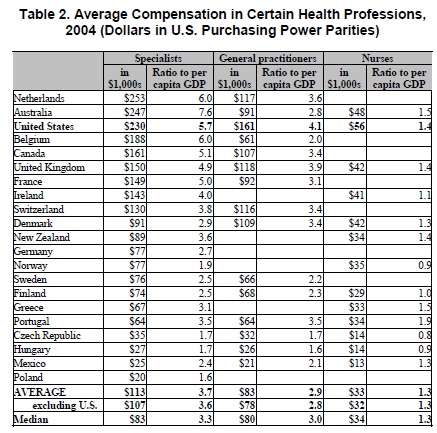
Our doctors are among the highest paid in the world


Source: Congressional Research Service (CRS) analysis of Remuneration of Health Professions, OECD Health Data 2006 (October 2006), available at [http://www.ecosante.fr/OCDEENG/70.html].

Our medical care, administrative, drugs and medical technology costs are also the highest in the world. This from economix:

One thing Americans do buy with this extra spending is an administrative overhead load that is huge by international standards. The McKinsey Global Institute estimated that excess spending on “health administration and insurance” accounted for as much as 21 percent of the estimated total excess spending ($477 billion in 2003). Brought forward, that 21 percent of excess spending on administration would amount to about $120 billion in 2006 and about $150 billion in 2008. It would have been more than enough to finance universal health insurance this year.

The study used a measure of administrative costs that includes not only the insurer’s costs, but also the costs borne by employers, health-care providers and governments – but not the value of the time patients spent claiming reimbursement. These authors estimated that in 1999, Americans spent $1,059 per capita on administration compared with only $307 in purchasing power parity dollars (PPP $) spent in Canada.

These expenses have to do with expectations:

  • Patients expect care: Price should not be an issue, at least to them. These expenses have been buffered by private insurance, government programs, and to a lesser degree our altruism (mandatory access to ER care in emergencies).
  • Health care providers also have expectations: They went to great expense and time to go through training and many have huge debts to repay. Their expectation is that they earn an excellent living.
  • Medical Insurers expect that they will keep 20% of premiums for their services–contributing to the highest administrative expenses in the world–and million dollar salaries and benefits for their executives
  • Medical suppliers, pharmaceutical companies: Huge international corporations also have high profit expectations. Patent laws provide exclusivity for a generation. Drugs are priced not by their cost of development or manufacture but whatever the market will bear. So those with serious illness pay more–because they have to.
  • Cost Efficiency is an oxymoron in our non-system: When you have a life-threatening illness cost, efficiency and “shopping” for the best deal are not priorities. Unfortunately, efficacy gets lost in the mix and patients and their insurers, (honoring the patient’s desires) pay exorbitant premiums for treatments that often offer very limited benefit.

Medicynical Note: Expectations and money:

It would seem a given in this the wealthiest (I think that still is the case) economy in the world that health care should be accessible and affordable to all. That is certainly the case in other industrialized nations.

Industry has figured out that health care is not cost sensitive. Why be efficient when the system will pay whatever is demanded. Patients are in a bind and buffered by third party payers; doctors earn more by doing more; industry charges cost plus at every level. Our health care system has become the moral equivalent of the Air Force’s $600 toilet multiplied 100 fold. We now spend more for a single drug than the average and median income–amazing.

One would think that with all this spending everyone would have some coverage, but it’s a fact that we have 50 million uninsured and still spend more per capita by a wide margin than anywhere else in the world.


Every man/woman for him/herself–the opposition to health reform

It’s fascinating to watch the public reaction to health reform.

It was a very difficult byzantine process complicated by the republican do nothing attitude and very unpleasant legislative maneuvering.

But what’s astounding and revealing is the public’s lack of enthusiasm which ultimately may doom the whole process.

Consider the situation.

  • Health care is not absolutely essential at any given time in most people’s lives–most of us are healthy and simply do not understand the difficulties and costs incurred of those who are.
  • And anyway most of us, have some form of health coverage. Those with coverage wonder what reform will offer them.
  • Reform will certainly add to the complexity and who knows whether it will add to our costs.
  • There are a large number of people in our country, around 50 million, with no coverage at all. In this group most are quite healthy and aside from an occasional visit to a doctor have few needs.
  • Those without health insurance either deny the possibility of illness or count on their savings, if they have any, or public payments in one form or another for their catastrophic illness care.
  • Preventive medicine is an unnecessary unaffordable, for the most part, luxury for these people.

Health reform rocks the boat and requires most of the “uninsured” to have coverage. I believe it will ultimately cut costs but can understand the skepticism. Our long national history of exceptionalism makes these folks unwilling to consider that health reform might be a positive. To them it’s a mandated enforced expenditure, a tax on their hard earned money.

On the other side of the argument are facts that:

  • Every single one of us, sooner or later will require medical care.
  • Health care spending over a lifetime is our largest expense.
  • To have rational system in which insurers provide coverage to those with illness and to prevent gaming of the system (only getting coverage when you become sick) universal coverage is necessary.
  • Costs will have to go down as we cannot afford our current health care expenditures and yearly inflation. Efficiency and value are concepts that must be applied to health care, like other business ventures.
  • Our current non-system of mandating access to emergency rooms for free care is inefficient, medically unsound and extremely expensive–guess who pays?
  • The more people covered the lower the premiums and ultimately the lower the costs
  • Our health outcomes are mixed. In some areas we do as well as other countries in others our outcomes are significantly worse.
  • Preventive medicine is underutilized in our system by those who need it most, the poor and the uninsured–ultimately tax payers pay their emergency room costs and other associated medical expenses.

Somewhere along the way Americans lost the notion of community and replaced it with a nasty NIMBY attitude. Companies, farmers, bankers and many other businesses baldfacedly accept and encourage all manner of subsidies, price supports, and bailouts that keep their business solvent. The idea that a benefit be available to individuals however, is “socialistic” and “un-American.”

That’s hardly the case since for the last 70 years we and our economy have benefitted and had wonderful years of growth and prosperity in a system with numerous social support programs. Abandoning these principles for a non-system in in which it’s every man for him/herself is a non plan leading nowhere. And that’s exactly where we’ll be if health reform is repealed.


Costs–why we pay more!

This is from Economix–quoting Dr. David Cutler:


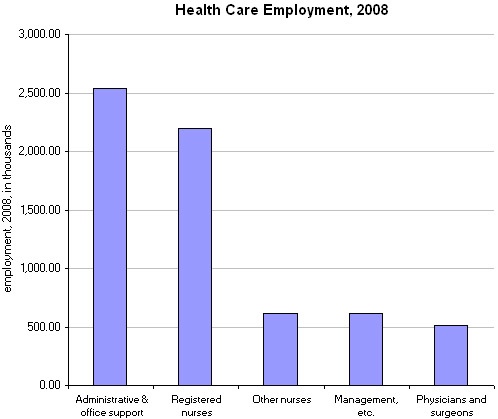
Medicynical Note: For every doctor there are 5, countem, five administrative and office support staff–and that doesn’t count another 500,000 “management” types. Guess who pays?


Cost Consciousness in Health Care: Value Value

This from the New England Journal of Medicine in an article by Molly Cooke:

It is old news that the cost of medical care in the United States is unsupportable, yet we seem unable to grapple with the issue effectively. As current ideas for health care reform have percolated through Congress, cost-control mechanisms have generally been recognized as the weak component. Our country is remarkably generative in the development of new diagnostic tests, drugs, and procedures — and remarkably undisciplined in their deployment. New diagnostic and therapeutic procedures and the broadened application of established ones account for two thirds of the growth in health care expenditures.

Cooke believes medical schools and teaching institutions have a responsibility to teach cost consciousness in health care. Such a responsibility would seem natural given that health care is the largest expense of many people’s lifetime.

But:

Philosophically, we physicians have conceived of ourselves as, and taught students that we are, advocates for each patient, obligated to eschew all considerations other than benefit to that patient and his or her preferences.

And:

A predominant driver of the cost of hospital care is the length of stay, so a high priority is readying patients for discharge — which serves as a rationale for preemptively ordering any test and consultation that might be called for, to avoid delaying discharge. Consequently, students and residents have scarce opportunity to practice devising cost-effective diagnostic strategies and explaining their rationale to patients and families.

And

Finally, cultural values powerfully influence the selection of teaching topics. Academia celebrates the “high knowledge” of medicine: pathophysiology, molecular biology, genomics. Even evidence-based medicine, although it deemphasizes fundamental mechanisms, is regarded as acceptably intellectual in comparison with “low,” real-world concerns such as cost.

Medicynical Note: Teaching cost consciousness would apprear to be a no brainer given the near 17% of GDP spent on health care, the excessive costs of health care in the U.S. compared with elsewhere, the high medical related bankrupcy rate in our country, and our yearly excessive increase in health care costs. The article goes on to point out the urgent need to change and to value value!